

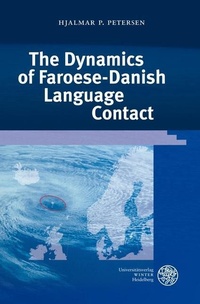
The Dynamics of Faroese-Danish Language Contact
Published in January 2012
315 pages
978-3-8253-7314-6 (ISBN)
Description

There are two official languages on the Faroe Islands, Faroese and Danish; Faroese is the dominant language and Danish the first second language that children acquire. The question addressed in this book is what the exact transmission processes in this asymmetrical bilingual setting are. By combining van Coetsem's notions of Recipient Language Agentivity and Source Language Agentivity with parts of Myers-Scotton's and Jake's frameworks, the author succeeds in explaining the language setting on the islands.
More details
Other editions
Additional editions
Hjalmar P. Petersen
The Dynamics of Faroese-Danish Language Contact
Book
10/2010
1st Edition
Universitätsverlag Winter
€55.00
Shipment within 5-7 days
Content
- Intro
- Preface and acknowledgment
- Contents
- Abbreviations and symbols
- 1 Introduction
- 2 A short overview of language contact and bilingualism
- 3 An overview of the history of the Faroese language
- 4 Bilingualism on the Faroe Islands and the social settings of Faroese
- 4.1. When did the Faroe Islanders become bilingual?
- 4.2. When do Faroese children acquire Danish?
- 4.3. The socially dominant language and the domains of Faroese and Danish
- 4.4. The attitude towards Danish
- 4.5. Language awareness and purism
- 5 State-of-the-art report
- 6 Methodology
- 7 Some typological differences between Faroese and Danish
- 8 Recipient language agentivity
- Source language agentivity and neutralization
- 8.1. RL agentivity
- 8.2. SL agentivity
- 8.3. Neutralization
- 8.4. Comparing with other models
- 9 Recipient language agentivity
- 9.1. Phraseology. Cases of RL agentivity
- multiple transfer
- 9.2. Lexical borrowings
- 9.3. The Borrowing Scale and Danish in Faroese
- 9.4. Adaptation and imitation to Faroese morphology and phonology
- 9.5. Conversion in Recipient language agentivity
- 9.6. Codeswitching or imitation as inclusion in Faroese
- 9.7. Why diffusion in Faroese?
- 10 Source language agentivity: Faro-Danish
- 10.1. Singly occurring words, embedded islands and nonce borrowings
- 10.2. Intra-sentential codeswitching or imposition as inclusion [÷nativized]
- 10.3. Conjunctions
- 10.4. Embedded islands
- 10.5. Summarizing the codeswitching and embedded island data
- 10.6. Nonce borrowings or imposition as integration [+nativized]
- 10.7. Conversionas imposition in SL agentivity
- 10.8. Genderin Faro-Danish
- 10.9. Mixed compounds
- 11. Imposition as approximation: Vowel values in Faro-Danish
- 12. Increasing English influence on Faroese
- 13. Conclusion
- References
- Appendix
- Some important numbers
- The letter to Heðin Brú (around1930)
- Faro-Danish data
- Codeswitching, nouns
- Self-repair, nouns
- Codeswitching, verbs
- Self-repair, verbs
- Codeswitching, other content morphemes
- Other morphemes:
- Early system morphemes
- Codeswitching, conjunction
- Embedded Islands
- Nonce borrowings
- Nonce borrowings, nouns: self repair
- Nonce borrowings, verbs
- Nonce borrowings, verbs: self-repair
- Nonce borrowings, adjectives, past participles
- Nonce borrowings, adverbs
- Accommodation rules in nonce borrowings
- Semantic conversion:
- Gender
- Mixed compounds
- Vowels
