

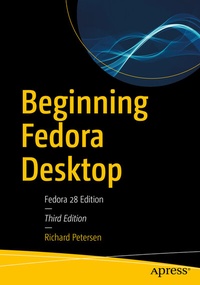
Beginning Fedora Desktop
Description

Get the most out of Fedora 28 Desktop, including free Office suites, editors, e-book readers, music and video applications. In addition to those features, you'll also work with codecs, email clients, web browsers, FTP and BitTorrent clients, VoIP clients, and IM applications. The major Fedora 28 desktop spins are covered in detail, including the Plasma desktop (KDE), Cinnamon, Mate-Compiz, LXDE, Xfce, and LXQT.
This is your complete guide to using the Fedora 28 Desktop Linux release as your daily driver for multimedia, productivity, social networking, administrative tasks, and more. Author and Linux expert Richard Petersen delves into the operating system as a whole and offers you a complete treatment of Fedora 28 Desktop configuration and use.
With Beginning Fedora Desktop at your side, you'll discover how to install and update the Fedora 28 Desktop, as well as access various software repositories. You'll also learn which applications perform which functions, how to manage software, use of the desktop configuration tools, useful shell commands, and both the system administration and network tools.
What You'll Learn
-
Review the available desktop choices, including GNOME, KDE, and alternative desktops
- Administer your system, add users, manage printers and perform backups
- Configure network connections and firewalls with FirewallD
- Access network resources with Samba
Who This Book Is For
Novice to intermediate users who are looking to install Fedora 20 as their primary computing environment.
More details
Other editions
New editions
Additional editions
Previous edition
Person
Content
Part 1. Getting Started.- 1. Fedora 28 Introduction.- 2. Installation and Upgrade.- 3. Usage Basics: Login, Desktop, and Help.- 4. Installing and Updating Software: DNF, GNOME Software, Packages, DnfDragora, and RPM.- Part 2. Applications.- 5. Office Applications, Email, Editors, and Databases.-6. Graphics and Multimedia.- 7. Internet Applications: Web and FTP.- Part 3. Desktops.- 8. The GNOME Desktop.- 9. Plasma Desktop: The K Desktop Environment: (KDE).- 10. Shells.- 11. Additional Desktops.- Part 4. Administration.- 12. Fedora System Tools.- 13. System Administration.- 14. Network Configuration.
