

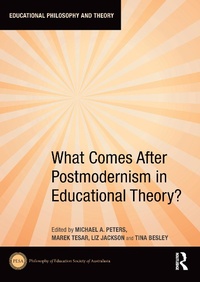
What Comes After Postmodernism in Educational Theory?
1st Edition
Published on 9. June 2020
400 pages
978-1-000-05096-7 (ISBN)
Description

Marking the fiftieth anniversary of the Educational Philosophy and Theory journal, this book brings together the work of over 200 international scholars, who seek to address the question: 'What happened to postmodernism in educational theory after its alleged demise?'.
Declarations of the death knell of postmodernism are now quite commonplace. Scholars in various disciples have suggested that, if anything, postmodernism is at an end and has been dead and buried for some time. An age dominated by playfulness, hybridity, relativism and the fragmentary self has given way to something else-as yet undefined. The lifecycle of postmodernism started with Derrida's 1966 seminal paper 'Structure, Sign and Play in the Discourse of the Human Sciences'; its peak years were 1973-1989; followed by uncertainty and reorientation in the 1990s; and the aftermath and beyond (McHale, 2015). What happened after 2001? This collection provides responses by over 200 scholars to this question who also focus on what comes after postmodernism in educational theory.
This book was originally published as a special issue of the journal Educational Philosophy and Theory.
Declarations of the death knell of postmodernism are now quite commonplace. Scholars in various disciples have suggested that, if anything, postmodernism is at an end and has been dead and buried for some time. An age dominated by playfulness, hybridity, relativism and the fragmentary self has given way to something else-as yet undefined. The lifecycle of postmodernism started with Derrida's 1966 seminal paper 'Structure, Sign and Play in the Discourse of the Human Sciences'; its peak years were 1973-1989; followed by uncertainty and reorientation in the 1990s; and the aftermath and beyond (McHale, 2015). What happened after 2001? This collection provides responses by over 200 scholars to this question who also focus on what comes after postmodernism in educational theory.
This book was originally published as a special issue of the journal Educational Philosophy and Theory.
More details
Series
Edition
1. Auflage
Language
English
Place of publication
London
United Kingdom
Publishing group
Taylor & Francis Ltd
Target group
College/higher education
ISBN-13
978-1-000-05096-7 (9781000050967)
Copyright in bibliographic data and cover images is held by Nielsen Book Services Limited or by the publishers or by their respective licensors: all rights reserved.
Schweitzer Classification
Other editions
Additional editions
Michael A. Peters | Marek Tesar | Liz Jackson
What Comes After Postmodernism in Educational Theory?
Book
06/2024
1st Edition
Routledge
€75.70
Shipment within 10-20 days
Michael A. Peters | Marek Tesar | Liz Jackson
What Comes After Postmodernism in Educational Theory?
Book
03/2020
1st Edition
Routledge
€191.88
Shipment within 15-20 days
Persons
Michael A. Peters is Distinguished Professor of Education at Beijing Normal University and Emeritus Professor at the University of Illinois. He is the Executive Editor of the journal Educational Philosophy and Theory. His interests are in education, philosophy and social policy, and he is the author of over 100 books, including The Chinese Dream: Educating the Future (2019), Wittgenstein, Education and Rationality (2020) and Wittgenstein: Antifoundationalism, Technoscience and Education (2020).
Marek Tesar is Associate Dean International and an Associate Professor at the Faculty of Education and Social Work, University of Auckland. His current scholarship is in childhood studies and early childhood education. His work focuses on educational policy, philosophy, pedagogy, methodology and curriculum, and draws on his background as a qualified teacher as well as his extensive knowledge of international education systems.
Liz Jackson is Associate Professor and the Director of the Comparative Education Research Centre at the Faculty of Education at the University of Hong Kong. She is also the President of the Philosophy of Education Society of Australasia. She is the author of Muslims and Islam in U.S. Education: Reconsidering Multiculturalism (2014) and Questioning Allegiance: Resituating Civic Education (2019). She is currently working on a third book entitled Against Virtue: The Politics of Educating Emotions.
Tina Besley is Distinguished Professor in the Faculty of Education, Beijing Normal University. She is Founding President of the Association for Visual Pedagogies (AVP) and Immediate Past President of Philosophy of Education Society of Australasia (PESA). She has published over 12 books and many articles and is deputy editor of Educational Philosophy and Theory, the Video Journal of Education and Pedagogy and an associate editor for the Beijing International Review of Education. She works closely with Professor Michael A. Peters and with a wide international network of scholars.
Marek Tesar is Associate Dean International and an Associate Professor at the Faculty of Education and Social Work, University of Auckland. His current scholarship is in childhood studies and early childhood education. His work focuses on educational policy, philosophy, pedagogy, methodology and curriculum, and draws on his background as a qualified teacher as well as his extensive knowledge of international education systems.
Liz Jackson is Associate Professor and the Director of the Comparative Education Research Centre at the Faculty of Education at the University of Hong Kong. She is also the President of the Philosophy of Education Society of Australasia. She is the author of Muslims and Islam in U.S. Education: Reconsidering Multiculturalism (2014) and Questioning Allegiance: Resituating Civic Education (2019). She is currently working on a third book entitled Against Virtue: The Politics of Educating Emotions.
Tina Besley is Distinguished Professor in the Faculty of Education, Beijing Normal University. She is Founding President of the Association for Visual Pedagogies (AVP) and Immediate Past President of Philosophy of Education Society of Australasia (PESA). She has published over 12 books and many articles and is deputy editor of Educational Philosophy and Theory, the Video Journal of Education and Pedagogy and an associate editor for the Beijing International Review of Education. She works closely with Professor Michael A. Peters and with a wide international network of scholars.
Content
Intoduction; 1. Postmodern Thinking 2. Postmodern Politics 3. Postmodern Crossdisciplines 4. Non-Western Postmodernism 5. Postmodern Critiques 6. Postmodern Legacies 7. Postmodern Education 8. Postmodern New Ontologies 9. Postmodern Theory 10. Conclusion
