

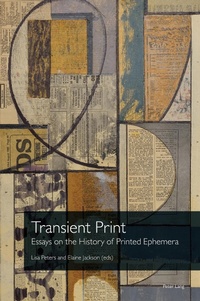
Transient Print
Description

This edited volume provides an opportunity to take a fresh look at the printed material often regarded as disposable by its contemporaries and, until recently, as unworthy of serious academic research. From the fifteenth century to the twentieth century, this volume not only demonstrates the wide variety of ephemeral publications which have survived to the present day, but also shows how they can be used to interpret history and printing history and culture in particular. Some of the forms of printed ephemera discussed will be familiar to scholars such as chapbooks and commercially-printed posters whilst others, such as papal indulgences and bellman's sheets are more unusual. The collection discusses the production, distribution and consumption of ephemera, including how it can be used demonstrate changes to print culture over time. This volume aims to demonstrate that printed ephemera, in its many and varied forms, is worthy of serious academic study.
More details
Other editions
Additional editions
Persons
Lisa Peters works in academic administration at the University of Chester, UK. She is the author of Politics, Publishing and Personalities: Wrexham Newspapers, 1848-1914 (2011), a contributor to the award-winning Routledge Handbook to Nineteenth-Century British Periodicals and Newspapers (2016) and the co-editor of Print, Politics and the Provincial Press in Modern Britain (2019).
Elaine Jackson is an independent researcher, particularly interested in book history, bibliography and women's studies. She has contributed to the Virginia Woolf Bulletin, Diegesis: Journal of the Association for Research in Popular Fictions, the Encyclopaedia of British Women's Writing 1900-1950 (2005) and Book Trade Connections from the Seventeenth to the Twentieth Centuries (2008).
Content
- Cover
- Contents
- List of Figures
- List of Tables
- Introduction (Lisa Peters / Elaine Jackson)
- 1 Yesterday's Tomorrows: A Throwaway History of Ephemera Studies (David Osbaldestin)
- 2 Trading on Fear of Purgatory: A Mass Printed Ticket to Tudor Popularity (Susan May)
- 3 Scottish Chapbooks, Their Woodcuts and Transient Print: Some Observations (Iain Beavan)
- 4 The Chapbooks Collection of Sir Walter Scott (Anette Hagan)
- 5 Bellman's and Lamplighter's Sheets (David Atkinson)
- 6 Parliamentary Rubbish, 1780-1830 (Diana Patterson)
- 7 Virtually Indestructible: The Ephemeral Life of Victorian Picturebooks for Children (Francesca Tancini)
- 8 Fifty Years Too Early: George Newnes and his Colour Magazine for the Masses (Anthony Quinn)
- 9 'The Best of "Modern" Printed Design Can Be Found in Everyday Articles': Ephemera from the Baynard Press and Kynoch Press in the National Art Library's Jobbing Printing Collection (Deborah Sutherland / Ruth Hibbard)
- 10 'I'd rather be good Bad than bad Good': Berta Ruck Writing 'Bad' Romance for Women's Magazines (Elaine Jackson)
- Notes on Contributors
- Index
- Series Index
