

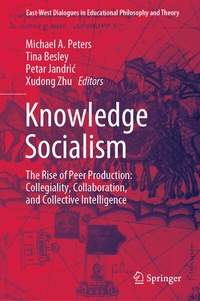
Knowledge Socialism
The Rise of Peer Production: Collegiality, Collaboration, and Collective Intelligence
1st Edition
Published on 7. October 2020
VIII, 325 pages
978-981-13-8126-3 (ISBN)
Description

This is the first collection focusing on knowledge socialism, a particularly apt term used to describe a Chinese socialist mode of production and socialist approach to development and modernity based around the rise of peer production, new forms of collaboration and collective intelligence. Making the case for knowledge socialism, the book is intended for students, teacher, scholars and policy theorists in the field of knowledge economy.
Reviews / Votes
"This book offers an important contribution to a slowly maturing field of enquiry and practice. . this book offers a great diversity of perspectives . . in this excellent and interesting book, transform the ordinary thought in society . help people to think together in a coherent way . ." (Michael Hogan, Postdigital Science and Education, Vol. 3, 2021)More details
Series
Language
English
Place of publication
Singapore
Singapore
Publishing group
Springer Singapore
Target group
Professional and scholarly
Product notice
Reflowable
Illustrations
VIII, 325 p. 1 illus.
File size
3,20 MB
ISBN-13
978-981-13-8126-3 (9789811381263)
DOI
10.1007/978-981-13-8126-3
Schweitzer Classification
Other editions
Additional editions
Michael A. Peters | Tina Besley | Petar Jandric
Knowledge Socialism
The Rise of Peer Production: Collegiality, Collaboration, and Collective Intelligence
Book
10/2020
Springer
€106.99
Shipment within 15-20 days
Persons
Michael A. Peters (PhD, FNZAH, FRSA, FRSNZ, FPESA) is Distinguished Professor of Education at the Faculty of Education, Beijing Normal University, and Emeritus Professor in Educational Policy, Organization, and Leadership at the University of Illinois at Urbana-Champaign and Senior Research Fellow at the University of Auckland. He is the Editor in Chief of
Educational Philosophy and Theory
and founding editor of ten other international journals. His interests are in educational theory and philosophy and he has written over one hundred books, including several books on Wittgenstein, Foucault, Derrida and Lyotard. He has acted as an advisor to governments in the USA, Scotland, NZ, South Africa, UNESCO and the EU. He was made a Fellow of The Royal Society of NZ in 2008 and awarded honorary doctorates by State University of New York in 2012 and University of Aalborg in 2015. His recently published books include:
Wittgenstein, Antifoundationalism, Technoscience andPhilosophy of Education
(2020),
The Chinese Dream: Educating the Future
(2019),
The Companion to Wittgenstein and Education: Pedagogical Investigations
(2017).
Tina Besley is Distinguished Professor at the Faculty of Education, Beijing Normal University, a Fellow of the Royal Society of Arts and Fellow of Philosophy of Education Society of Australasia (PESA). She was previously Professor and Associate Dean International, at the University of Waikato's Faculty of Education; Research Professor, University of Illinois Urbana Champaign; Professor, California State University San Bernardino; and Research Fellow at the University of Glasgow. She is the founding president of the Association for Visual Pedagogies and Immediate Past President of the PESA. Tina has published over 12 books and numerous articles. She is deputy editor of Educational Philosophy and Theory , the Video Journal of Education and Pedagogy and associate editor of the Beijing International Review of Education . Formerly she was editor of E-Learning & Digital Media and Knowledge Cultures . She works closely with Professor Michael A. Peters and a wide international network of scholars. Recent books include: Post-Truth, Fake News: Viral Modernity & Higher Education (2018) and Teaching, Responsibility & Corruption of Youth (2019).
Petar Jandric is Professor at the Zagreb University of Applied Sciences, Croatia, and Visiting Professor at University of Wolverhampton, Wolverhampton, UK. He previously worked at the Croatian Academic and Research Network, National e-Science Centre at the University of Edinburgh, Glasgow School of Art, and Cass School of Education at the University of East London. Petar's background is in physics, education and information science, and his research interests are situated at the post-disciplinary intersections between technologies, pedagogies and the society. Research methodologies of his choice are inter-, trans-, and anti-disciplinarity. His recent books include Education and Technological Unemployment (2019), Mobility, Data, and Learner Agency in Networked Learning (2020), and Postdigital Dialogues on Critical Pedagogy, Liberation Theology and Information Technology (2020). Petar is Editor-in-Chief of Postdigital Science and Education journal and book series Postdigital Science and Education .
Xudong Zhu is Professor and General Secretary of Teacher Education Experts Committee of Ministry of Education, Dean of Faculty of Education at Beijing Normal University, Director of the Center for Teacher Education Research, General Secretary of the National Teacher Education Society, and a senior visiting scholar of Fulbright Program at University of Maryland. Prof. Zhu's areas of research include Teacher Education, Comparative Education, Foreign Education History, and others. He has published more than ten books, about 200 papers, and has edited four series.
Tina Besley is Distinguished Professor at the Faculty of Education, Beijing Normal University, a Fellow of the Royal Society of Arts and Fellow of Philosophy of Education Society of Australasia (PESA). She was previously Professor and Associate Dean International, at the University of Waikato's Faculty of Education; Research Professor, University of Illinois Urbana Champaign; Professor, California State University San Bernardino; and Research Fellow at the University of Glasgow. She is the founding president of the Association for Visual Pedagogies and Immediate Past President of the PESA. Tina has published over 12 books and numerous articles. She is deputy editor of Educational Philosophy and Theory , the Video Journal of Education and Pedagogy and associate editor of the Beijing International Review of Education . Formerly she was editor of E-Learning & Digital Media and Knowledge Cultures . She works closely with Professor Michael A. Peters and a wide international network of scholars. Recent books include: Post-Truth, Fake News: Viral Modernity & Higher Education (2018) and Teaching, Responsibility & Corruption of Youth (2019).
Petar Jandric is Professor at the Zagreb University of Applied Sciences, Croatia, and Visiting Professor at University of Wolverhampton, Wolverhampton, UK. He previously worked at the Croatian Academic and Research Network, National e-Science Centre at the University of Edinburgh, Glasgow School of Art, and Cass School of Education at the University of East London. Petar's background is in physics, education and information science, and his research interests are situated at the post-disciplinary intersections between technologies, pedagogies and the society. Research methodologies of his choice are inter-, trans-, and anti-disciplinarity. His recent books include Education and Technological Unemployment (2019), Mobility, Data, and Learner Agency in Networked Learning (2020), and Postdigital Dialogues on Critical Pedagogy, Liberation Theology and Information Technology (2020). Petar is Editor-in-Chief of Postdigital Science and Education journal and book series Postdigital Science and Education .
Xudong Zhu is Professor and General Secretary of Teacher Education Experts Committee of Ministry of Education, Dean of Faculty of Education at Beijing Normal University, Director of the Center for Teacher Education Research, General Secretary of the National Teacher Education Society, and a senior visiting scholar of Fulbright Program at University of Maryland. Prof. Zhu's areas of research include Teacher Education, Comparative Education, Foreign Education History, and others. He has published more than ten books, about 200 papers, and has edited four series.
Content
the rise of peer production.- the history of peer review.- openness - open science, open access.- the model of open knowledge production.- cognitive capitalism.- knowledge capitalism.- knowledge cultures.- forms of collegiality.- creative labour vs human capitalism.- collective intelligence.- social innovation.
