

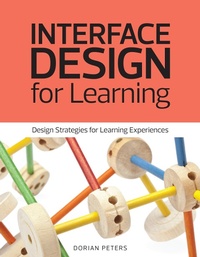
Interface Design for Learning
Design Strategies for Learning Experiences
1st Edition
Published on 26. November 2013
272 pages
978-0-13-336551-1 (ISBN)
Description

In offices, colleges, and living rooms across the globe, learners of all ages are logging into virtual laboratories, online classrooms, and 3D worlds. Kids from kindergarten to high school are honing math and literacy skills on their phones and iPads. If that weren't enough, people worldwide are aggregating internet services (from social networks to media content) to learn from each other in "Personal Learning Environments." Strange as it sounds, the future of education is now as much in the hands of digital designers and programmers as it is in the hands of teachers.
And yet, as interface designers, how much do we really know about how people learn? How does interface design actually impact learning? And how do we design environments that support both the cognitive and emotional sides of learning experiences? The answers have been hidden away in the research on education, psychology, and human computer interaction, until now. Packed with over 100 evidence-based strategies, in this book you'll learn how to:
Design educational games, apps, and multimedia interfaces in ways that enhance learning
Support creativity, problem-solving, and collaboration through interface design
Design effective visual layouts, navigation, and multimedia for online and mobile learning
Improve educational outcomes through interface design.
And yet, as interface designers, how much do we really know about how people learn? How does interface design actually impact learning? And how do we design environments that support both the cognitive and emotional sides of learning experiences? The answers have been hidden away in the research on education, psychology, and human computer interaction, until now. Packed with over 100 evidence-based strategies, in this book you'll learn how to:
Design educational games, apps, and multimedia interfaces in ways that enhance learning
Support creativity, problem-solving, and collaboration through interface design
Design effective visual layouts, navigation, and multimedia for online and mobile learning
Improve educational outcomes through interface design.
More details
Edition
1. Auflage
Language
English
Place of publication
Hoboken
United States
Publishing group
Pearson Education (US)
Target group
Professional and scholarly
File size
28,13 MB
ISBN-13
978-0-13-336551-1 (9780133365511)
Copyright in bibliographic data and cover images is held by Nielsen Book Services Limited or by the publishers or by their respective licensors: all rights reserved.
Schweitzer Classification
Other editions
Additional editions
Book
12/2013
New Riders
€36.50
Article not available at the moment
Person
Dorian Peters has specialized in user experience design for learning for over a decade. She directs online strategy for the Faculty of Education at the University of Sydney and is a member of the Centre for Research on Computer Supported Learning and Cognition. She has designed for Carnegie Mellon, Cambridge University, Westpac Bank, ABC, and Sony Music. She is a founder of the eLearning Network of Australasia, and a member of the eLearning Guild and the User Experience Professionals Association. Her other book, Positive Computing, looks at design for wellbeing and will be released by MIT Press (2014). She writes regular articles for conferences and trade publications like UX Magazine, UX Matters, ACM Interactions, and A List Apart. www.InterfaceDesignforLearning.com
Content
1 Introducing IDL
2 How We Learn
3 A View of the eLearning Landscape
4 Basic Principles A-Z
5 Learning Is Visual
6 Learning Is Social
7 Learning Is Emotional
8 Multimedia and Games
9 Learning Is Mobile
10 Designing the Space
11 Toolkit
Index
2 How We Learn
3 A View of the eLearning Landscape
4 Basic Principles A-Z
5 Learning Is Visual
6 Learning Is Social
7 Learning Is Emotional
8 Multimedia and Games
9 Learning Is Mobile
10 Designing the Space
11 Toolkit
Index
