

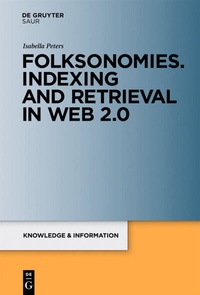
Folksonomies. Indexing and Retrieval in Web 2.0
Description

In Web 2.0 users not only make heavy use of Col-laborative Information Services in order to create, publish and share digital information resources - what is more, they index and represent these re-sources via own keywords, so-called tags. The sum of this user-generated metadata of a Collaborative Information Service is also called Folksonomy. In contrast to professionally created and highly struc-tured metadata, e.g. subject headings, thesauri, clas-sification systems or ontologies, which are applied in libraries, corporate information architectures or commercial databases and which were developed according to defined standards, tags can be freely chosen by users and attached to any information resource. As one type of metadata Folksonomies provide access to information resources and serve users as retrieval tool in order to retrieve own re-sources as well as to find data of other users.
The book delivers insights into typical applications of Folksonomies, especially within Collaborative Information Services, and discusses the strengths and weaknesses of Folksonomies as tools of knowl-edge representation and information retrieval. More-over, it aims at providing conceptual considerations for solving problems of Folksonomies and presents how established methods of knowledge representa-tion and models of information retrieval can successfully be transferred to them.
Reviews / Votes
"[...] ist das Buch eine Pflichtlektüre für alle, die sich wissenschaftlich mit Folksonomies auseinandersetzen."In: Social Media Magazin 1/2011 "Für alle, die sich für Wissensrepräsentation, Information Retrieval und kollaborative Informationsdienste interessieren, ist Folksonomies: Indexing and Retrieval in Web 2.0 [...] unbedingt zu empfehlen."Ulrike Spree in: Information, Wissenschaft + Praxis November/Dezember 2010 "Folksonomies: Indexing and Retrieval in Web 2.0 is an essential reading for those involved in folksonomy-related research, or the design or implementation of collaborative information systems. Although the book covers introductory topics pertaining to information retrieval and KOS, Folksonomies is perhaps too advanced for undergraduate students but is suited to postgraduates, researchers, and academics within the overlapping disciplines of information and computer science, library science, and human-computer interaction."George Macgregor in: Library Review 7/2010More details
Other editions
Additional editions
Person
Content
2 - Introduction [Seite 8]
3 - Collaborative Information Services [Seite 20]
4 - Basic Terms in Knowledge Representation and Information Retrieval [Seite 126]
5 - Knowledge Representation in Web 2.0: Folksonomies [Seite 160]
6 - Information Retrieval with Folksonomies [Seite 290]
7 - Conclusion [Seite 418]
8 - Index of Names [Seite 426]
9 - Subject Index [Seite 438]
