

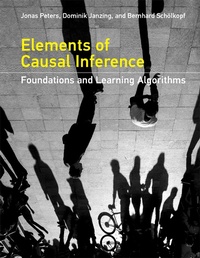
Elements of Causal Inference
Description

The mathematization of causality is a relatively recent development, and has become increasingly important in data science and machine learning. This book offers a self-contained and concise introduction to causal models and how to learn them from data. After explaining the need for causal models and discussing some of the principles underlying causal inference, the book teaches readers how to use causal models: how to compute intervention distributions, how to infer causal models from observational and interventional data, and how causal ideas could be exploited for classical machine learning problems. All of these topics are discussed first in terms of two variables and then in the more general multivariate case. The bivariate case turns out to be a particularly hard problem for causal learning because there are no conditional independences as used by classical methods for solving multivariate cases. The authors consider analyzing statistical asymmetries between cause and effect to be highly instructive, and they report on their decade of intensive research into this problem.
The book is accessible to readers with a background in machine learning or statistics, and can be used in graduate courses or as a reference for researchers. The text includes code snippets that can be copied and pasted, exercises, and an appendix with a summary of the most important technical concepts.
More details
Other editions
Additional editions
Persons
Dominik Janzing is a Senior Research Scientist at the Max Planck Institute for Intelligent Systems in Tübingen, Germany.
Bernhard Schölkopf is Director at the Max Planck Institute for Intelligent Systems in Tübingen, Germany. He is coauthor of Learning with Kernels (2002) and is a coeditor of Advances in Kernel Methods: Support Vector Learning (1998), Advances in Large-Margin Classifiers (2000), and Kernel Methods in Computational Biology (2004), all published by the MIT Press.
Content
- Intro
- Series Announcement Page
- Title Page
- Copyright Page
- Dedication
- Table of Contents
- Preface
- Notation and Terminology
- 1. Statistical and Causal Models
- 1.1 Probability Theory and Statistics
- 1.2 Learning Theory
- 1.3 Causal Modeling and Learning
- 1.4 Two Examples
- 2. Assumptions for Causal Inference
- 2.1 The Principle of Independent Mechanisms
- 2.2 Historical Notes
- 2.3 Physical Structure Underlying Causal Models
- 3. Cause-Effect Models
- 3.1 Structural Causal Models
- 3.2 Interventions
- 3.3 Counterfactuals
- 3.4 Canonical Representation of Structural Causal Models
- 3.5 Problems
- 4. Learning Cause-Effect Models
- 4.1 Structure Identifiability
- 4.2 Methods for Structure Identification
- 4.3 Problems
- 5. Connections to Machine Learning, I
- 5.1 Semi-Supervised Learning
- 5.2 Covariate Shift
- 5.3 Problems
- 6. Multivariate Causal Models
- 6.1 Graph Terminology
- 6.2 Structural Causal Models
- 6.3 Interventions
- 6.4 Counterfactuals
- 6.5 Markov Property, Faithfulness, and Causal Minimality
- 6.6 Calculating Intervention Distributions by Covariate Adjustment
- 6.7 Do-Calculus
- 6.8 Equivalence and Falsifiability of Causal Models
- 6.9 Potential Outcomes
- 6.10 Generalized Structural Causal Models Relating Single Objects
- 6.11 Algorithmic Independence of Conditionals
- 6.12 Problems
- 7. Learning Multivariate Causal Models
- 7.1 Structure Identifiability
- 7.2 Methods for Structure Identification
- 7.3 Problems
- 8. Connections to Machine Learning, II
- 8.1 Half-Sibling Regression
- 8.2 Causal Inference and Episodic Reinforcement Learning
- 8.3 Domain Adaptation
- 8.4 Problems
- 9. Hidden Variables
- 9.1 Interventional Sufficiency
- 9.2 Simpson's Paradox
- 9.3 Instrumental Variables
- 9.4 Conditional Independences and Graphical Representations
- 9.5 Constraints beyond Conditional Independence
- 9.6 Problems
- 10. Time Series
- 10.1 Preliminaries and Terminology
- 10.2 Structural Causal Models and Interventions
- 10.3 Learning Causal Time Series Models
- 10.4 Dynamic Causal Modeling
- 10.5 Problems
- Appendices
- Appendix A. Some Probability and Statistics
- A.1 Basic Definitions
- A.2 Independence and Conditional Independence Testing
- A.3 Capacity of Function Classes
- Appendix B. Causal Orderings and Adjacency Matrices
- Appendix C. Proofs
- C.1 Proof of Theorem 4.2
- C.2 Proof of Proposition 6.3
- C.3 Proof of Remark 6.6
- C.4 Proof of Proposition 6.13
- C.5 Proof of Proposition 6.14
- C.6 Proof of Proposition 6.36
- C.7 Proof of Proposition 6.48
- C.8 Proof of Proposition 6.49
- C.9 Proof of Proposition 7.1
- C.10 Proof of Proposition 7.4
- C.11 Proof of Proposition 8.1
- C.12 Proof of Proposition 8.2
- C.13 Proof of Proposition 9.3
- C.14 Proof of Theorem 10.3
- C.15 Proof of Theorem 10.4
- Bibliography
- Index
- Series Page
