

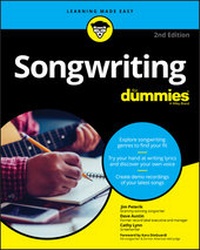
Songwriting For Dummies
Description

This friendly, hands-on guide tackles the new face of the recording industry, guiding you through the shift from traditional sales to downloads and mobile music, as well as how you can harness social media networks to get your music "out there." You get basic songwriting concepts, insider tips and advice, and inspiration for writing -- and selling -- meaningful, timeless songs.
* Songwriting 101 -- get a grip on everything you need to know to write a song, from learning to listen to your "inner voice" to creating a "mood" and everything in between
* Jaunt around the genres -- discover the variety of musical genres and find your fit, whether it's rock, pop, R&B, gospel, country, or more
* Let the lyrics out -- master the art of writing lyrics, from finding your own voice to penning the actual words to using hooks, verses, choruses, and bridges
* Make beautiful music -- find your rhythm, make melodies, and use chords to put the finishing touches on your song
* Work the Web -- harness online marketing and social networks like Facebook, Twitter, and others to get your music heard by a whole new audience
Open the book and find:
* What you need to know before you write a single note
* Tips on finding inspiration
* Ways to use poetic devices in lyrics
* Computer and Web-based shortcuts and technologies to streamline songwriting
* A look at famous songwriting collaborators
* Writing for stage, screen, and television
* How to make a demo to get your song heard
* Advice on how to make money from your music
P.S. If you think this book seems familiar, you're probably right. The Dummies team updated the cover and design to give the book a fresh feel, but the content is the same as the previous release of Songwriting For Dummies (9780470615140). The book you see here shouldn't be considered a new or updated product. But if you're in the mood to learn something new, check out some of our other books. We're always writing about new topics!
More details
Other editions
Additional editions
Persons
Content
Chapter 1
Capturing That Solid-Gold Nugget
IN THIS CHAPTER
Gathering song ideas from anywhere
Organizing and tracking your thoughts and inspirations
Documenting your ideas
This book is for everyone who shares the dream of harnessing the songwriting power we all have within. You've come to the right place if your heart keeps telling you to write a song, but your mind is uncertain as to the process of the craft or what's required to create a really good song. You bought the right book if you're wondering how to collect and organize your ideas. You have found the right resource if you have pieces of songs lying in notebooks and on countless cassettes but can't seem to put the pieces together. This book is for you if you have racks of finished song demos but don't know what to do next to get them heard. When you know the elements that make up a great song and how the pros go about writing one, you can get on the right path to creating one of your own.
Unless you're lucky enough to have fully finished songs come to you in your deepest dreams, or to somehow take dictation from the ghosts of Tin Pan Alley (the publishing area located in New York City in the 1930s and 1940s), most of us need to summon the forces, sources, reasons, and seasons that give us the necessary motivation to draw a song from our heart of hearts. Given that initial spark, you then need the best means of gathering those ideas, organizing them, putting them into form, and documenting them as they roll in - before it's too late and they roll right out again!
Have you ever noticed how you can remember a powerful dream just after you've awakened only for it to vanish into thin air in the light of day? Song ideas can be just as illusive. Songwriting is all about capturing the moment of musical inspiration at its source. This is perhaps the single most important element of songwriting because, like the moment that rain turns to snow, at the instant of inspiration, your mind grows wings and a song takes flight.
In this chapter, we explore the various places to mine for golden nuggets of inspiration for your songs, ways to gather that information, and methods of documenting your ideas. We also demonstrate the importance of brainstorming ideas with others to let inspiration flow, and provide simple exercises to show you the way.
Ground Zero - Before You Write a Single Note
So, you want to write songs. But writing a song can be an intimidating process. After all, where do you really begin?
Is formal music training a must?
Music training is not a prerequisite for songwriting. However, if you don't at least have some ability on the piano or guitar to help put the ideas from your head into some tangible form, you may be at a disadvantage. (Notice we said "may." Funnyman Mel Brooks composed the musical score to his hit Broadway show The Producers by humming the melodies into a tape recorder and having someone translate that into musical notes on a page.) Even if you're solely a lyricist (the one who puts the words to the music), it may be helpful to you and your collaborator (the person writing the music to go with your words) if you have a working knowledge of a musical instrument. Musical ability could also help you with the rhythm of your words and the structure of your songs. That being said, even though musical expertise is advantageous, it is not required by any means.
Although songwriting is more than just an assembly line of components to be bolted together, it doesn't hurt to know what's available in the "parts bin." A song is made up of chords (a combination of two or more tones sounded together in harmony), a melody (the arrangement of single tones in sequence - the part you sing), a rhythm (the beat or pulse of the song), and words (often called lyrics in the context of a song). Many successful songwriters excel in one area or another. Rare individuals can do it all. Even the ones who are a songwriting one-man band often choose to collaborate with others to come up with that magical song that comes from a blend of styles and personalities. It's your task at hand, if you are challenged in a given area, to find writers to complete your vision and contribute the expertise you lack.
Most of what I know about songwriting, I learned by being a fan of music. Truly the best teacher is listening. I emulated the styles of songs that inspired me, and gradually, over the course of many years, integrated these influences into a style of my own. The Beatle's songwriting, to cite a notable example, was heavily influenced by the American rock 'n' roll of Chuck Berry, Carl Perkins, The Everly Brothers, and Little Richard. The Beatles created songs by absorbing those influences and adding their own unique personalities. The fact that they could barely read music hardly mattered at all. They had ears!
- JIM PETERIK, PERFORMER, SONGWRITER, AND MULTI-INSTRUMENTALIST FOR THE BANDS IDES OF MARCH AND SURVIVOR, PLUS WRITER OF HITS FOR .38 SPECIAL, SAMMY HAGAR, AND OTHERS
Studying music theory, history, and arrangement can only enhance your abilities as a writer, but it would be a mistake to infer that formal training is a necessity to write a great song. Music appreciation classes can open your eyes and ears to what you should be listening for in songs, but you really don't need anyone to tell your foot when to start tapping or your lips to break out into a big smile when the chorus hits - that's just the power of great music. Start with your love for the songs you hear and then tap into all you have to express in your soul.
If you're still not convinced that you don't need training, consider the fact that some of the greatest songs ever written were composed by people with virtually no formal music training. Folk music, chants, delta blues, country, and rock 'n' roll all got their start with people who had the raw talent to create songs. On the other hand, many legendary composers have extensive musical training in all forms of music, including classical composition. It's all good. Just don't let the so-called "rules" hold you back or keep you frozen.
In college, my harmony teacher told me at the end of the semester, "You know all that stuff I taught you about avoiding parallel fifths? Forget about it! If it sounds good, just do it!" By the way, that was the only formal music training I ever got, other than two years of piano and a few years of saxophone lessons. I earned a C+ in that class. It is my belief that life is the best teacher, and listening to and enjoying a good song are perhaps the best ways to learn to do it yourself.
- JIM PETERIK, WRITER OF 18 BILLBOARD TOP 10 HITS INCLUDING THE PERENNIAL FAVORITE "EYE OF THE TIGER: FEATURED IN ROCKY III
Although some songwriters do well with the trial-and-error method, the more you know about music, the better chance you have to write a great song. The more adept you can become at an instrument, the easier it will be to create and demonstrate the ideas in your head. You do not need to enroll in a college course to study music, because there are other ways to get instruction in music theory, composition, instrumental performance, and voice at a per-session rate. Qualified, reasonably priced private teachers can be located through your local music shop or record store or in the back pages of the local "freebie" entertainment newspaper and through a simple Internet search. Finding someone who inspires you will make songwriting a lot easier.
Being prepared when inspiration strikes
Ideas will come into your brain while you're in the strangest of places, at any time of the day or night. You've probably heard stories about how some of the greatest hits were born. Paul McCartney has said some of his best songs came to him in his dreams. Billy Joel also got the song "River of Dreams" from - you guessed it - a dream. And Sting, former lead singer of the group The Police, awakened in the middle of the night, wrote a song in ten minutes flat, then went back to sleep. The song? "Every Breath You Take." (Makes you want to get plenty of shut-eye, now doesn't it?)
When a melody or a lyrical idea pops into your head, make sure you have a way of freezing it in time. Try to carry with you, at all times, a notebook to jot down ideas and a digital recorder to capture your musical phrases. Never fool yourself into thinking you'll remember the ideas when you get home. And don't think that "If it's really so great of an idea, I won't forget it." Some great songs will never be heard because the songwriter couldn't reconstruct some once-in-a-lifetime moment of inspiration. Those cool ideas that you know you'll never forget will be "dust in the wind" if you don't have the discipline to write them down or hum them into the recorder when they hit.
A flash of inspiration may hit you when you least expect it. Be ready to catch it - then be prepared to work hard at turning the initial idea into a finished song.
Finding you own inner voice and expression
So you aren't being awakened in the middle of the night by divine inspiration? Not to worry. You can find a way to tap into that inspiration even if it hasn't quite found its way...
