

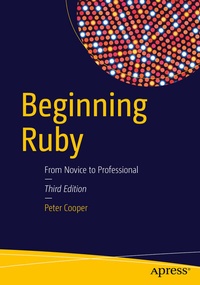
Beginning Ruby
Description

Learn the principles behind object-oriented programming and within a few chapters create a fully functional Ruby application. You'll also gain a basic understanding of many ancillary technologies such as databases, XML, web frameworks, and networking - some of which are needed as part of a fully functioning Ruby application.
Based on the bestselling first and second editions, Beginning Ruby, Third Edition is a leading guide to learn Ruby from the ground up. The new edition of this book provides the same excellent introduction to Ruby as the previous editions plus updates for the newest version of Ruby 2.3. This book can also be used as a textbook or companion to a textbook on beginning Ruby programming.
The light and agile Ruby programming language remains a very popular open source scripting option for developers building today's web and even some enterprise applications. And, now, Ruby also has applications using the Raspberry Pi, popular among hobbyists and makers. Many former Java developers still use Ruby on Rails today, the most popular framework for building Ruby applications.
What You'll Learn
- Discover the fundamentals of Ruby and its object-oriented building blocks
- Use the Ruby libraries, gems, and documentation
- Work with files and databases
- Write and deploy Ruby applications
- Harness the various Ruby web frameworks and how to use them
- Do network programming with Ruby
Beginning programmers, programmers new to Ruby, and web developers interested in learning and knowing the foundations of the Ruby programming language.
Reviews / Votes
"The material is organized well and reads like a novel. Examples are clear, and accompanied by ample explanations. . Readers in any context in which the Ruby programming language is utilized will find this book an approachable, enabling primer. The book also assists readers by making them aware of the more advanced aspects of the language and its facilities. Summing Up: Highly recommended. All readers." (F. H. Wild III, Choice, Vol. 54 (7), March, 2017)
"The book gives a well-structured introduction to Ruby from the ground up, starting from installation through main building blocks and advanced features, without assuming any prior programming knowledge and skills. . The text provides an excellent introduction to Ruby, and also has value as a reference source for Ruby developers at various levels." (Alexander Tzanov, Computing Reviews, December, 2016)More details
Other editions
Additional editions
Previous edition
Person
Content
1. Let's Get It Started: Installing Ruby.- 2. Programming = Joy: A Whistle-Stop Tour of Ruby and Object Orientation.- 3. Ruby's Building Blocks: Data, Expressions, and Flow Control.- 4. Developing Your First Ruby Application.- 5. The Ruby Ecosystem.- 6. Classes, Objects, and Modules.- 7. Projects and Libraries.- 8. Documentation, Error Handling, Debugging, and Testing.- 9. Files and Databases.- 10. Deploying Ruby Applications and Libraries.- 11. Advanced Ruby Features.- 12. Tying It Together: Developing a Larger Ruby Application.- 13. Web Application Frameworks: Rails, Sinatra, and Ramaze.- 14. Ruby and the Internet.- 15. Networking, Sockets, and Daemons.- 16. Useful Ruby Libraries.- Appendix A. Ruby Primer and Review for Developers.- Appendix B. Useful Resources.
