

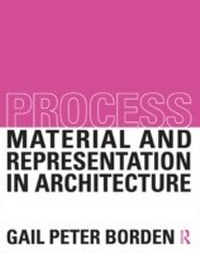
Process: Material and Representation in Architecture
1st Edition
Published on 3. February 2014
288 pages
978-1-317-80565-6 (ISBN)
Description

This book examines the interrelationship of representational methods and material systems as fundamental drivers of the design process. Identifying four primary categories of representational logics - point, line, surface, mass - each category is illustrated through four precedent projects that deploy iterative material sensibilities. As a collection, this text provides a comprehensive categorization of the architectural design process.
Through the comprehensive definition of categorical typologies, it illustrates the collective capability of this conceptual methodology. By unpacking projects through their specific design devices, the collective analysis reveals the impact of material techniques and methods of representation as a generative tool. Broad in scope, it identifies and uniformly analyses some of the most significant projects from the last century, including:
UK Pavilion Shanghai - Heatherwick Studio, Shanghai,China
Gatehouse - Office dA, Beijing, China
Maison Colonial - Jean Prouve, France/Africa
de Young Museum - Herzog and de Meuron, California USA
Montreal Expo 67 - Buckminster Fuller, Montreal, Canada
Jean Marie Tjibou Cultural Center - RPBW, Noumea, Indonesia
House III - Peter Eisenman, New York, USA
Barcelona Pavilion - Mies van der Rohe, Barcelona, Spain
Tel Aviv - Scott Cohen, Tel Aviv, Israel
Los Manantiales - Felix Candella, Mexico City, Mexico
Yokahama Terminal - FOA, Yokahama, Japan
Pantheon, Rome, Italy
Tres Grand Bibliotheque - Rem Koolhaas, OMA, Paris, France
Brother Claus Field Chapel - Peter Zumthor, Switzerland
Embryonic House- Greg Lynn
Richly illustrated with consistent, clear and precise line drawings, the book presents a series of iconic precedents through a unique analytical and graphic sensibility.
Through the comprehensive definition of categorical typologies, it illustrates the collective capability of this conceptual methodology. By unpacking projects through their specific design devices, the collective analysis reveals the impact of material techniques and methods of representation as a generative tool. Broad in scope, it identifies and uniformly analyses some of the most significant projects from the last century, including:
UK Pavilion Shanghai - Heatherwick Studio, Shanghai,China
Gatehouse - Office dA, Beijing, China
Maison Colonial - Jean Prouve, France/Africa
de Young Museum - Herzog and de Meuron, California USA
Montreal Expo 67 - Buckminster Fuller, Montreal, Canada
Jean Marie Tjibou Cultural Center - RPBW, Noumea, Indonesia
House III - Peter Eisenman, New York, USA
Barcelona Pavilion - Mies van der Rohe, Barcelona, Spain
Tel Aviv - Scott Cohen, Tel Aviv, Israel
Los Manantiales - Felix Candella, Mexico City, Mexico
Yokahama Terminal - FOA, Yokahama, Japan
Pantheon, Rome, Italy
Tres Grand Bibliotheque - Rem Koolhaas, OMA, Paris, France
Brother Claus Field Chapel - Peter Zumthor, Switzerland
Embryonic House- Greg Lynn
Richly illustrated with consistent, clear and precise line drawings, the book presents a series of iconic precedents through a unique analytical and graphic sensibility.
More details
Edition
1. Auflage
Language
English
Place of publication
London
United Kingdom
Publishing group
Taylor & Francis Ltd
Target group
College/higher education
Professional and scholarly
Illustrations
255 farbige Abbildungen
255 Illustrations, color
File size
43,17 MB
ISBN-13
978-1-317-80565-6 (9781317805656)
Copyright in bibliographic data and cover images is held by Nielsen Book Services Limited or by the publishers or by their respective licensors: all rights reserved.
Schweitzer Classification
Other editions
Additional editions
Gail Peter Borden
Process: Material and Representation in Architecture
Material and Representation in Architecture
Book
02/2014
1st Edition
Routledge
€297.56
Shipment within 15-20 days
Gail Peter Borden
Process: Material and Representation in Architecture
Material and Representation in Architecture
Book
01/2014
1st Edition
Routledge
€109.30
Shipment within 15-20 days
Person
Gail Peter Borden attended Rice University, simultaneously receiving Bachelor of Arts degrees (all cum laude) in fine arts, art history, and architecture. Upon graduation, he won the prestigious William Ward Watkins Traveling Fellowship, the AIA Certificate for Excellence, the Chillman Prize, and the John Swift Medal in Fine Arts. After receiving a Texas Architectural Foundation Scholarship, Professor Borden returned to Rice for his BARCH, also cum laude. He went on to Harvard University's Graduate School of Design to complete a postprofessional Masters of Architecture with distinction.In addition to holding a tenured position as associate professor at the University of Southern California, Borden is the architecture discipline head and director of the graduate architecture programs. As principal of Borden Partnership since 2002, his design work has won numerous recognitions including: the Architectural League Prize; the AIA Young Architect Award; Building Design and Construction magazine's "40 Under 40" award; and numerous AIA, ACSA, and RADA awards. Borden received artist-in-residence awards from the Chinati Foundation in Marfa, Texas; the Atlantic Center for the Arts; the Borchard Fellowship; and the MacDowell Colony. His teaching has been recognized with an ACSA New Faculty Teaching Award as one of the top emerging architecture faculty. His first book, Material Precedent: The Typology of Modern Tectonics, published in 2010 (Wiley Press); his second, Matter: Material Processes in Architectural Production, published in 2011 (Routledge) his third Principia: Architectural Principles of Material Form, published in 2013 (Pearson); and this book Process: Material and Representation in Architecture (Routledge) all focus on materiality.As an artist, theoretician, and practitioner, Professor Borden's research and practice focuses on the role of materiality and architecture in contemporary culture.
Content
Acknowledgements Preface Layout description Part 1: Point 1. Unit: UK Pavilion Shanghai - Heatherwick Studio, Shanghai, China 2. Aggregation: Gatehouse - Office dA, Beijing, China 3. Module: Maison Colonial - Jean Prouve, Africa/France 4. Network: de Young Museum - Herzog and de Meuron, California, USA Part 2: Line 5. Stick/Member: Jean Marie Tjibou Cultural Center - RPBW, Noumea, Indonesia 6. Grid: Faulk House - Peter Eisenman, New York, USA 7. Frame/Cage: US Pavilion at Expo 67 - Buckminster Fuller 8. Field Effect: Kimbell Art Museum - louis I. Kahn Part 3: Surface 9. Wall: Barcelona Pavilion - Mies van der Rohe, Barcelona, Spain 10. Facet: Tel Aviv - Scott Cohen, Tel Aviv, Israel 11. Shell: Los Manantiales - Felix Candella, Mexico City, Mexico 12. Serial: Yokahama Terminal - FOA, Yokahama, Japan Part 4: Mass 13. Cast/Solid: Pantheon, Rome, Italy Postscript 14. Void: Tres Grand Bibliotheque - Rem Koolhaas, OMA, Paris, France 15. Inversion: Brother Claus Field Chapel - Peter Zumthor, Switzerland 16. Series: Monument to the Murdered Jews - Peter Eisenman Postscript Index
