

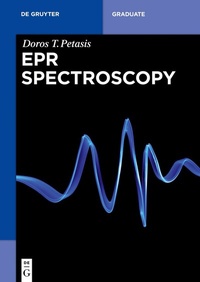
EPR Spectroscopy
Description

EPR spectroscopy is a versatile, nondestructive technique widely used in chemistry, biology, and physics. It detects molecules and materials with unpaired electrons making it a very selective technique that produces a wealth of information on such systems. Its high sensitivity makes it suitable in analyzing very small samples, single crystals, or reaction intermediates like radicals. This textbook takes a practical approach that introduces the basic concepts of EPR to suffi cient detail to allow the reader to gain a basic knowledge of EPR and understand how experiments are carried out and how spectra are analyzed and interpreted. Many illustrative examples are included drawn from solid-state physics and bioinorganic chemistry. It is suitable as a short introduction for advanced undergraduate and beginning graduate students taking their fi rst steps into EPR research.
More details
Other editions
Additional editions
Person
Doros T. Petasis
B. S. Physics at Indiana University, M. S. Physics and Ph. D. Physics at Carnegie Mellon University, Post-Doctoral Fellow and Research Scientist at the Department of Chemistry, Carnegie Mellon University. Now Professor of Physics at Allegheny College.
Content
- Theory of EPR Spectroscopy
- Practical Approach to EPR Spectroscopy
- Computational Techniques for Analysis
- Spectra Interpretation
- Biological Application of EPR Spectroscopy
