

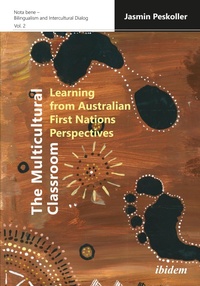
The Multicultural Classroom: Learning from Australian First Nations Perspectives
Published on 19. October 2021
188 pages
978-3-8382-7587-1 (ISBN)
Description

The scope of multilingualism and multiculturalism within societies is increasing on a global scale. As this is happening, discussions are emerging concerning the significance of including a variety of perspectives in classroom discourse as well as the imperative of ridding it of a prevailing monocultural straitjacket. Against the backdrop of these changing realities, authors have advocated for a revision and adaptation of current teaching methodology and classroom materials in order to do greater justice to an increasingly diverse student population. This book presents the findings from a qualitative research project conducted in Australia, a country acclaimed for its linguistic and cultural diversity. Specifically, the study investigated the educational context of Indigenous Australian learners by shedding light on the incorporation of First Nations perspectives in teaching materials and methodology. Additionally, the project identified therewith-related challenges and possibilities for improvement. The results provide insights into the multifacetedness of language- as well as culture-related factors, which prove vital for learning processes. Moreover, the results reveal the complexities arising in connection with the incorporation of First Nations perspectives in classroom discourse. The data also point towards dimensions for improvement and recommendations for action for educators working in diverse classroom settings. As growing linguistic and cultural diversity has become a global reality, this volume, addressing Australian First Nations perspectives, offers an important contribution to the field of contemporary education.
More details
Series
Edition
New edition
Language
English
Place of publication
Berlin
Germany
Target group
Professional and scholarly
Edition type
New edition
Illustrations
Illustrations
File size
1,89 MB
ISBN-13
978-3-8382-7587-1 (9783838275871)
Copyright in bibliographic data and cover images is held by Nielsen Book Services Limited or by the publishers or by their respective licensors: all rights reserved.
Schweitzer Classification
Other editions
Additional editions
Book
10/2021
ibidem
€29.90
Shipment within 10-15 days
Persons
Jasmin Peskoller is a researcher in the field of Foreign Language Education at the University of Innsbruck, Austria. Her research interests include cultural learning and global education as well as diversity-sensitive approaches to teaching and learning in the contemporary foreign language classroom. For her outstanding research in the Australian educational context, she was awarded the Würdigungspreis by the Austrian Federal Ministery of Education, Research and Economy.
Content
- Intro
- Acknowledgments
- List of Tables
- List of Figures
- List of Abbreviations
- Preface
- Chapter I Introduction
- 1. Background and Relevance
- 2. Approach and Objectives
- 3. Structure of the Book
- Chapter II Foundations of Multicultural Classrooms
- 1. Language and Multilingualism
- 2. Culture and Multiculturalism
- 3. Teaching and Learning in Multicultural Classrooms
- 3.1 Perspectives on Diversity in Education
- 3.2 Implementing Bilingual and Bicultural Approaches
- 3.2.1 Two-Way Education
- 3.2.2 Immersion Education
- 3.3 Education Policies
- Chapter III Languages and Cultures in Australia
- 1. Multilingualism and Multiculturalism
- 2. The Multicultural Australian Classroom
- 3. Indigenous Australia
- 3.1 The Bilingual Context
- 3.1.1 The Significance of Indigenous Languages
- 3.1.2 The Significance of the English Language
- 3.2 The Bicultural Context
- Chapter IV First Nations Education in Australia
- 1. A History of First Nations Education
- 2. Foundations of Indigenous Teaching and Learning
- 2.1 Relationships
- 2.2 Storytelling and Yarning
- 2.3 The Concept of Shame
- 3. Proposed Frameworks and Pedagogies
- 3.1 Eight Ways of Aboriginal Learning
- 3.2 Culturally Nourishing Pedagogy
- 3.3 Culturally Responsive Pedagogy
- 4. Adopted Approaches in Australian Schools
- 4.1 Two-way Schooling
- 4.1.1 Two-way Bidialectal Education
- 4.1.2 Worawa Aboriginal College
- 4.2 The Stronger Smarter Approach
- 5. Challenges in Indigenous Australian Education
- Chapter V Research Study
- 1. Current Research Directions
- 2. Objectives and Design of the Study
- 2.1 Procedure
- 2.1.1 Constructing the Interview Form
- 2.1.2 Transcribing the Interview Data
- 2.1.3 Coding the Transcripts
- 2.2 Sample
- 3. Findings
- 3.1 The Role of Indigenous Languages
- 3.1.1 Pride vs. Embarrassment
- 3.1.2 Recognition of Linguistic Heritage
- 3.1.3 Orality of Indigenous Languages
- 3.1.4 Code-switching
- 3.1.5 Language Concepts and Worldview
- 3.2 The Role of Indigenous Cultures
- 3.2.1 Pride in Culture
- 3.2.2 Relationship Building
- 3.2.3 Family and Community Involvement
- 3.2.4 Home Values and Worldview
- 3.2.5 Cultural Concepts and Learning Styles
- 3.3 Frequency Analyses of Language and Culture Categories
- 3.4 Challenges in Indigenous Education
- 3.4.1 Historical Burden
- 3.4.2 Culture-related Differences
- 3.4.3 Lack of Awareness and Recognition
- 3.4.4 Systemic Shortcomings in Education
- 3.4.5 Lack or Stereotypical Inclusion of Culture
- 3.4.6 Socio-economic and Health Parameters
- 3.5 Frequency Analyses of Challenge Categories
- 3.6 Incorporating Indigenous Perspectives
- 3.6.1 The Importance of Incorporating Indigenous Language and Culture
- 3.6.2 Strategies for Incorporating First Nations Perspectives
- 3.6.3 Analysis of the Honey Ant Readers Textbooks
- 4. Summary and Discussion of Findings
- 4.1 Summary of Findings
- 4.2 Discussion of Findings
- 5. Implications for Teaching Practice
- Chapter VI Conclusion and Outlook
- Bibliography
- Appendix: Interview Form
