

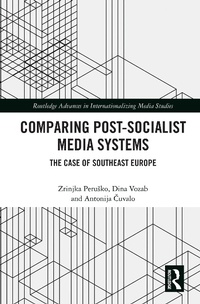
Comparing Post-Socialist Media Systems
The Case of Southeast Europe
1st Edition
Published on 4. October 2020
320 pages
978-1-000-17737-4 (ISBN)
Description

This book explains divergent media system trajectories in the countries in southeast Europe, and challenges the presumption that the common socialist experience critically influences a common outcome in media development after democratic transformations, by showing different remote and proximate configuration of conditions that influence their contemporary shape.
Applying an innovative longitudinal set-theoretical methodological approach, the book contributes to the theory of media systems with a novel theoretical framework for the comparative analysis of post-socialist media systems. This theory builds on the theory of historical institutionalism and the notion of critical junctures and path dependency in searching for an explanation for similarities or differences among media systems in the Eastern European region.
Extending the understanding of media systems beyond a political journalism focus, this book is a valuable contribution to the literature on comparative media systems in the areas of media systems studies, political science, Southeast and Central European studies, post-socialist studies and communication studies.
Applying an innovative longitudinal set-theoretical methodological approach, the book contributes to the theory of media systems with a novel theoretical framework for the comparative analysis of post-socialist media systems. This theory builds on the theory of historical institutionalism and the notion of critical junctures and path dependency in searching for an explanation for similarities or differences among media systems in the Eastern European region.
Extending the understanding of media systems beyond a political journalism focus, this book is a valuable contribution to the literature on comparative media systems in the areas of media systems studies, political science, Southeast and Central European studies, post-socialist studies and communication studies.
Reviews / Votes
This is a conceptually rich, methodologically sophisticated, and interdisciplinary analysis of south-east European media systems that explains continuity, change and divergence between the six cases. It deserves to be read not only by scholars of the region but by those considering how to approach more generally the study of comparative media systems and cultures.- John Downey, Professor of Comparative Media Analysis, Loughborough University
There was the need to fill a gap in the study of media systems in Southeast Europe. This book is doing this in a very convincing way. Perusko and colleagues support their discussion of the media systems in Southeast Europe with a rich and often complex interpretative apparatus deriving both from media studies and political science. Undoubtedly this mixture represents a major enrichment of their attempt that opens the doors to other possible applications, avoiding the frequent self-reference that often characterizes media studies.
- Paolo Mancini
This book reveals major changes in media systems in the six post-socialist countries of Southeast Europe between their early development in the late 19th century and the end of the socialist period (1945-1990) after World War II, and the breakup of their common state of Yugoslavia (1918-1990). The authors follow common threads of changes in contemporary media policy and media systems from the prolific challenges they pose to democracies to the appalling combination of conditions that reinforce media dependence on agents of political and economic power in what they call a "hybrid and competitive authoritarian media systems". This is an important contribution to comparative media studies, providing an exciting insight into media culture across diverse national contexts and advancing a theoretical understanding of the complex and little-known changes in the post-socialist countries of the former Yugoslavia.
- Slavko Splichal, University of Ljubljana
Perusko, Vozab and Cuvalo's book focusing on one of the most troubled regions of European history is an important contribution to the study of comparative media systems. Taking an interdisciplinary approach, this excellent study offers historical depth, conceptual innovation and methodological sophistication and will be a benchmark for future comparative research in the field. A fascinating read for everybody interested in the transformation of media systems in emerging democracies!
- Katrin Voltmer, Professor of Communication and Democracy, University of Leeds
More details
Series
Edition
1. Auflage
Language
English
Place of publication
London
United Kingdom
Publishing group
Taylor & Francis Ltd
Target group
College/higher education
Product notice
Reflowable
Illustrations
27 Tables, black and white; 7 Illustrations, black and white
ISBN-13
978-1-000-17737-4 (9781000177374)
Copyright in bibliographic data and cover images is held by Nielsen Book Services Limited or by the publishers or by their respective licensors: all rights reserved.
Schweitzer Classification
Other editions
Additional editions
Zrinjka Perusko | Dina Vozab | Antonija Cuvalo
Comparing Post-Socialist Media Systems
The Case of Southeast Europe
Book
08/2022
1st Edition
Routledge
€65.80
Shipment within 15-20 days
Zrinjka Perusko | Dina Vozab | Antonija Cuvalo
Comparing Post-Socialist Media Systems
The Case of Southeast Europe
Book
10/2020
1st Edition
Routledge
€206.90
Shipment within 15-20 days
Persons
Zrinjka Perusko is full professor of sociology of media and communication in the Faculty of Political Science at the University of Zagreb, Croatia.
Dina Vozab is assistant professor in the Faculty of Political Science at the University of Zagreb, Croatia.
Antonija Cuvalo is assistant professor in the Faculty of Political Science at the University of Zagreb, Croatia.
Dina Vozab is assistant professor in the Faculty of Political Science at the University of Zagreb, Croatia.
Antonija Cuvalo is assistant professor in the Faculty of Political Science at the University of Zagreb, Croatia.
Content
1. Introduction 2. Explaining the transformations of post-socialist media systems 3. Prelude to modernity 4.Media systems in socialist modernity 5. Towards democracy: Post-socialist media systems in digital modernity 6. Why the media systems are the way they are
