

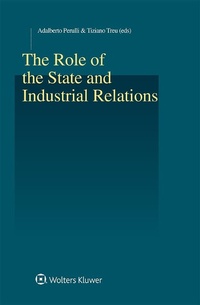
Role of the State and Industrial Relations
Published on 5. October 2019
312 pages
978-94-035-0662-3 (ISBN)
Description

The Role of the State and Industrial Relations Edited by Adalberto Perulli & Tiziano Treu The new era of industrial relations that has been stealthily changing the world of work in recent decades seems to have reached a stage where it can be systematically monitored and analyzed, in great part because the ';creeping renationalization' that has been noted since the financial crisis of 2008 has reinvigorated state intervention in essential economic structures. The contributions in this unrivalled book provide important new perspectives on the many challenges inherent in the present and future of the relationship between industrial relations and the state. Analyzing industrial relations systems from international, supranational, European and national points of viewand with an interdisciplinary approach connecting labour law, commercial law, corporate governance and international lawthis one-of-kind book examines such salient aspects of the subject as the following: cooperative versus conflictual industrial relations systems; phenomenon of constitutionalization of power by multinational enterprises; competitive, illiberal and protectionist patterns of state regulation; freedom of association and industrial relations; potential power of transnational collective bargaining; impact of worktime arrangements; role of European Works Councils; exemplary value of the German system of workers' participation; and global framework agreements. Using a comparative approach (the European Union, France, Spain, Germany, Italy, Japan, China, the United States, Brazil, South Africa, India), the book reconstructs the general framework of global industrial relations, considering challenges and future prospects and proposing a new agenda for the state. Contributors include widely renowned professors of labour, commercial and international law, as well as experts from the International Labour Organization and the International Society for Labour and Social Security Law. The debate about industrial relations and the state in our globalized world is of major concern for practitioners in governments, companies, employers' associations and trade unions, as well as for company managers, entrepreneurs, consultants, judges, human rights lawyers and academics interested in labour, industrial relations and social rights in European and international contexts.
More details
Other editions
Additional editions
Adalberto Perulli | Tiziano Treu
The Role of the State and Industrial Relations
Book
10/2019
Kluwer Law International
€153.26
Shipment within 15-20 days
Content
- Intro
- Half-Title Page
- Title Page
- Copyright Page
- Editors
- Contributors
- Summary of Contents
- Table of Contents
- Introduction: Book Presentation
- Part I: The Industrial Relations System and the Role of the State in a Globalized World
- CHAPTER 1 Still a Century of Industrial Relations?
- 1.1 Industrial Relations As a System: Evolutionary Profiles
- 1.2 The New Millennium: A Decline in Industrial Relations?
- 1.3 The Functional Transformations of Collective Bargaining
- 1.4 Trends Toward Decentralization of the Collective Bargaining Structure
- 1.5 Workers' Participation: A New Horizon for the Company's Social Organization
- 1.6 Platform Capitalism and Industrial Relations: A Rebirth?
- CHAPTER 2 The Role of the State in Industrial Relations
- 2.1 The Contribution of the States and of Public Policies to the Formation of Modern Industrial Relations
- 2.2 The Changing Scenario of Industrial Relations and the (Different) Reactions of National States
- 2.3 Different Industrial Relations Trends: Union Density
- 2.4 The Coverage of Collective Agreements: Different Legislative Measures
- 2.5 The Impact of Decentralization on the Structure of Collective Bargaining
- 2.6 Factors and Trends of Decentralized Bargaining
- 2.7 State Policies and the Promotion of Participatory Practices
- 2.8 Unions' Revitalization Policies
- 2.9 Instruments of Social Regulation of International Trade
- CHAPTER 3 Reflexive Labour Law and Industrial Relations from the Perspective of Modern Social System Theory
- 3.1 Introduction
- 3.2 Industrial Relations As a Social System
- 3.3 The State, Law and Industrial Relations
- 3.4 Reflexive Labour Law
- 3.5 Global Labour Law
- 3.6 Conclusions
- CHAPTER 4 The Role of the State in the Globalization Process: An Economic Perspective
- 4.1 Globalization and the State: A Summary of Two Stylized Historical Facts
- 4.2 A Bit of History and of Economic Theory
- 4.3 The Current Situation and Some Economic Puzzles
- 4.4 The Cases of China and Many Other Countries that Globalized and Developed
- 4.5 Conclusions
- CHAPTER 5 The EU and the Industrial Relations Systems: A Critical Assessment
- 5.1 Law in Books and Law in Action
- 5.2 The European Social Dialogue: The Institutional Framework
- 5.3 Autonomous Agreements
- 5.4 Inborn Weakness of the Autonomous Social Dialogue (And the Relentless Decline of the Institutional Social Dialogue)
- 5.5 New Economic and Financial Governance, and Common 'Neoliberal Trajectories'
- Part II Patterns and Comparative Analysis: Cooperative Versus Conflictual Industrial Relations - Collective Bargaining - Participation
- CHAPTER 6 Cooperative Versus Conflictual Industrial Relations: Japanese Experience
- 6.1 Introduction
- 6.2 Historical Developments of Japanese Industrial Relations and Labour Law
- 6.2.1 The Pre-war Period (The End of the Nineteenth Century-1945)
- 6.2.2 Establishment of Modern Industrial Relations in the Period of Reconstruction of the Economy (1945-1954)
- 6.2.2.1 Legislation Establishing Modern Industrial Relations
- 6.2.2.2 Confrontation Between Labour and Management
- 6.2.2.3 Government's Direct Intervention into Industrial Relations
- 6.2.3 Transformation of Industrial Relations (1955-1964)
- 6.2.3.1 The Beginning of Economic Growth and the Productivity Increase Movement
- 6.2.3.2 A Split in Militant Unions and an Emergence of Moderate Unions
- 6.2.3.3 The Peak of Militant Labour Movement
- 6.2.4 High Economic Growth and Establishment of Japanese-Model Employment Relations (1965-1973)
- 6.2.5 Adjustment of Japanese Industrial Relations in the Period of Low Economic Growth (1974-1985)
- 6.2.5.1 Impact of the Two Oil Crises
- 6.2.5.2 Beginning of the Decline of Public Sector Unions
- 6.2.5.3 Government Active Employment Policy in Low Economic Growth
- 6.2.6 Labour Law Reforms in the Era of Structural Changes and Globalized Economy (1985-Present)
- 6.2.6.1 Modernization of Traditional Labour Protective Laws
- 6.2.6.2 Responses to the New Values in Employment
- 6.2.6.2.1 Equal Employment Regulations
- 6.2.6.2.2 Regulations for Work-Life Balance
- 6.2.6.3 Responses to the Changing Structure of the Society
- 6.2.6.3.1 Aging Society
- 6.2.6.3.2 Changing Corporate Governance
- 6.2.6.3.3 Increased Individual Labour Disputes and Establishment of Labour Tribunal System
- 6.2.6.3.4 Increased Non-standard Employment
- 6.3 The State's Role in Labour and Employment Relations and Economic Development in Japan
- 6.4 Challenges the Japanese Decentralized Industrial Relations Face
- CHAPTER 7 Cooperative Industrial Relations: The German Example and Its Impact
- 7.1 Introduction
- 7.2 The German System of Workers' Participation as an Example
- 7.2.1 The Works Council System
- 7.2.2 Workers' Representation in the Supervisory Boards
- 7.2.3 The Link to the Works Council System
- 7.2.4 Attempt of Evaluation
- 7.3 Transferability of the German System?
- 7.4 Negative Impact by the EU Law on the German System?
- 7.4.1 Possible Negative Impact by the SE Directive
- 7.4.2 CJEU on Company Law
- 7.4.3 Safeguarding Employee Representation in Case of Cross-Border Mobility
- 7.5 Conclusion
- CHAPTER 8 Cooperative Versus Conflictual Industrial Relations: The Case of Spain
- 8.1 Two Channels of Representation
- 8.2 Some Remarks on Work Councils or Staff Delegates
- 8.3 Legislative Trends
- 8.4 Academic Discussions
- 8.5 Trends in Collective Bargaining
- 8.6 Some Outcomes
- 8.7 Involvement of Workers
- 8.8 Conclusive Remarks
- Chapter 9 Industrial Relations after the Crisis: In Search of New Patterns for Comparative Analysis
- 9.1 Deterritorialization and Moving Beyond Conventional Models of Industrial Relations
- 9.2 The Push Towards Industrial Relations Centred on the Company
- 9.3 Are We in the Lead-Up to Non-intermediated Work Relations?
- 9.4 A New Idea of Participation?
- 9.5 Conclusive Considerations and Open Issues
- Part III After the Century of Corporativism: A New Agenda for the State in Industrial Relations
- CHAPTER 10 The Faces of the State
- 10.1 Introduction
- 10.2 A New State Authoritarianism
- 10.3 The Challenges Launched by a Radiant Private Power
- CHAPTER 11 The Muted Voice of Labour in Labour Policy in the United States
- 11.1 Introduction
- 11.2 Unions and the Political Climate
- 11.3 The Conservative Tide Affecting Labour Relations
- 11.4 Employer Resistance to Unions
- 11.5 Other Obstacles to Union Organizing
- 11.5.1 Legal Hurdles
- 11.5.2 Legal Notions of Property Rights
- 11.5.3 The Legal Position of American Employees
- 11.6 The Impact of the Missing Worker Voice
- CHAPTER 12 The State, Industrial Relations and Freedom of Association: A History of Functional Embeddedness
- Introduction
- 12.1 The Supranational (Cross-Sectoral) Level: Freedom of Association, Social Partnership and the Legislative Support
- 12.2 The National (Sectoral) Level: Freedom of Association, Trade Union Pluralism and the Legislative Interference
- 12.3 The Transnational (Company) Level: Freedom of Association, Workers Involvement and Collective Agreements
- 12.4 Reasonable Adjustments to Freedom of Association: A Functionalist Conclusive Approach to Embeddedness
- Part IV: Industrial Relations and the International/Supranational Dynamics
- CHAPTER 13 Collective Bargaining at the Transnational Level
- 13.1 Introduction
- 13.2 Transnational Collective Bargaining
- 13.3 Trade Union Responses at Transnational, Sectoral and Company Level
- 13.4 IFAs and EFAs
- 13.5 Legal Framework
- 13.6 European Social Dialogue
- 13.7 The Future of Collective Bargaining at Transnational Level
- 13.8 Transnational Company Agreement
- 13.9 Social Dialogue and Governance
- 13.9.1 Multi-stakeholder Initiatives
- 13.9.2 International Framework Agreements
- 13.9.3 Accord for Fire and Building Safety in Bangladesh
- 13.10 Conclusion
- Bibliography
- Chapter 14 Transformation of Work and Collective Bargaining Current Trends: The Paradigmatic Example of the New Worktime Arrangements
- 14.1 Introduction: Crisis of Adaptation of Labour Law?
- 14.2 A Paradigmatic Example of Adaptation: From the Perspective of Generalized Working Time Reduction to the Work-Sharing Address
- 14.3 The 'Defensive' Approach: Working Time Reduction As an Employment Protection Measure
- 14.4 The 'Work-Life Balance' Approach
- 14.5 Limits of the Experimented Models
- 14.6 Some Emerging Innovative Trends: From the Collective Standards to the Promotion of Individual Choices on Worktime Issues - The New Solutions Offered by the 2018 IG Metall/Südwestmetall and 2017 GD Coesia Agreements
- 14.7 Conclusions
- CHAPTER 15 Strategic Interventions in Labour Administration and Industrial Relations in Brazil, South Africa and India
- 15.1 Introduction
- 15.2 Brazil
- 15.2.1 Industrial Relations under the Vargas Era
- 15.2.2 Recent Trends in Labour Administration and Industrial Relations in Brazil
- 15.3 South Africa
- 15.3.1 Introduction
- 15.3.2 The New Labour Market Institutions
- 15.3.3 Issues Facing the Governance of Labour Market in South Africa
- 15.3.4 Assessing South Africa's Commission for Conciliation, Mediation and Arbitration
- 15.3.5 Labour Inspections
- 15.4 India
- 15.4.1 Introduction
- 15.4.2 Issues Facing the Labour Administration and Industrial Relations System in India
- 15.4.3 Labour Inspection
- 15.5 Conclusions
- CHAPTER 16 Global Framework Agreements: The Experiences of Enel and Petrobras
- 16.1 Introduction
- 16.1.1 Transnational Social Dialogue, The ILO and GFAs
- 16.1.2 Definition and Scope of GFAs
- 16.1.3 Methodology
- 16.2 The Experiences of Enel and Petrobras
- 16.2.1 Enel and Petrobras Profiles
- 16.2.2 Overview of Enel GFA
- 16.2.3 Overview of Petrobras GFA
- 16.3 Enel GFA Versus Petrobras GFA
- 16.4 Conclusion: Key Findings
