

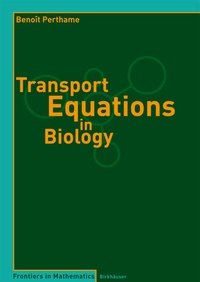
Transport Equations in Biology
Description

This book presents models written as partial differential equations and originating from various questions in population biology, such as physiologically structured equations, adaptive dynamics, and bacterial movement. It develops appropriate mathematical tools and qualitative properties of the solutions (long time behavior, concentration phenomena, asymptotic behavior, regularizing effects, blow-up or dispersion). The book describes such original mathematical methods as the generalized relative entropy method, a unique method to tackle most of the problems in population biology; the description of Dirac concentration effects using a new type of Hamilton-Jacobi equations; and a general point of view on chemotaxis including various scales of description leading to kinetic, parabolic or hyperbolic equations.
More details
Other editions
Additional editions
Content
Chapter 2 Adaptive dynamics, an asymptotic point of view (p. 27)
So far, we have given examples of physiologically structured populations, i.e., structured by a parameter describing a biological, physiological or ecological characteristic of the individuals. Further examples are also described in Chapter 4 below. When this characteristic is inherent to the individual, i.e., it is fixed at the very beginning of its life, we refer to it as a trait, we prefer to avoid calling it a phenotype.
The theory which focusses on phenotypic evolution driven by small mutations in replication, while ignoring both sex and genes, is known by the name Adaptive dynamics and is part of Evolution theory, see [172, 115, 80, 81, 169, 45] and the references given therein. A general mathematical treatment of the general subject of selection vs mutation can also be found in [43] (in particular population geneticists might prefer the assumption that mutations are rare rather than small).
The two main ingredients in this theory are (i) the selection principle which favorizes the population with best adapted trait, and (ii) mutations which allow offsprings to have slightly different traits than their mother. The combination of the two e.ects is studied by adaptive dynamics.
This turns out to be an extremely intricate theory on which several possible mathematical approaches are possible. One of the reasons is that it is merely impossible to consider this problem without introducing small parameters (mutations can be small or rare for instance, population should be large in any case but relative death rates can vary).
Therefore adaptive evolution can be studied with various mathematical tools. Evolutionary game theory is a standard point of view, see for instance [135, 136, 134] after it was introduced by J. Maynard Smith (see [169]). Probability theory is also natural because .uctuations are important at the individual level and individual centered models are naturally stochastic.
Departing from an individual centered stochastic dynamics, several possible limits are possible as the population becomes large ([101]). Here we look at models which are in one special class of those limits. In this chapter, we give a first and very elementary point of view based on structuring an ODE and including mutations.
Our main goal is to apply the corresponding asymptotic theory and show how the concept of monomorphic population arises naturally in the limit of small mutations over a long time compared to one generation length.
Such rescaling has also been used for the spread of genetic traits, in a probabilistic framework (see [110] and the references therein). Our presentation in this chapter follows the lines of [83] but uses a simpler framework for the population model. We begin with several simple examples of physiologically structured population (without mutations) where a selection principle can be proved.
Then we introduce the mutations and this raises the question of finding the appropriate scales. Here, and this is one the possible scales, we assume that mutations are frequent but have a very small effect on the trait. This allows us to state an asymptotic problem.
