

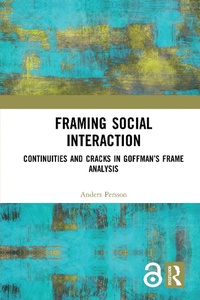
Framing Social Interaction
Continuities and Cracks in Goffman's Frame Analysis
1st Edition
Published on 20. July 2018
190 pages
978-1-317-13354-4 (ISBN)
Description

The Open Access version of this book, available at http://www.taylorfrancis.com/books/e/9781315582931, has been made available under a Creative Commons Attribution-NonCommercial-No Derivatives 4.0 license.
This book is about Erving Goffman's frame analysis as it, on the one hand, was presented in his 1974 book Frame Analysis and, on the other, was actually conducted in a number of preceding substantial analyses of different aspects of social interaction such as face-work, impression management, fun in games, behavior in public places and stigmatization. There was, in other words, a frame analytic continuity in Goffman's work. In an article published after his death in 1982, Goffman also maintained that he throughout his career had been studying the same object: the interaction order. In this book, the author states that Goffman also applied an overarching perspective on social interaction: the dynamic relation between ritualization, vulnerability and working consensus. However, there were also cracks in Goffman?s work and one is shown here with reference to the leading question in Frame Analysis - what is it that's going on here? While framed on a "microsocial" level, that question ties in with "the interaction order" and frame analysis as a method. If, however, it is framed on a societal level, it mirrors metareflective and metasocial manifestations of changes and unrest in the interaction order that, in some ways, herald the emphasis on contingency, uncertainty and risk in later sociology. Through analyses of social media as a possible new interaction order - where frame disputes are frequent - and of interactional power, the applicability of Goffman's frame analysis is illustrated. As such, this book will appeal to scholars and students of social theory, classical sociology and social interaction.
This book is about Erving Goffman's frame analysis as it, on the one hand, was presented in his 1974 book Frame Analysis and, on the other, was actually conducted in a number of preceding substantial analyses of different aspects of social interaction such as face-work, impression management, fun in games, behavior in public places and stigmatization. There was, in other words, a frame analytic continuity in Goffman's work. In an article published after his death in 1982, Goffman also maintained that he throughout his career had been studying the same object: the interaction order. In this book, the author states that Goffman also applied an overarching perspective on social interaction: the dynamic relation between ritualization, vulnerability and working consensus. However, there were also cracks in Goffman?s work and one is shown here with reference to the leading question in Frame Analysis - what is it that's going on here? While framed on a "microsocial" level, that question ties in with "the interaction order" and frame analysis as a method. If, however, it is framed on a societal level, it mirrors metareflective and metasocial manifestations of changes and unrest in the interaction order that, in some ways, herald the emphasis on contingency, uncertainty and risk in later sociology. Through analyses of social media as a possible new interaction order - where frame disputes are frequent - and of interactional power, the applicability of Goffman's frame analysis is illustrated. As such, this book will appeal to scholars and students of social theory, classical sociology and social interaction.
Reviews / Votes
"The way Persson takes his reader through the book is progressive and intuitive. He starts with a thorough presentation of Goffman's sociological work, embedded in historical and social contexts. He proposes a way to understand and read Goffman's Frame Analysis. Building on a gradual explanation, giving the reader a solid background, he demonstrates how to draw on Goffman's analytical framework to analyze social interaction taking account of a metaperspective." - Maud Mazaniello-Chezol, Language, Discourse & SocietyMore details
Edition
1. Auflage
Language
English
Place of publication
London
United Kingdom
Publishing group
Taylor & Francis Ltd
Target group
College/higher education
Illustrations
3 Tables, black and white; 3 Line drawings, black and white; 3 Illustrations, black and white
File size
5,76 MB
ISBN-13
978-1-317-13354-4 (9781317133544)
Copyright in bibliographic data and cover images is held by Nielsen Book Services Limited or by the publishers or by their respective licensors: all rights reserved.
Schweitzer Classification
Other editions
Additional editions
Book
11/2019
1st Edition
Routledge
€65.00
Shipment within 15-20 days
Book
08/2018
1st Edition
Routledge
€193.50
Shipment within 10-20 days
Person
Anders Persson is Professor of Sociology and Educational Sciences respectively at Lund University, Sweden.
Content
Preface
1. Introduction
I: Goffman and the Interaction Order
2. Goffman Style - Outsider on the Inside
3. The Interaction Order is in the Balance - The Dynamic Relation between Ritualisation, Vulnerability, and Working Consensus
II: Frame and Framing
4. Frame Analysis and Frame Analysis
5. The Development of Goffman's Interactional and Situational Frame Concept
6. Continuities and Cracks in Goffman's Frame Analysis
III: Framing Social Media, Online Chess, and Power
7. A New Interaction Order? - Framing Interaction in Social Media
8. Frame Disputes in Online Chess and Chat Interaction
9. Interactional Power - Influencing Others by Framing Social Interaction
IV: Conclusions
10. Concluding Remarks
Epilogue: Framed Boundlessness - Action and Everyday Life in Las Vegas
Complete Bibliography: Erving Goffman's Writings
References
1. Introduction
I: Goffman and the Interaction Order
2. Goffman Style - Outsider on the Inside
3. The Interaction Order is in the Balance - The Dynamic Relation between Ritualisation, Vulnerability, and Working Consensus
II: Frame and Framing
4. Frame Analysis and Frame Analysis
5. The Development of Goffman's Interactional and Situational Frame Concept
6. Continuities and Cracks in Goffman's Frame Analysis
III: Framing Social Media, Online Chess, and Power
7. A New Interaction Order? - Framing Interaction in Social Media
8. Frame Disputes in Online Chess and Chat Interaction
9. Interactional Power - Influencing Others by Framing Social Interaction
IV: Conclusions
10. Concluding Remarks
Epilogue: Framed Boundlessness - Action and Everyday Life in Las Vegas
Complete Bibliography: Erving Goffman's Writings
References
