

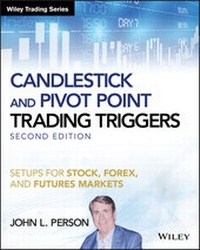
Candlestick and Pivot Point Trading Triggers
Description

Candlestick and Pivot Point Trading Triggers +Website makes Pivot Point analysis relevant for today's market, with up-to-date data and new techniques that reflect the current trading environment. Tried-and-true tactics are modernized with new tools and approaches, and novel methodologies are introduced to help you make smarter trades while minimizing risk. Directional options strategies draw on analysis from Thinkorswim, TradeStation and Genesis Software, and are integrated with PPS Indicator and Persons Pivots. Quarterly pivots are introduced for long-term trading opportunities and option strategists, and leveraged and inverse-leveraged ETFs are brought into the detailed discussion on trading vehicles. The author's own proprietary setups have been updated to align with the new trading realities, and the new chapter on volume analysis covers the techniques used in his book Mastering the Stock Market. Combined with the tools and resources featured on the companion website, this book gives you the tools and techniques you need to boost your portfolio's performance.
Technical analysis offers more profit opportunities than ever before, but the tools of the trade have changed. This book brings you up to date with the latest, so you can start getting even more out of your trades.
* Utilize leveraged and inverse-leveraged ETFs
* Integrate directional options strategies
* Apply new techniques for volume analysis
* Implement quarterly pivots for longer-term opportunities
The 2006 publications of this book's first edition brought pivot point and candlestick charting into the limelight. The market has undergone massive changes in the past ten years, and many of the most effective techniques have been adjusted and integrated with new tools to become even more effective in today's market. This new second edition of Candlestick and Pivot Point Trading Triggers +Website brings clarity to the current market, and strength to your investment strategy.
More details
Other editions
Additional editions
Person
Content
1 Trading Vehicles, Stock, ETFs, Futures, and Forex
2 Determining Market Condition
3 How to Read Oscillators to Spot Overbought or Oversold Conditions
4 Momentum Changes
5 Pivot Points
6 Pivot Point Moving Average System
7 Candle Charts and Top Reversal Patterns
8 Setups and Triggers
9 Risk & Trade Management
10 Projecting Entry and Exit Points
11 The Sample Analysis
12 Confidence to Pull the Trigger Comes from Within
Introduction
Wow how time flies! The first edition was published in 2005 and here it is May 21st, 2020, in the midst of a global pandemic that caused a historic market sell-off, recovery for some stocks, and new all-time highs for others like Walmart, Microsoft, Amazon, and PayPal. The incredible part is I am using the same tactics to trade the markets with the methodology and trading tools in this book with amazing success in my managed fund and for the traders in our live trade room and Weekly Stock advisory service.
To all the individual traders looking to learn how to invest and trade wisely and to all those who are looking for new ideas and who have been around looking to learn a more positive approach, I say that after reading this material, you will find a great approach to trading and will learn the importance of, or at least will expand your knowledge of how to develop your personalized mechanical trading system from the methods provided in these pages. There is no doubt this method will stand the test of time because it has stood the test of time for the most amazing trading environment in the last 200 years-the decades between 2006 and 2020!
You will specifically learn what methods and parameters to use with time-tested material. This second edition brings some awesome new developments in trading tools that have been modernized, like a volume indicator, a Relative Strength tool, and a modified breadth indicator, which we can apply to the indexes we mainly trade: the S&P 500 ($SPY), the NASDAQ 100 ($QQQ), and The Russell 2000 ($IWM).
THINGS CHANGE
Times have changed, as have price values of stocks and raw commodities. Markets and access to trading changed, and products we trade, besides the commodity markets, include other hard assets (e.g., housing and real estate).
Things changed since the first edition was written, from President Bush to President Obama and now to President Trump. We have had a significant change in monetary policies, with global interest rates at negative to zero returns. Gold has risen not because of fears of inflationary pressures, rather because the Federal Reserve (Fed) lowered rates. In turn, the US dollar fell as the interest rate differentials narrowed in the United States against foreign central banks. All are the reverse of when the first edition was written.
THE CONUNDRUM
One favorite word among economists in 2005 was conundrum, which was used by then chairman of the Federal Reserve, Alan Greenspan. This was the term he used to describe the event of Treasury yields declining while the Fed was raising interest rates.
Fast forward to 2020 and we have historic low yields and the highest price printed in 30-year Treasury bonds ever.
HISTORY SHOULD REPEAT ITSELF
Often it is said that history repeats itself. I believe this to be true.to a degree. Not all market crashes or rallies are led by the same sectors or reasons. The crash in 1987 lasted four days and was blamed in part on a currency crunch in Asia. Then in 1998 we had Long-Term Capital Management, 2001 was the "tech wreck," and 2008 was due to a housing bubble. Then the 2020 meltdown was caused by a global shutdown due to Covid-19. I do believe now more than ever global economies and the world move in cycles. Based on the climb that bonds and equities made in 2016-2020, the market's price behavior or intermarket relationships were not behaving in a traditional way. At least not compared to when the first edition was printed in 2006. One main reason can be summed up in two words: quantitative easing. Based on a rise in stocks, bonds should have moved lower; the great rotation out of treasuries into equities never happened. History should have repeated itself, but it did not; or if it does, it will be a delayed reaction.
Due to this keen observation, there was one solid piece of advice I was constantly giving to people through our trading room or in my newsletter advisory service. It was, "Trade the markets independently of each other." One reason for this advice was this: Not much was making sense at times in the traditional way. Let's face it, when crude oil and energies stocks plunge, it is deflationary and should have a positive effect for consumers. But when OPEC decided to go to "war" with Russia at the March 2020 meeting, this was an event that had no playbook. Saudi Arabia decided to cut prices and boost production. The question is: what ripple effect will it have on the world banks that may have loans out to small drilling and production companies? This led to a first time ever event: the day before expiration, Crude Oil May futures contracts traded at negative $37.00 per barrel.
It is still not known what lasting impact the Coronavirus will have on commerce. My predictions are that it will be short-lived, at least by the time this book is in print.
Despite the fact that we have increased federal deficits, tax cuts, and reduction of regulatory requirements, the only thing that would worry me as a trader is that trading might become illegal, or that taxation on trading scares investors away, which would eliminate volatility. Traders need volatility.
DELAYED REACTION
As of March 2020, the US economy was in its 11th year of an economic expansion from the March 2009 bottom-a bottom that was supported by Person's Monthly Pivot support calculation.
As we move forward, I have to say it should be a stock picker's market: We will continue to use cell phones and computers, we will eat, and travel may slow due to the Coronavirus scare, but it will return. People love to live! On that note I want to reassure all of my European friends who I met through the decades from the old MTA (now CMT), IFTA, and AAPTA associations and those individuals who invited me to present my methodology, like Ludvik in Prague, Eduardo in Italy, Andre in Paris, Lothar in Germany, and Elaine in Switzerland: I will certainly travel back to see you this new decade, if invited, coronavirus or not. It goes without saying, here in the US many found interest in my 20 years of speaking with the TradersEXPO and MoneyShows. I thank the founder, Kim Githler, for the opportunity and ability to present my teachings and meet so many individual traders at these events.
With that said, will there be a recession? I would say yes, but no matter what happens, the teachings in these pages will help you navigate these markets with a better sense of direction.
No one knows for sure how soon or by how much consumers will adjust their spending habits: with an accommodative Fed and next to zero interest rates on a global scale, it will take a long time and a gradual removal of that monetary stimulus to change a way of life-buying things. From houses and cars to electronics, furniture, food (and for Carlos, the newcomer student trader, there's the diaper and baby items purchases), we all like deals and now more than ever we sit at home or on a train and buy online. Then when the boxes show up at your residence, its like Christmas every day. Successful trading allows us the luxury of this lifestyle.
TRADING FOR A LIVING
I started in the business as a runner on the floor of the Chicago Mercantile Exchange back in the late 1970s. I had the privilege of working with a true master trader, George Lane, the creator of stochastics. I had a knack for the financial markets and learned to trade the 30-year bonds. I also discovered how to use pivot points and how to incorporate longer-term time periods in my analysis. Then came options on commodities; and in 1986 I made a fortune for myself and others in the bond market. I gradually improved my techniques, and through the understanding of candle charts, while using them in conjunction with pivot points, I have developed quite a methodology that shows a high frequency of recurring patterns. This is what I believe is one of the single best methods for identifying market moves for various trading vehicles. Trading for a living is a fabulous career. Now more than ever, we have global market influences, advanced technology, equal access, market liquidity, and, best of all, diversified markets investment vehicles.
We have stocks; ETFs, both leveraged and inverse; volatility products like the ($VXX); futures products with the micro E-mini futures that launched in 2019; and options on these markets, so there are hundreds of products to trade through regulated exchanges that allow speculators to participate in a structured, open marketplace that offers controllable leverage.
What you now need is a complete understanding of solid trading tools and a structured trade plan, both of which can be found in this book.
THE NEW AGE TECHNICIAN
As a technician, one who practices the art of technical analysis, I have now-more than at any time in the past-a greater edge in the marketplace. Through electronic market access and charting software with the power of today's computers, I can take my refined market analysis methods and implement these strategies and apply them to all markets. As long as there is liquidity and a structured environment, and as long as I keep my trading capital intact and follow specific trading rules to manage risk, there will be a bonanza of opportunities in the years ahead. I fully expect the techniques that I am sharing with you in this book to help you discover how to be a consistently profitable trader. This book opens the door to how you can learn to read charts and rely on price rather than on indicators. You will learn what...
