

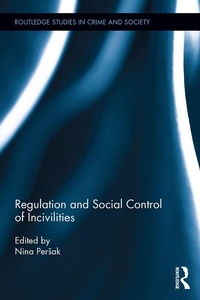
Regulation and Social Control of Incivilities
Published on 23. June 2016
193 pages
978-1-317-36023-0 (ISBN)
Description

The increasing trend and prevalence of incivilities-targeting punitive regulatory measures across Europe raises important issues regarding the legitimacy, effectiveness and impact of such formal social control. Regulation and Social Control of Incivilities addresses the pertinent issues of current punitive regulation and the social control of incivilities, their trends, criminological explanations, political, spatial, cultural, representational and policing dimensions as well as the underlying behaviour it targets.
Part I explores issues surrounding the regulation of incivilities, drawing examples from several European countries including Spain, Italy, Great Britain, Belgium, Slovenia and Hungary. It inspects the legal form and content of the prohibition of incivilities and the social factors that can help explain it, as well as the effectiveness and societal impact of various anti-nuisance measures. Part II focuses on social control and the representation of incivilities, including the construction and control of public nuisance in Belgium, the spatial and cultural aspects of incivilities and of law enforcement against them, the media representations of incivilities in the British and Flemish press, and the intersections between migration and control of incivilities when policing in the Netherlands.
This book brings together international scholars to examine the ways in which understudied European countries approach the issue of anti-social behaviour. This multidisciplinary text will be of interest to students, scholars and policymakers concerned with issues of social control, incivilities and criminalisation.
Part I explores issues surrounding the regulation of incivilities, drawing examples from several European countries including Spain, Italy, Great Britain, Belgium, Slovenia and Hungary. It inspects the legal form and content of the prohibition of incivilities and the social factors that can help explain it, as well as the effectiveness and societal impact of various anti-nuisance measures. Part II focuses on social control and the representation of incivilities, including the construction and control of public nuisance in Belgium, the spatial and cultural aspects of incivilities and of law enforcement against them, the media representations of incivilities in the British and Flemish press, and the intersections between migration and control of incivilities when policing in the Netherlands.
This book brings together international scholars to examine the ways in which understudied European countries approach the issue of anti-social behaviour. This multidisciplinary text will be of interest to students, scholars and policymakers concerned with issues of social control, incivilities and criminalisation.
Reviews / Votes
"European criminal policy is characterized by both inclusive and exclusive tendencies. The heritage of enlightenment and the post-World War II revival of fundamental rights allow elements of inclusive criminal policy survive on the old Continent. That however does not prevent, rather mitigates control societies' exclusive tendencies, which can be traced in occupying territories both upwards by blurring the line between the war against terrorism and criminal justice and downwards, through a remarkable societal readiness to demand legal and - more often than not - penal law solutions for incivilities. The volume edited by Nina Persak is an elegant attempt to document and analyze these latter disturbing tendencies in contemporary Europe. The multi-layered and interdisciplinary nature of the problem is mirrored by methodology: the volume is scientifically embedded into criminology, political science, sociology and criminal law; is characterized by a balanced representation of European states; and an equally fair proportioning of country analyses, empirical research and theory."Petra Bard, Senior Researcher and Head of the Criminal Law Division, National Institute of Criminology, Hungary; Assistant Professor, ELTE School of Law, Hungary; and Visiting Professor, Central European University, Hungary
"This book is an important addition to the literature on the control of 'incivilities' - understood broadly as contested uses of, and presences in, public spaces. It reminds us of the fine line between targeting behaviours of others, and targeting others for what or who they are. From homelessness in Hungary to political protest in Spain, the measure of acceptability of behaviour in public increasingly becomes its potential for causing feelings of discomfort in others. Keenly observed trends in different European countries provide illustrative detail of a growing trend of low-level suppression that redraws the boundaries of ownership of public spaces."
Antje du Bois-Pedain, Senior Lecturer in the Faculty of Law and Deputy Director of the Centre for Penal Theory and Penal Ethics at the Institute of Criminology, University of Cambridge, UK
More details
Series
Language
English
Place of publication
London
United Kingdom
Publishing group
Taylor & Francis Ltd
Target group
College/higher education
Illustrations
3 s/w Abbildungen, 3 s/w Tabellen, 3 s/w Zeichnungen
3 Tables, black and white; 3 Line drawings, black and white; 3 Illustrations, black and white
File size
1,17 MB
ISBN-13
978-1-317-36023-0 (9781317360230)
Copyright in bibliographic data and cover images is held by Nielsen Book Services Limited or by the publishers or by their respective licensors: all rights reserved.
Schweitzer Classification
Other editions
Additional editions
Nina Persak
Regulation and Social Control of Incivilities
Book
02/2018
1st Edition
Routledge
€81.89
Shipment within 10-20 days
Nina Persak
Regulation and Social Control of Incivilities
Book
07/2016
1st Edition
Routledge
€222.84
Shipment within 10-20 days
Person
Nina Persak is a research professor at the Faculty of Law, Ghent University, Belgium. She holds a doctorate in law from University of Ljubljana and an LL.M. (Law) and M.Phil. (Social and Developmental Psychology) from University of Cambridge. Her research interests lie in the fields of criminology, criminal law, criminal legal philosophy (in particular criminalisation theory), human rights, victimology, sociology of law and social psychology. She is the author of Criminalising Harmful Conduct: The Harm Principle, its Limits and Continental Counterparts (Springer, 2007) and editor of Legitimacy and Trust in Criminal Law, Policy and Justice: Norms, Procedures, Outcomes (Ashgate, 2014).
Content
1. The rude, the bad and the ugly: penalising incivilities in Europe (Nina Persak)
Part I: Regulation of disorder and uncivil behaviour
2. Criminalising through the back door: normative grounds and social accounts of the incivilities' regulation (Nina Persak)
3. The top-down instruments for governing crime and disorder: what lessons can be drawn from the Italian experience (2007-2011)? (Marco Calaresu)
4. Punitive decriminalisation? The repression of political dissent through administrative law and nuisance ordinances in Spain (Manuel Maroto)
5. Tackling homelessness through criminalisation: the case of Hungary (Lena Podoletz)
Part II: Social control and representations of incivilities
6. Normalisation of behaviour in public space: the construction and control of 'public nuisance' in Belgium (Stefaan Pleysier)
7. Understanding uncivil behaviour through urban space and culture (Anna Di Ronco)
8. Media representations of incivilities in the British and Flemish press (Nina Persak)
9. Over-policed? Tackling incivilities and the intersections with migration control (Joanne van der Leun)
Part III: Concluding thoughts
10. Dimensions, concerns and effects of addressing uncivil behaviour through punitive law (Nina Persak)
Part I: Regulation of disorder and uncivil behaviour
2. Criminalising through the back door: normative grounds and social accounts of the incivilities' regulation (Nina Persak)
3. The top-down instruments for governing crime and disorder: what lessons can be drawn from the Italian experience (2007-2011)? (Marco Calaresu)
4. Punitive decriminalisation? The repression of political dissent through administrative law and nuisance ordinances in Spain (Manuel Maroto)
5. Tackling homelessness through criminalisation: the case of Hungary (Lena Podoletz)
Part II: Social control and representations of incivilities
6. Normalisation of behaviour in public space: the construction and control of 'public nuisance' in Belgium (Stefaan Pleysier)
7. Understanding uncivil behaviour through urban space and culture (Anna Di Ronco)
8. Media representations of incivilities in the British and Flemish press (Nina Persak)
9. Over-policed? Tackling incivilities and the intersections with migration control (Joanne van der Leun)
Part III: Concluding thoughts
10. Dimensions, concerns and effects of addressing uncivil behaviour through punitive law (Nina Persak)
