

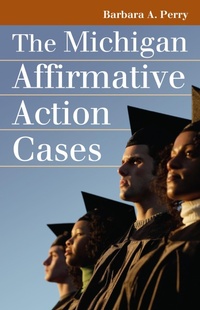
The Michigan Affirmative Action Cases
Description

In its controversial Bakke decision of 1978, the Supreme Court upheld racial and ethnic diversity in university admissions?but it was not to be the last word on the matter. When Jennifer Gratz and Barbara Grutter challenged the University of Michigan's admission policies because they were passed over in favor of ostensibly less-qualified minority applicants, the Court was once again compelled to address affirmative action.
Barbara Perry takes readers behind the scenes to tell the riveting story of how the two rejected applicants allied with conservative interest groups in an attempt to overturn affirmative action programs in higher education?and how in a 5-4 decision Justice Sandra Day O'Connor provided the decisive vote reaffirming Bakke. While the plaintiffs argued that their rights to equal protection under the Fourteenth Amendment and Title VI of the Civil Rights Act had been violated, the Court in 2003 disagreed and upheld the constitutionality of affirmative action, citing the goal of diversity as a legitimate state interest but also making it clear that there were limits to that interest and the policies to implement it.
Drawing on interviews with key figures in the litigation, Perry follows the twists and turns of the district and appellate cases, then reveals the inside story of how Justice O'Connor joined her liberal colleagues to uphold the use of race in university admissions and thereby establish an important new precedent. Perry provides a play-by-play account of the dramatic oral arguments before the Court, explains how the Court's decisions emerged, and reveals how Justice O'Connor's personal, professional, and judicial background brought her to that pivotal moment in legal history.
As Perry shows, the Supreme Court's decisions frustrated both conservatives and civil rights advocates, who continue to battle each other when anti-affirmative action initiatives appear on state ballots. Her compelling study helps us understand why affirmative action remains one of our most hotly contested issues.
More details
Other editions
Additional editions
Person
Barbara A. Perry is Senior Fellow at the McConnell Center at the University of Louisville and Carter Glass Professor of Government at Sweet Briar College. Her other books include The Priestly Tribe: The Supreme Court's Image in the American Mind; ?The Supremes?: Essays on the Current Justices of the Supreme Court of the United States; and most recently Jacqueline Kennedy: First Lady of the New Frontier.
Content
Editors' Preface
Preface
1. ?An American Dilemma?: Racial Politics in the Pre-Bakke Era
2. Bakke to the Future: Affirmative Action Precedents
3. Admission Denied: The University of Michigan Rejects Jennifer Gratz and Barbara Grutter
4. ?Can We Sue?: Gratz and Grutter Go to Court
5. ?All the Way to the Supreme Court?: Briefs for the Justices
6. ?Jim Crow, Hell No!?: Oral Argument at the U.S. Supreme Court
7. ?Diversity Is a Compelling State Interest?: Justice Sandra Day O'Connor Upholds Affirmative Action
8. ?Affirmative Reaction:? In the Wake of Gratz and Grutter
Chronology
Relevant Cases
Bibliographic Essay
Index
