

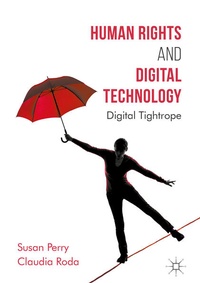
Human Rights and Digital Technology
Description

Analysing the convergence of law and regulation with rapidly evolving communications technologies, this interdisciplinary work navigates the intricate balancing act between human rights protection and technological innovation in a digital age, and illuminates the comprehensive potential of human rights to frame our intelligent use of technology. The authors address such pressing questions as how to protect user privacy online, whether digital pollution is a health hazard, who should have control and be responsible for data technologies and how to maintain human autonomy in a world of interconnected objects. By considering specific cases, this book provides an in-depth exploration of the many regulatory and technological choices citizens, states, civil society organizations and the private sector should consider to ensure that digital technology more fully serves human needs.
Reviews / Votes
"Never has it been more urgent than at this moment in history to use the lens of human rights to explore the power, possibilities, and limitations of digital technology. Susan Perry and Claudia Roda's book - positioning itself at the intersection of these two profound modern revolutions - is a rich and complex exploration and a must read for the informed global citizen." (Carolyn Patty Blum, Visiting Fellow, Kellogg College, Oxford University Clinical Professor of Law Emerita, University of California, Berkeley)"Perry and Roda's volume is a must-read for all concerned about technology and human rights. In this cutting-edge work, they explore how these two fields intersect in ways that create both promise and peril. The authors focus on a series of particular topics, offering concrete proposals to protect human rights norms even as technology continues to expand into our everyday lives." (Alex Whiting, Professor of Practice Harvard LawSchool, UK)
"This book is a timely wake-up call for those concerned with the impact of new technologies on human rights. It is conceptually and historically well-rooted. More than that, it is erudite, insightful, sensitive, inquisitive, well-structured and a pleasure to read. I can heartily recommend Human Rights and Digital Technology, not only to academics, but also to policy-makers, civil society organisations and corporate decision-makers." (David Wright Director, Trilateral Research, London)
More details
Other editions
Additional editions
Persons
Susan Perry is Professor of International and Comparative Politics at the American University of Paris, France, where she teaches and directs several graduate programs. She was the recipient, with her co-author, of a European Commission grant to support privacy-by-design research and is currently working on technology-related issues in humanitarian law. She has published widely on the convergence between international human rights law and technology.
Claudia Roda is Professor of Computer Science and Dean at the American University of Paris. Her research focuses on the impact of digital technology on human behaviour and social structures. She is internationally known for her work on theoretical and applied models for attention computing. Professor Roda's research has been widely published and generously sponsored by several organisations.
