

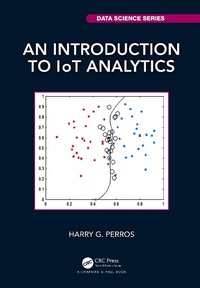
An Introduction to IoT Analytics
1st Edition
Published on 31. March 2021
372 pages
978-1-000-33782-2 (ISBN)
Description

This book covers techniques that can be used to analyze data from IoT sensors and addresses questions regarding the performance of an IoT system. It strikes a balance between practice and theory so one can learn how to apply these tools in practice with a good understanding of their inner workings. This is an introductory book for readers who have no familiarity with these techniques.
The techniques presented in An Introduction to IoT Analytics come from the areas of machine learning, statistics, and operations research. Machine learning techniques are described that can be used to analyze IoT data generated from sensors for clustering, classification, and regression. The statistical techniques described can be used to carry out regression and forecasting of IoT sensor data and dimensionality reduction of data sets. Operations research is concerned with the performance of an IoT system by constructing a model of the system under study and then carrying out a what-if analysis. The book also describes simulation techniques.
Key Features
IoT analytics is not just machine learning but also involves other tools, such as forecasting and simulation techniques.
Many diagrams and examples are given throughout the book to fully explain the material presented.
Each chapter concludes with a project designed to help readers better understand the techniques described.
The material in this book has been class tested over several semesters.
Practice exercises are included with solutions provided online at www.routledge.com/9780367686314
Harry G. Perros is a Professor of Computer Science at North Carolina State University, an Alumni Distinguished Graduate Professor, and an IEEE Fellow. He has published extensively in the area of performance modeling of computer and communication systems.
The techniques presented in An Introduction to IoT Analytics come from the areas of machine learning, statistics, and operations research. Machine learning techniques are described that can be used to analyze IoT data generated from sensors for clustering, classification, and regression. The statistical techniques described can be used to carry out regression and forecasting of IoT sensor data and dimensionality reduction of data sets. Operations research is concerned with the performance of an IoT system by constructing a model of the system under study and then carrying out a what-if analysis. The book also describes simulation techniques.
Key Features
IoT analytics is not just machine learning but also involves other tools, such as forecasting and simulation techniques.
Many diagrams and examples are given throughout the book to fully explain the material presented.
Each chapter concludes with a project designed to help readers better understand the techniques described.
The material in this book has been class tested over several semesters.
Practice exercises are included with solutions provided online at www.routledge.com/9780367686314
Harry G. Perros is a Professor of Computer Science at North Carolina State University, an Alumni Distinguished Graduate Professor, and an IEEE Fellow. He has published extensively in the area of performance modeling of computer and communication systems.
More details
Series
Edition
1. Auflage
Language
English
Place of publication
London
United Kingdom
Publishing group
Taylor & Francis Ltd
Target group
Professional and scholarly
Illustrations
24 Tables, color; 186 Illustrations, color
ISBN-13
978-1-000-33782-2 (9781000337822)
Copyright in bibliographic data and cover images is held by Nielsen Book Services Limited or by the publishers or by their respective licensors: all rights reserved.
Schweitzer Classification
Other editions
Additional editions
Harry G. Perros
An Introduction to IoT Analytics
Book
03/2021
1st Edition
Chapman & Hall/CRC
€202.40
Shipment within 15-20 days
Harry G. Perros
An Introduction to IoT Analytics
Book
03/2021
1st Edition
Chapman & Hall/CRC
€101.80
Shipment within 15-20 days
Person
Harry G. Perros is a Professor of Computer Science at North Carolina State University, an Alumni Distinguished Graduate Professor, and an IEEE Fellow. He has published extensively in the area of performance modelling of computer and communication systems, and in his free time he likes to go sailing and play the bouzouki.
Content
1. Introduction 2. Review of Probability Theory 3. Simulation Techniques 4. Hypothesis Testing 5. Multivariable Linear Regression 6. Time Series Forecasting 7. Dimensionality Reduction 8. Clustering Techniques 9. Classification Techniques 10. Artificial Neural Networks 11. Support Vector Machines 12. Hidden Markov Models
