

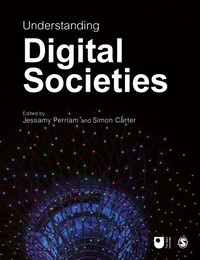
Understanding Digital Societies
1st Edition
Published on 24. March 2021
496 pages
978-1-5297-3387-7 (ISBN)
Description

Understanding Digital Societies provides a framework for understanding our changing, technologically shaped society and how sociology can help us make sense of it. You will be introduced to core sociological ideas and texts along with exciting global examples that shed light on how we can use sociology to understand the world around us.
This innovative, new textbook:
Provides unique insights into using theory to help explain the prevalence of digital objects in everyday interactions.
Explores crucial relationships between humans, machines and emerging AI technologies.
Discusses thought-provoking contemporary issues such as the uses and abuses of technologies in local and global communities.
Understanding Digital Societies is a must-read for students of digital sociology, sociology of media, digital media and society, and other related fields.
This innovative, new textbook:
Provides unique insights into using theory to help explain the prevalence of digital objects in everyday interactions.
Explores crucial relationships between humans, machines and emerging AI technologies.
Discusses thought-provoking contemporary issues such as the uses and abuses of technologies in local and global communities.
Understanding Digital Societies is a must-read for students of digital sociology, sociology of media, digital media and society, and other related fields.
More details
Series
Edition
First Edition
Language
English
Place of publication
London
United Kingdom
Publishing group
Sage Publications Ltd (Digital)
Target group
College/higher education
Product notice
Reflowable
File size
20,92 MB
ISBN-13
978-1-5297-3387-7 (9781529733877)
Copyright in bibliographic data and cover images is held by Nielsen Book Services Limited or by the publishers or by their respective licensors: all rights reserved.
Schweitzer Classification
Other editions
Additional editions
Jessamy Perriam | Simon Carter
Understanding Digital Societies
Book
05/2021
1st Edition
SAGE Publications Ltd
€120.20
Shipment within 15-20 days
Jessamy Perriam | Simon Carter
Understanding Digital Societies
Book
05/2021
1st Edition
SAGE Publications Ltd
€176.78
Shipment within 15-20 days
Persons
Jessamy Perriam is Assistant Professor in the Technologies in Practice research group and the Centre for Digital Welfare at the IT University of Copenhagen. She was previously Lecturer in Sociology at The Open University. Her research is situated within Science and Technology Studies and Sociology, and focuses on public sector digital transformation, failure, cybersecurity and public demonstrations of expertise.
Jessamy is currently part of an Engineering and Physical Sciences Research Council-funded interdisciplinary group of social science and engineering researchers investigating the emergence and role of shadow infrastructures in society in light of pandemics and other global events.
Jessamy received her PhD in Sociology from Goldsmiths, University of London in 2018 with a thesis titled Theatres of Failure: digital demonstrations of disruption in everyday life. She has also written about digital methods in a post-API environment for the International Journal of Social Research Methodology.
Prior to working in academia full time, Jessamy worked as a digital transformation practitioner in the UK public sector, conducting qualitative research for government departments and other public sector organisations.
Jessamy currently teaches Computer Supported Cooperative Work (CSCW) and ethnography at an undergraduate level, and Science and Technology Studies and research methods at a graduate level. She is interested in innovative forms of teaching, including online distance education and using live radio as an alternative to in person lectures.
Simon Carter is a sociologist working at The Open University with interests in Science and Technology Studies, health and medicine and science engagement. He originally was a research chemist working in the automotive industry and then in environmental protection. But after studying at The Open University, his career took a different direction when he returned to full time higher education to complete a PhD at Lancaster University. After this, Simon mainly specialised in the sociology of health and illness, and medical sociology.
Simon has conducted research into: the cultural turn towards the sun and sunlight in early twentieth-century Europe; critical approaches to the public understanding of science as applied to health issues; how biosecurity interfaces with other concerns in our globalised world; and, more recently, the impact of wearables and digital technologies on health.
Jessamy is currently part of an Engineering and Physical Sciences Research Council-funded interdisciplinary group of social science and engineering researchers investigating the emergence and role of shadow infrastructures in society in light of pandemics and other global events.
Jessamy received her PhD in Sociology from Goldsmiths, University of London in 2018 with a thesis titled Theatres of Failure: digital demonstrations of disruption in everyday life. She has also written about digital methods in a post-API environment for the International Journal of Social Research Methodology.
Prior to working in academia full time, Jessamy worked as a digital transformation practitioner in the UK public sector, conducting qualitative research for government departments and other public sector organisations.
Jessamy currently teaches Computer Supported Cooperative Work (CSCW) and ethnography at an undergraduate level, and Science and Technology Studies and research methods at a graduate level. She is interested in innovative forms of teaching, including online distance education and using live radio as an alternative to in person lectures.
Simon Carter is a sociologist working at The Open University with interests in Science and Technology Studies, health and medicine and science engagement. He originally was a research chemist working in the automotive industry and then in environmental protection. But after studying at The Open University, his career took a different direction when he returned to full time higher education to complete a PhD at Lancaster University. After this, Simon mainly specialised in the sociology of health and illness, and medical sociology.
Simon has conducted research into: the cultural turn towards the sun and sunlight in early twentieth-century Europe; critical approaches to the public understanding of science as applied to health issues; how biosecurity interfaces with other concerns in our globalised world; and, more recently, the impact of wearables and digital technologies on health.
Content
Part 1: Everyday Life and The Digital
Chapter 1: The Digital Sociological Imagination - Jessamy Perriam
Chapter 2: The Presentation of Self in Digital Spaces - Jessamy Perriam
Part 2: Society, Technology, Citizens and Cities
Chapter 3: Planning the Cities of the Future - Liz McFall and Darren Umney
Chapter 4: Migration, Diaspora and Transnationalism in the Digital Age - Marie Gillespie and Rhys Crilley
Chapter 5: Transnational Digital Networks: families and religion - Umut Erel and John Maiden
Part 3: Humans and Machines
Chapter 6: Autonomous Digital Objects: between humans and machines - Simon Carter
Chapter 7: Freedom, Fetishes and cyborgs - Paul-Francois Tremlett
Chapter 8: Health and Digital Technologies: the case of walking and cycling - Simon Carter
Part 4: Uses and Abuses of the Digital
Chapter 9: Material Digital Technologies - Jessamy Perriam and Simon Carter
Chapter 10: Disinformation, 'fake news' and Conspiracies - David Robertson
Chapter 11: Cybersecurity, Digital Failure and Social Harm - Jessamy Perriam and Simon Carter
Chapter 12: Too Much, Too Young? Social media, moral panics and young people's mental health - Peter Redman
Chapter 13: Algorithms - Simon Carter and Jessamy Perriam
Chapter 1: The Digital Sociological Imagination - Jessamy Perriam
Chapter 2: The Presentation of Self in Digital Spaces - Jessamy Perriam
Part 2: Society, Technology, Citizens and Cities
Chapter 3: Planning the Cities of the Future - Liz McFall and Darren Umney
Chapter 4: Migration, Diaspora and Transnationalism in the Digital Age - Marie Gillespie and Rhys Crilley
Chapter 5: Transnational Digital Networks: families and religion - Umut Erel and John Maiden
Part 3: Humans and Machines
Chapter 6: Autonomous Digital Objects: between humans and machines - Simon Carter
Chapter 7: Freedom, Fetishes and cyborgs - Paul-Francois Tremlett
Chapter 8: Health and Digital Technologies: the case of walking and cycling - Simon Carter
Part 4: Uses and Abuses of the Digital
Chapter 9: Material Digital Technologies - Jessamy Perriam and Simon Carter
Chapter 10: Disinformation, 'fake news' and Conspiracies - David Robertson
Chapter 11: Cybersecurity, Digital Failure and Social Harm - Jessamy Perriam and Simon Carter
Chapter 12: Too Much, Too Young? Social media, moral panics and young people's mental health - Peter Redman
Chapter 13: Algorithms - Simon Carter and Jessamy Perriam
