

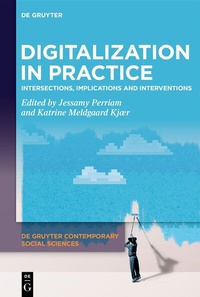
Digitalization in Practice
Description

Digitalization in Practice: Intersections, Implications and Interventions shows that as welfare is increasingly digitalized, an investigation of the social implications of this digitalization becomes increasingly pertinent. The book offers chapters on how the state operates, from the day-to-day practices of governance to keeping registers of businesses, from overarching and sometimes contradictory policies to considering how to best include citizens in digitalized processes. Moreover, the book takes a citizen perspective on key issues of access, identification and social harm to consider the social implications of digitalization in the everyday. The diversity of topics in Digitalization in Practice reflects how digitalization as an ongoing process and practice fundamentally impacts and often reshapes the relationship between states and citizens.
More details
Other editions
Additional editions
Persons
Jessamy Perriam is Assistant Professor in the Technologies in Practice research group and the Centre for Digital Welfare at the IT University of Copenhagen. Her research is situated within Science and Technology Studies and Sociology, and focuses on public sector digital transformation, failure, and public demonstrations of expertise. Jessamy received her PhD in Sociology from Goldsmiths. Prior to working in academia full time, Jessamy worked as a digital transformation practitioner in the UK public sector, conducting qualitative research for government departments and other public sector organisations. Jessamy currently teaches Computer Supported Cooperative Work (CSCW) and ethnography at an undergraduate level, and Science and Technology Studies and digital research methods at a graduate level. She is a member of the ETHOS Lab at the IT University of Copenhagen, which focuses on feminist methodologies at the intersection of social sciences and technology.
Katrine Meldgaard Kjær
is Assistant Professor in the Technologies in Practice research group at the IT University of Copenhagen. Her research is situated with feminist Science and Technology Studies and critical data studies, and focuses on the social negotiation and construction of health controversies. She has published in journals such as
Catalyst: Feminism, theory, technoscience
and
Feminist media studies
. She currently teaches on topics relating to digital media studies and critical organizational studies. She is also a member of ETHOS Lab at the IT University of Copenhagen.
Content
- Intro
- Table of Contents
- Introduction: encountering the intersections, implications and interventions of digital transformation
- Chapter 1 Between bureaucracy and agility: the quiet transformation of the Danish digital state
- Chapter 2 One data state, two data logics: unfolding China's data governance
- Chapter 3 Digital state APIs: sociotechnical approaches to a small yet important piece of digital infrastructure
- Chapter 4 The digital state overflowing its boundaries: considering the case of digital inclusion in Denmark
- Chapter 5 The politics of seamlessness: a rights claims perspective on digital identification technologies
- Chapter 6 The citizen from hell: experiencing digitalization
- Chapter 7 Matters of subjects: the digital citizen in technology comprehension
- Chapter 8 Poor policy made durable: when digital transformation meets social harm
- Chapter 9 Aggregating like a state: discriminatory data practices of legislated ghettoization in Denmark
- Contributor biographies
- Index
