

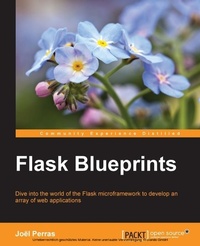
Flask Blueprints
Dive into the world of the Flask microframework to develop an array of web applications
Published on 7. October 2025
198 pages
978-1-78439-734-0 (ISBN)
Description

Dive into the world of the Flask micro-framework to develop an array of web applications
Key Features
Book DescriptionFlask is a small but powerful web development framework for Python. Though Flask is termed a micro-framework, it is no way lacking in functionality; there are many extensions available to Flask which helps it to function at the same level as other large frameworks such as Django and Ruby on Rails. This book will demonstrate how to develop a series of web application projects with the Python web micro-framework, and leverage extensions and external Python libraries and APIs to extend the development of a variety of larger and more complex web applications. The book will start by explaining Python's Virtualenv library and how to create and switch between multiple virtual environments. You'll first build an SQL database-backed application, which will use Flask-WTF, Flask-SQLAlchemy, Jinja templates, and other methods. Next you'll move on to a timeline application, built using concepts including pytest-Flask, the Blinker package, data modelling for user timelines, exception handling, and creating and organizing CLI tools. Moving on, you'll discover how to implement a photo timeline application where you'll explore topics such as writing and running celery tasks, API error handling and testing, and Werkzeug middlewares. Finally, the book walks you through creating an application which fetches data from GitHub and stores it locally. You will also learn how to install and configure Flask-Click extension.What you will learn
Use the virtualenv Python package to effectively isolate your development environments
Convert a simple onefile Flask application into a more fullfledged multipackage application
Integrate FlaskLogin for simple user authentication, FlaskWTF for forms, and FlaskSQLAlchemy for database interactions
Explore URL routing and dispatching in a blueprint structured application
Create your own signals and consume them within your application
Learn to leverage Werkzeug, the WSGI library that powers much of Flask
Implement custom exceptions for handling non20x response codes
Write your own CLI tools for administrative and development tasks of your Flask application using FlaskScript/Click
Build your Flask extensions to encapsulate reusable behaviors across your applications
Integrate your application with open source JavaScriptbased graphing libraries to create simple data visualizations
Who this book is forIf you are a Python web developer who has developed basic Flask applications and now wants to build a series of more complex web applications, then this is the book for you.
Key Features
Book DescriptionFlask is a small but powerful web development framework for Python. Though Flask is termed a micro-framework, it is no way lacking in functionality; there are many extensions available to Flask which helps it to function at the same level as other large frameworks such as Django and Ruby on Rails. This book will demonstrate how to develop a series of web application projects with the Python web micro-framework, and leverage extensions and external Python libraries and APIs to extend the development of a variety of larger and more complex web applications. The book will start by explaining Python's Virtualenv library and how to create and switch between multiple virtual environments. You'll first build an SQL database-backed application, which will use Flask-WTF, Flask-SQLAlchemy, Jinja templates, and other methods. Next you'll move on to a timeline application, built using concepts including pytest-Flask, the Blinker package, data modelling for user timelines, exception handling, and creating and organizing CLI tools. Moving on, you'll discover how to implement a photo timeline application where you'll explore topics such as writing and running celery tasks, API error handling and testing, and Werkzeug middlewares. Finally, the book walks you through creating an application which fetches data from GitHub and stores it locally. You will also learn how to install and configure Flask-Click extension.What you will learn
Use the virtualenv Python package to effectively isolate your development environments
Convert a simple onefile Flask application into a more fullfledged multipackage application
Integrate FlaskLogin for simple user authentication, FlaskWTF for forms, and FlaskSQLAlchemy for database interactions
Explore URL routing and dispatching in a blueprint structured application
Create your own signals and consume them within your application
Learn to leverage Werkzeug, the WSGI library that powers much of Flask
Implement custom exceptions for handling non20x response codes
Write your own CLI tools for administrative and development tasks of your Flask application using FlaskScript/Click
Build your Flask extensions to encapsulate reusable behaviors across your applications
Integrate your application with open source JavaScriptbased graphing libraries to create simple data visualizations
Who this book is forIf you are a Python web developer who has developed basic Flask applications and now wants to build a series of more complex web applications, then this is the book for you.
All prices
More details
Edition
Digital original
Language
English
Place of publication
Birmingham
United Kingdom
Target group
Professional and scholarly
US School Grade: College Graduate Student
Edition type
Digital original
File size
1,96 MB
ISBN-13
978-1-78439-734-0 (9781784397340)
Copyright in bibliographic data and cover images is held by Nielsen Book Services Limited or by the publishers or by their respective licensors: all rights reserved.
Schweitzer Classification
Other editions
Additional editions
Person
Perras Joel :
Joel Perras has been professionally involved in technology and computing for over 12 years. He got his start in the world of programming by attempting to teach himself Java at the tender age of 13 and got his first job at a small web development firm a few years later writing Java Server Pages. The first site he built is still running. While studying physics and mathematics at McGill University in Montreal, he helped set up a Tier II analysis centre for the Worldwide LHC Computing Grid, which cemented his interest in distributed systems architecture and high performance computing. Currently, his days are spent building infrastructure and Python applications with the incredible people at Fictive Kin, writing open source code, and trying to lift heavy weights over his head on a regular basis.
Joel Perras has been professionally involved in technology and computing for over 12 years. He got his start in the world of programming by attempting to teach himself Java at the tender age of 13 and got his first job at a small web development firm a few years later writing Java Server Pages. The first site he built is still running. While studying physics and mathematics at McGill University in Montreal, he helped set up a Tier II analysis centre for the Worldwide LHC Computing Grid, which cemented his interest in distributed systems architecture and high performance computing. Currently, his days are spent building infrastructure and Python applications with the incredible people at Fictive Kin, writing open source code, and trying to lift heavy weights over his head on a regular basis.
Content
Table of Contents
Starting on the Right Food: Using Virtualenv
Small to Big: Growing the Flask Application Structure
Snap: The Code Snippet Sharing Application
Shutterbug
Hublot
Dinnerly
Starting on the Right Food: Using Virtualenv
Small to Big: Growing the Flask Application Structure
Snap: The Code Snippet Sharing Application
Shutterbug
Hublot
Dinnerly

