

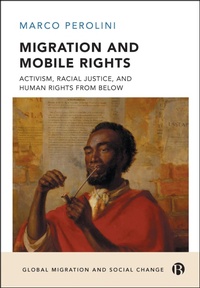
Migration and Mobile Rights
Activism, Racial Justice, and Human Rights from Below
1st Edition
Published on 18. December 2025
208 pages
978-1-5292-4358-1 (ISBN)
Description

Migrant activism is key in today's world, where countries in the Global North employ border regimes to reinforce racial hierarchies, limit freedom of movement, and exploit migrant labour. But how do migrant-led movements engage with human rights - do they see them as limited tools, or as frameworks that can be reimagined in the fight for border justice?
In this compelling study, Perolini critically examines the various ways migrants challenge these border regimes, and highlights the transformative potential of constructing human rights from below, moving beyond the state and legal norms.
Drawing on rich ethnographic research in Berlin, the book offers a fresh and provocative perspective on the intersections of migrant activism, human rights, and racial and border justice
In this compelling study, Perolini critically examines the various ways migrants challenge these border regimes, and highlights the transformative potential of constructing human rights from below, moving beyond the state and legal norms.
Drawing on rich ethnographic research in Berlin, the book offers a fresh and provocative perspective on the intersections of migrant activism, human rights, and racial and border justice
Reviews / Votes
'Based on thorough ethnographic research he carried out with migrants and their allies in Germany, Perolini shows how grassroots organizations and collective mobilizations construct human rights beyond the state-centric framework of international and national human rights law, beyond spectacular violations of rights reported in the media, and beyond the more visible claims made by NGOs. This lively and engaging book is a significant contribution to the political sociology of human rights. It demonstrates how migrants' rights are constructed at different scales and for different purposes. This includes mobilising resources, raising awareness of structural racism, and migrants themselves learning about the 'right to rights', both legal and non-legal. It is an invaluable resource for students and researchers interested in migrant mobilizations and rights.' Kate Nash, London School of Economics and Political Science 'This thought-provoking book paves the ground for developing an abolitionist approach to borders that, instead of just dismantling and tearing down, enacts world making practices through a tactical use of human rights and the law. By introducing the notion of "mobile rights", the book poignantly shows how a radical critique of state-based norms and racialized border mechanisms might hold together with mobilisations grounded in emancipatory and non-legal notions of human rights. In a time of socio-political fragmentation, it is paramount to interrogate how to re-compose and build up, without falling back into the trap of methodological nationalism. Perolini invites us to look at migrants' constituent struggles, escaping the binary between reform and revolution. This is an invaluable book for critical migration and border scholars who are interested in interrogating what a transformative critique of the border regime today should look like.' Martina Tazzioli, University of BolognaMore details
Series
Edition
First Edition
Language
English
Place of publication
Bristol
United Kingdom
Target group
Professional and scholarly
Illustrations
11 s/w Abbildungen
Not illustrated
File size
2,69 MB
ISBN-13
978-1-5292-4358-1 (9781529243581)
Copyright in bibliographic data and cover images is held by Nielsen Book Services Limited or by the publishers or by their respective licensors: all rights reserved.
Schweitzer Classification
Other editions
Additional editions
Book
approx. 12/2025
1st Edition
Bristol University Press
€105.50
Not yet published
Person
Marco Perolini is a human rights research and policy specialist and Visiting Fellow with LSE Human Rights at the London School of Economics and Political Science.
Content
Introduction
1. Human Rights: For Whom and by Whom? Approaches to Human Rights in Mobility Struggles
2. Racism, Migration, and Collective Resistance in Germany
3. Change Beyond the State? Mobility Struggles, Rights Claiming and the State
4. 'We Are All Refugees': Mobility Struggles and Their Ambiguous Approach to Legal Norms
5. Non-Reformist Reforms, Border Abolitionism, and Mobile Rights
6. Mobility Struggles in Berlin 2.0
Conclusions
Postscript: My Freedom of Movement 143
Appendix: List of Organizations and Interviewees
1. Human Rights: For Whom and by Whom? Approaches to Human Rights in Mobility Struggles
2. Racism, Migration, and Collective Resistance in Germany
3. Change Beyond the State? Mobility Struggles, Rights Claiming and the State
4. 'We Are All Refugees': Mobility Struggles and Their Ambiguous Approach to Legal Norms
5. Non-Reformist Reforms, Border Abolitionism, and Mobile Rights
6. Mobility Struggles in Berlin 2.0
Conclusions
Postscript: My Freedom of Movement 143
Appendix: List of Organizations and Interviewees
