

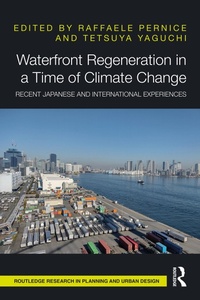
Waterfront Regeneration in a Time of Climate Change
Recent Japanese and International Experiences
Published on 28. July 2025
288 pages
978-1-040-40218-4 (ISBN)
Description

The current climate crisis and the rapid transformation of the natural environments will inevitably pose a threat to human settlements around the world. This book explores possible local strategies and global solutions in the safeguarding of coastal cities and the often-neglected urban waterfronts, in terms of a more effective integration with the city, whilst paying attention to the mitigation of the risks related to climate change.
Designers, administrators and engineers need to start developing various scenarios and possible solutions to tackle the inevitable transformation which is currently unfolding. This edited book contains essays which discuss several themes related to the effects of climate change on waterfronts, looking at Japan's experience and other international case studies. Collectively, they provide a multi-faceted analysis of selected projects and relevant urban experiences and practices which address issues such as the environmental disruption and the need for more efficient and sustainable forms of regeneration and urban renewal practice for the waterfronts.
The volume will appeal to architects, planners, geographers and general readers with an interest in landscape design and social science in an international context, as well as undergraduate and postgraduate students in the disciplines of built environment.
Designers, administrators and engineers need to start developing various scenarios and possible solutions to tackle the inevitable transformation which is currently unfolding. This edited book contains essays which discuss several themes related to the effects of climate change on waterfronts, looking at Japan's experience and other international case studies. Collectively, they provide a multi-faceted analysis of selected projects and relevant urban experiences and practices which address issues such as the environmental disruption and the need for more efficient and sustainable forms of regeneration and urban renewal practice for the waterfronts.
The volume will appeal to architects, planners, geographers and general readers with an interest in landscape design and social science in an international context, as well as undergraduate and postgraduate students in the disciplines of built environment.
Reviews / Votes
"This is a relevant and surprising book which presents and compares some policies and practices of waterfront regeneration in Tokyo, Sydney, Shanghai, and elsewhere. It shows an international perspective with several original contributions of young scholars and more experienced academics."Xiaoming Zhu, Professor, College of Architecture and Urban Planning, Tongji University, Shanghai.
"As the world faces the onslaught of intensified environmental calamities, Waterfront Regeneration in a Time of Climate Change: Recent Japanese and International Experiences presents a timely, must-read compendium of perspectives to address these contemporary challenges through rigorous, multi-disciplinary analysis by architects, urban planners and designers, and architectural historians."
Ken Tadashi Oshima, Professor, Department of Architecture, University of Washington, Seattle.
"Building on Japan's extensive experience in water urbanism and flood management, Waterfront Regeneration in a Time of Climate Change is an ambitious publication that bridges the gap between research, planning, and design for resilient coastal cities."
Grulois Geoffrey, Professor, Faculty of Architecture, Universite libre de Bruxelles.
"This compelling collection of contemporary and historic essays leaves no doubt about the profound environmental, social and governance challenges confronting waterside cities in the era of global warming. Its many insights and ideas about precarity and preparedness underline the salience of transformative, grounded and inclusive long term strategies transcending business-as-usual."
Robert Freestone, Professor, School of Built Environment, UNSW Sydney.
More details
Series
Language
English
Place of publication
London
United Kingdom
Publishing group
Taylor & Francis Ltd
Target group
College/higher education
Professional and scholarly
Illustrations
11 Tables, black and white; 37 Line drawings, black and white; 49 Halftones, black and white; 86 Illustrations, black and white
File size
26,33 MB
ISBN-13
978-1-040-40218-4 (9781040402184)
Copyright in bibliographic data and cover images is held by Nielsen Book Services Limited or by the publishers or by their respective licensors: all rights reserved.
Schweitzer Classification
Other editions
Additional editions
Raffaele Pernice | Tetsuya Yaguchi
Waterfront Regeneration in a Time of Climate Change
Recent Japanese and International Experiences
Book
07/2025
1st Edition
Routledge
€215.77
Shipment within 10-20 days
Persons
Raffaele Pernice is a licensed architect and Senior Lecturer in Architecture and Urbanism in the Faculty of Arts, Design & Architecture at the University of New South Wales (UNSW Sydney), Australia. An urban and architectural historian by training, he holds a PhD in architecture from Waseda University, Japan and a MArch from the University IUAV of Venice, Italy.
Tetsuya Yaguchi is Professor at Waseda University, Japan, where he conducts theoretical research and leads urban design initiatives aimed at sustaining and enhancing the built environment. In addition to his academic work, Mr. Yaguchi actively conducts pre-disaster planning workshops for communities in Tokyo and develops disaster education programmes for younger generations.
Tetsuya Yaguchi is Professor at Waseda University, Japan, where he conducts theoretical research and leads urban design initiatives aimed at sustaining and enhancing the built environment. In addition to his academic work, Mr. Yaguchi actively conducts pre-disaster planning workshops for communities in Tokyo and develops disaster education programmes for younger generations.
Content
List of figures
List of tables
List of contributors
Acknowledgments
Foreword
Carola Hein
Introduction
Pernice Raffaele, Tetsuya Yaguchi
Part 1 - Water and the City in the early 21st Century. Architectural and Urban Dimensions: Case Studies Japan
1) A Metabolist Utopia in the Crisis of a Flooded Society
Leonardo Zuccaro Marchi, Alice Covatta
2) Urban life on the Water. Concepts, Models and Prototypes for Marine Habitats in Japan 1958-2025
Raffaele Pernice
3) Tokyo Waterfront Urban Planning and Disaster Resilience: An Unforgettable Memory
George Kurumado
4) Pre-Disaster Recovery Planning and Consensus Building in Riverfront Neighbourhoods through Risk Communication. A Case of "Nige Chizu" Creation in Totsuka District, Shinjuku, Tokyo
Tetsuya Yaguchi
5) Resilience in Tokyo
William Galloway
6) From Shipyards to Skylines: The Evolution of Yokohama's Waterfront
Heide Imai
7) Waterfront Restoration in Yokohama after the Great Kanto Earthquake in 1923?Focusing on the Reconstruction of Yokohama Harbor and Canals
Yunlian Chen
Part 2 - Water and the City in the early 21st Century. Architectural and Urban Dimensions: Case Studies International
8) Venice Floods: an Urban Morphology Perspective
Paola Favaro
9) Waterfront Regeneration and Vitality in Hong Kong Central
Hee Sun 'Sunny' Choi
10) Affordable Floating Communities: How can Human Life on Water be made Attractive and Socially Sustainable for Larger Communities?
Harry den Hartog
11) Small-Scale Green Infrastructure for Sustainable Urban Flood Mitigation in the Tropical High-density Cities: A Case of Bangkok's Polder Areas
Theeraporn Premchaiswadi
12) San Francisco Waterfront Resilience Program Draft Plan
Adam Varat, Luiz Barata
13) Waterfronts as Shared Heritage: Balancing Heritage Conservation and Climate Change Mitigation in Metro Vancouver's waterfront areas
Yiting Pan
14) Climate Adaptation in Sydney Waterfront Planning Management
Nan Ye, Jing Li
15) Exit the Waterfront. Enter Coastal Landscape Design: A Case Study of the Mekong Delta
Bruno De Meulder, Kelly Shannon
16) Reformulating Peri-urban Landscape Guidelines to Maintain Stormwater Management Capacity in Low-lying Developing Cities: a case of Phnom Penh
Sokuncharia Srey
Afterword
Helen Lochhead
Index
List of tables
List of contributors
Acknowledgments
Foreword
Carola Hein
Introduction
Pernice Raffaele, Tetsuya Yaguchi
Part 1 - Water and the City in the early 21st Century. Architectural and Urban Dimensions: Case Studies Japan
1) A Metabolist Utopia in the Crisis of a Flooded Society
Leonardo Zuccaro Marchi, Alice Covatta
2) Urban life on the Water. Concepts, Models and Prototypes for Marine Habitats in Japan 1958-2025
Raffaele Pernice
3) Tokyo Waterfront Urban Planning and Disaster Resilience: An Unforgettable Memory
George Kurumado
4) Pre-Disaster Recovery Planning and Consensus Building in Riverfront Neighbourhoods through Risk Communication. A Case of "Nige Chizu" Creation in Totsuka District, Shinjuku, Tokyo
Tetsuya Yaguchi
5) Resilience in Tokyo
William Galloway
6) From Shipyards to Skylines: The Evolution of Yokohama's Waterfront
Heide Imai
7) Waterfront Restoration in Yokohama after the Great Kanto Earthquake in 1923?Focusing on the Reconstruction of Yokohama Harbor and Canals
Yunlian Chen
Part 2 - Water and the City in the early 21st Century. Architectural and Urban Dimensions: Case Studies International
8) Venice Floods: an Urban Morphology Perspective
Paola Favaro
9) Waterfront Regeneration and Vitality in Hong Kong Central
Hee Sun 'Sunny' Choi
10) Affordable Floating Communities: How can Human Life on Water be made Attractive and Socially Sustainable for Larger Communities?
Harry den Hartog
11) Small-Scale Green Infrastructure for Sustainable Urban Flood Mitigation in the Tropical High-density Cities: A Case of Bangkok's Polder Areas
Theeraporn Premchaiswadi
12) San Francisco Waterfront Resilience Program Draft Plan
Adam Varat, Luiz Barata
13) Waterfronts as Shared Heritage: Balancing Heritage Conservation and Climate Change Mitigation in Metro Vancouver's waterfront areas
Yiting Pan
14) Climate Adaptation in Sydney Waterfront Planning Management
Nan Ye, Jing Li
15) Exit the Waterfront. Enter Coastal Landscape Design: A Case Study of the Mekong Delta
Bruno De Meulder, Kelly Shannon
16) Reformulating Peri-urban Landscape Guidelines to Maintain Stormwater Management Capacity in Low-lying Developing Cities: a case of Phnom Penh
Sokuncharia Srey
Afterword
Helen Lochhead
Index
