

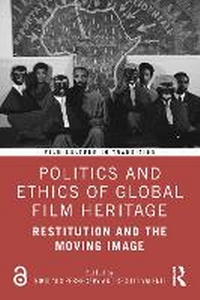
Restitution and the Moving Image
Global Film Heritage Between Return, Access, and Archival Reparation
Will be published approx. on 25. June 2026
346 pages
E-Book
978-1-040-83962-1 (ISBN)
Description

As global demands grow for the restitution of looted artifacts from Western museums and ethnological collections, what about the displaced and sequestered moving-image heritage of the Global Majority? This book examines restitutive practices in audiovisual archives worldwide, addressing pressing practical questions with immediate policy implications. It explores legal frameworks, codes of conduct, and institutional governance while offering a groundbreaking theoretical contribution to film and heritage studies.
If calls for restitution challenge traditional film archival practices, film itself-used as an archival medium-complicates conventional notions of restitution. Moving beyond a limited view of restitution as simply "giving back," the contributors to this volume envision a broader, decolonial horizon. They reassert historical demands for decolonial worldmaking that remain unfulfilled, proposing new political and ethical relationships between the unequal stakeholders of global film heritage.
This book is an essential resource for scholars in film and media history, feminist and decolonial theory, critical geography, and archival studies, as well as for curators, archivists, cultural practitioners, and general readers. It offers a vital perspective for anyone engaged in the ongoing work of decolonizing audiovisual archives.
If calls for restitution challenge traditional film archival practices, film itself-used as an archival medium-complicates conventional notions of restitution. Moving beyond a limited view of restitution as simply "giving back," the contributors to this volume envision a broader, decolonial horizon. They reassert historical demands for decolonial worldmaking that remain unfulfilled, proposing new political and ethical relationships between the unequal stakeholders of global film heritage.
This book is an essential resource for scholars in film and media history, feminist and decolonial theory, critical geography, and archival studies, as well as for curators, archivists, cultural practitioners, and general readers. It offers a vital perspective for anyone engaged in the ongoing work of decolonizing audiovisual archives.
Reviews / Votes
For those yet to engage with restitution and the moving image, this book not only unpacks the concept but also traces its historical significance across multiple territories, offering a valuable introduction to this vital debate and its implications for film heritage.June Givanni, founder of June Givanni Pan African Cinema Archive, London, UK.
An enthralling volume that addresses the possibilities and limitations of a "global cinematic commons" of film heritage. A powerful plea by a multiplicity of voices to reassess traditional debates about the restitution and repatriation of the moving image.
Elizabeth Ramirez-Soto, Associate Professor of Film and Media Studies, Columbia University, USA.
Restitution and the Moving Image is a vital and groundbreaking intervention in scholarship on film archives and debates on global cultural heritage. The volume expands the notion of restitution beyond material, as a process rather than an endpoint-one that unfolds through media infrastructures, institutional practices, and epistemic struggles over the very meaning of the archive. Bringing together scholars, archivists, and artists from across continents, the book reveals how film's displaced histories are continually reproduced by the inequities that structure global media heritage, while also showing how acts of restitution open new imaginaries of responsibility and repair. This is essential reading for anyone committed to decolonizing visual culture and reimagining justice and solidarity across the longue duree of film history.
Masha Salazkina, Professor of Film and Moving Image Studies, Concordia University, Montreal, Canada
More details
Series
Language
English
Place of publication
London
United Kingdom
Publishing group
Taylor & Francis Ltd
Target group
Professional and scholarly
College/higher education
Illustrations
54 Halftones, black and white; 54 Illustrations, black and white
ISBN-13
978-1-040-83962-1 (9781040839621)
Copyright in bibliographic data and cover images is held by Nielsen Book Services Limited or by the publishers or by their respective licensors: all rights reserved.
Schweitzer Classification
Other editions
Additional editions
Nikolaus Perneczky | Cecilia Valenti
Restitution and the Moving Image
Global Film Heritage Between Return, Access and Archival Reparation
Book
approx. 06/2026
1st Edition
Pallas Publications
€191.50
Not yet published
Persons
Nikolaus Perneczky is a researcher, educator, and curator based in London.
Cecilia Valenti is Assistant Professor of Film Studies at Johannes Gutenberg University Mainz, Germany.
Cecilia Valenti is Assistant Professor of Film Studies at Johannes Gutenberg University Mainz, Germany.
Content
Contributors
Preface
Introduction
1. Film/Restitution: Contesting Displacement, Enclosure, and Uneven Relations of Care in Global Audiovisual Archiving
Nikolaus Perneczky and Cecilia Valenti
I. With and Against the Colonial Archive
2. Footage Lost and Found: A Roundtable on Africa's Displaced and Silenced Film Heritage
Ali Essafi, Nii-Kwate Owoo, Jihan El-Tahri, and Jean-Marie Teno in Conversation with Nikolaus Perneczky
3. Six Scenes of (Dis)engagement: Creating Friction in the Italian Fascist and Colonial Archives
Alessandra Ferrini
4. Decolonizing the Colonial Film Archive: Access to Ghana's Shared Cinematic Heritage
Rebecca Ohene-Asah
5. Scenes from the Archive
Onyeka Igwe
6. Burning to Give Access: Mapping, Repatriating, and Sustaining Audiovisual Archives of the South African Liberation Struggle Through the Visual History Explorer
Janneke van Dalen
7. Reactivating Ethnographic Image Collections: Toward a Decolonial Archivology
Petra Loeffler
II. Institutions & Practices
8. A View from the North: A Conversation on Global Audiovisual Archiving, Shared Heritage, and Archival Cooperation
Giovanna Fossati, Nikolaus Perneczky, and Cecilia Valenti
9. Restoring Ray: On the Geo-Cultural Politics of "Saving Cinema"
Amrita Biswas
10. Caring for Indigenous Audiovisual Heritage in Australia: On Shared Archival Authority, Culturally Appropriate Protocols, and Digital Returns
Tasha James
11. Institutional Memory and Archival Returns: History of a Negotiated Transport of Films from the BFI to the National Archives of Trinidad and Tobago
Xavier Alexandre Pillai
12. African Cinema Returns: Tracing Guinean Film Heritage in Eastern European Archives
Gabrielle Chomentowski
III. Rethinking Restitution, Widening the Circle
13. Questioning Return: A Conversation on Decolonial Approaches Toward Restitution, Repair, and Care in Authoritarian (Post)colonial and Imperial Film Heritage and Cinema Cultures
Ali Hussein Al-Adawy and Brigitta Kuster
14. Films That Don't Exist Do Exist: Restituting a Missing Cinema
Lea Morin
15. Restoration, Restitution, and Potential History: A Dialogue with Abdoul War on Med Hondo's Archive
Annabelle Aventurin
16. Noli Me Tangere: Contextualizing Moving Image Restitution in the Community-Based Archival Practice of Forum Lenteng and Otty Widasari
Luthfan Nur Rochman
17. To Oralize or to Digitize? Re-Membering Nigeria's Contested Archives
Didi Cheeka
Index
Preface
Introduction
1. Film/Restitution: Contesting Displacement, Enclosure, and Uneven Relations of Care in Global Audiovisual Archiving
Nikolaus Perneczky and Cecilia Valenti
I. With and Against the Colonial Archive
2. Footage Lost and Found: A Roundtable on Africa's Displaced and Silenced Film Heritage
Ali Essafi, Nii-Kwate Owoo, Jihan El-Tahri, and Jean-Marie Teno in Conversation with Nikolaus Perneczky
3. Six Scenes of (Dis)engagement: Creating Friction in the Italian Fascist and Colonial Archives
Alessandra Ferrini
4. Decolonizing the Colonial Film Archive: Access to Ghana's Shared Cinematic Heritage
Rebecca Ohene-Asah
5. Scenes from the Archive
Onyeka Igwe
6. Burning to Give Access: Mapping, Repatriating, and Sustaining Audiovisual Archives of the South African Liberation Struggle Through the Visual History Explorer
Janneke van Dalen
7. Reactivating Ethnographic Image Collections: Toward a Decolonial Archivology
Petra Loeffler
II. Institutions & Practices
8. A View from the North: A Conversation on Global Audiovisual Archiving, Shared Heritage, and Archival Cooperation
Giovanna Fossati, Nikolaus Perneczky, and Cecilia Valenti
9. Restoring Ray: On the Geo-Cultural Politics of "Saving Cinema"
Amrita Biswas
10. Caring for Indigenous Audiovisual Heritage in Australia: On Shared Archival Authority, Culturally Appropriate Protocols, and Digital Returns
Tasha James
11. Institutional Memory and Archival Returns: History of a Negotiated Transport of Films from the BFI to the National Archives of Trinidad and Tobago
Xavier Alexandre Pillai
12. African Cinema Returns: Tracing Guinean Film Heritage in Eastern European Archives
Gabrielle Chomentowski
III. Rethinking Restitution, Widening the Circle
13. Questioning Return: A Conversation on Decolonial Approaches Toward Restitution, Repair, and Care in Authoritarian (Post)colonial and Imperial Film Heritage and Cinema Cultures
Ali Hussein Al-Adawy and Brigitta Kuster
14. Films That Don't Exist Do Exist: Restituting a Missing Cinema
Lea Morin
15. Restoration, Restitution, and Potential History: A Dialogue with Abdoul War on Med Hondo's Archive
Annabelle Aventurin
16. Noli Me Tangere: Contextualizing Moving Image Restitution in the Community-Based Archival Practice of Forum Lenteng and Otty Widasari
Luthfan Nur Rochman
17. To Oralize or to Digitize? Re-Membering Nigeria's Contested Archives
Didi Cheeka
Index
