

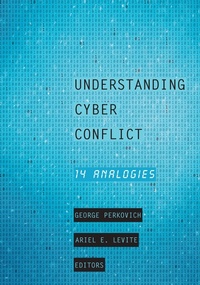
Understanding Cyber Conflict
Description

Cyber weapons and the possibility of cyber conflict?including interference in foreign political campaigns, industrial sabotage, attacks on infrastructure, and combined military campaigns?require policymakers, scholars, and citizens to rethink twenty-first-century warfare. Yet because cyber capabilities are so new and continually developing, there is little agreement about how they will be deployed, how effective they can be, and how they can be managed.
Written by leading scholars, the fourteen case studies in this volume will help policymakers, analysts, scholars, and students make sense of contemporary cyber conflict through historical analogies to past military-technological problems. The Chapters are divided into three sections: ?What Are Cyber Weapons Like?? ?What Might Cyber Wars Be Like?? And ?What Is Preventing and/or Managing Cyber Conflict Like??.
More details
Other editions
Additional editions
Persons
George Perkovich is Vice President for Studies at the Carnegie Endowment for International Peace and author of several books including the award-winning India's Nuclear Bomb.
Ariel E. Levite is a nonresident senior associate in the Nuclear Policy Program and the Cyber Policy Initiative at the Carnegie Endowment for International Peace.
Content
Introduction
George Perkovich and Ariel E. Levite
I. What Are Cyber Weapons Like?
1. Intelligence in Cyber?and Cyber in Intelligence
Michael Warner
2. Nonlethal Weapons and Cyber Capabilities
Lt. Gen. Robert E. Schmidle Jr. (USMC, Ret.), Michael Sulmeyer, and Ben Buchanan
3. Cyber Weapons and Precision-Guided Munitions
James M. Acton
4. Cyber, Drones, and Secrecy
David E. Sanger
II. What Might Cyber Wars Be Like?
5. Cyber War and Information War à la Russe
Stephen Blank
6. An Ounce of (Virtual) Prevention?
John Arquilla
7. Crisis Instability and Preemption: The 1914 Railroad Analogy
Francis J. Gavin
8. Brits-Krieg: The Strategy of Economic Warfare
Nicholas A. Lambert
9. Why a Digital Pearl Harbor Makes Sense . . . and Is Possible
Emily O. Goldman and Michael Warner
III. What Are Preventing and Managing Cyber Conflict Like?
10. Cyber Threats, Nuclear Analogies? Divergent Trajectories in Adapting to New Dual-Use Technologies
Steven E. Miller
11. From Pearl Harbor to the ?Harbor Lights?
John Arquilla
12. Active Cyber Defense: Applying Air Defense to the Cyber Domain
Dorothy E. Denning and Bradley J. Strawser
13. ?When the Urgency of Time and Circumstances Clearly Does Not Permit . . .?: Pre-delegation in Nuclear and Cyber Scenarios
Peter Feaver and Kenneth Geers
14. Cybersecurity and the Age of Privateering
Florian Egloff
Conclusions
George Perkovich and Ariel E. Levite
List of Contributors
Index
