

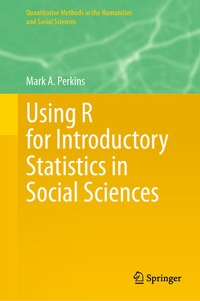
Using R for Introductory Statistics in Social Sciences
Description

This book teaches R programming for fundamental statistical and data analysis skills, specifically tailored to social scientists and others new to quantitative research. Traditionally, this audience has relied on costly software packages such as SPSS, STATA, and SAS. However, R is a free, open-source alternative that, with proper guidance, is accessible and powerful for their needs. Many existing resources, whether books or online, are overly technical or difficult to follow. This book fills that gap by offering a concise, practical guide to mastering essential statistical processes, equipping readers with skills they can use throughout their careers.
Data analysts, institutional researchers, and other professionals will use the book to perform statistical analyses and generate reports for their organizations. The included code-both in the book and online-helps them apply techniques to their own data. Readers will gain the following skills:
- Install and set up R and RStudio; write R scripts and create R Markdown documents.
- Understand variable types, measurement scales, and the basics of descriptive and inferential statistics.
- Conduct chi-square tests, t-tests, ANOVA, regression, and time series analysis in R.
- Assess and interpret statistical outputs; write results in APA format.
- Visualize data using ggplot2 and related libraries; create publication-ready charts and tables
- Evaluate statistical assumptions and apply techniques responsibly to real-world datasets
- Communicate findings clearly and concisely using professional standards
More details
Other editions
Additional editions
Person
Mark A. Perkins is a researcher, teacher, and writer whose academic path began in English education and evolved into a passion for statistics and data science. After earning a Ph.D. in Educational Research Methods from Colorado State University in 2014, he built a career focused on applied analytics, research design, and helping others make sense of complex data. He currently serves as an associate professor of educational research methods at the University of Wyoming. His work has appeared in PLOS ONE , STAR Protocols , and other peer-reviewed journals. Mark lives in Wyoming with his wife, Sarah, and their son, Jason, and is proud of his adult daughter Cora, an engineer. He enjoys technology, problem-solving, and the wide-open landscapes of the Mountain West.
Content
Chapter 1. Introduction to the R Environment.- Chapter 2. Statistical Concepts.- Chapter 3. Running Descriptive Statistics and Frequencies in R.- Chapter 4. Concepts for Research and Inferential Statistics.- Chapter 5. The Chi-Square Family of Tests.- Chapter 6. Group Comparisons with Scale Dependent Variables.- Chapter 7. One-Way Dependent Samples and Time Series Tests.- Chapter 8. Correlation and Regression Modeling.
