

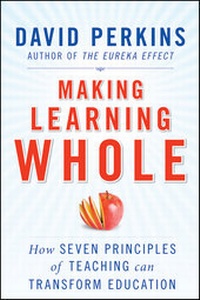
Making Learning Whole,
Description

David Perkins, a noted authority on teaching and learning and co-director of Harvard's Project Zero, introduces a practical and research-based framework for teaching. He describes how teaching any subject at any level can be made more effective if students are introduced to the 'whole game,' rather than isolated pieces of a discipline. Perkins explains how learning academic subjects should be approached like learning baseball or any game, and he demonstrates this with seven principles for making learning whole: from making the game worth playing (emphasizing the importance of motivation to sustained learning), to working on the hard parts (the importance of thoughtful practice), to learning how to learn (developing self-managed learners).
- Vividly explains how to organize learning in ways that allow people to do important things with what they know
- Offers guidelines for transforming education to prepare our youth for success in a rapidly changing world
- Filled with real-world, illustrative examples of the seven principles
At the end of each chapter, Perkins includes 'Wonders of Learning,' a summary of the key ideas.
More details
Other editions
Additional editions
Content
- MAKING LEARNING WHOLE: How SEVEN PRINCIPLES of TEACHING can TRANSFORM EDUCATION
- Contents
- Acknowledgments
- Introduction: A Whole New Ball Game
- Chapter 1: Play the Whole Game
- The Quest for the Whole Game
- Kinds of Whole Games
- The Quest for the Junior Game
- The Quest for the Right Game
- Keeping the Game in Motion
- Gaming for Understanding
- Chapter 2: Make the Game Worth Playing
- Learning What's Worth Learning
- Picking What's Worth Learning
- Making the Most of Beginnings
- Making the Most of Understanding
- Making the Most of Expectations
- Making the Most of Choice
- Challenge, Imagination, and More
- Chapter 3: Work on the Hard Parts
- Slighting the Hard Parts
- Embracing the Hard Parts
- Anticipating the Hard Parts
- Building a Theory of Difficulty
- From Exercises to Études
- Chapter 4: Play Out of Town
- The Meaning of Transfer
- The Trouble with Transfer
- The Hope for Transfer
- Shepherding Transfer
- Transfer as Importing
- Making the Most of Transfer
- Chapter 5: Uncover the Hidden Game
- The Hidden Game of Strategy
- The Hidden Game of Causal Thinking
- The Hidden Game of Inquiry
- The Hidden Game of Power
- How Games Hide
- Chapter 6: Learn from the Team
- A Social View of Learning
- Pair Problem Solving
- Studio Learning
- Communities of Practice
- Cross-Age Tutoring
- Extreme Team Learning
- Chapter 7: Learn the Game of Learning
- The Driver's Seat
- The Passenger's Seat
- The Driver's View
- Driver Education
- Driving to Tomorrow
- AFTERWORD: THE FUTURE OF LEARNING
- Learning Today for Tomorrow
- Teaching Today for Tomorrow
- Tomorrow's Knowledge
- NOTES
- Introduction: A Whole New Ball Game
- 1. Play the Whole Game
- 2. Make the Game Worth Playing
- 3. Work on the Hard Parts
- 4. Play Out of Town
- 5. Uncover the Hidden Game
- 6. Learn from the Team
- 7. Learn the Game of Learning
- Afterword: The Future of Learning
- Index
