

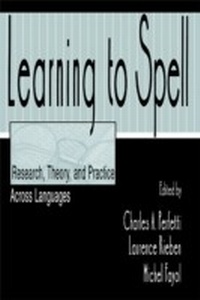
Learning to Spell
Research, Theory, and Practice Across Languages
1st Edition
Published on 1. August 1997
386 pages
978-1-135-69133-2 (ISBN)
Description

This distinctive cross-linguistic examination of spelling examines the cognitive processes that underlie spelling and the process of learning how to spell. The chapters report and summarize recent research in English, German, Hebrew, and French.
Framing the specific research on spelling are chapters that place spelling in braod theoretical perspectives provided by cognitive neuroscience, psycholinguistic, and writing system-linguistic frameworks. Of special interest is the focus on two major interrelated issues: how spelling is acquired and the relationship between reading and spelling. An important dimension of the book is the interweaving of these basic questions about the nature of spelling with practical questions about how children learn to spell in classrooms. A motivating factor in this work was to demonstrate that spelling research has become a central challenging topic in the study of cognitive processes, rather than an isolated skill learned in school. It thus brings together schooling and learning issues with modern cognitive research in a unique way. testing, children writing strings of letters as a teacher pronounces words ever so clearly. In parts of the United States it can also bring an image of specialized wizardry and school room competition, the "spelling bee." And for countless adults who confess with self-deprecation to being "terrible spellers," it is a reminder of a mysterious but minor affliction that the fates have visited on them. Beneath these popular images, spelling is a human literacy ability that reflects language and nonlanguage cognitive processes. This collection of papers presents a sample of contemporary research across different languages that addresses this ability.
To understand spelling as an interesting scientific problem, there are several important perspectives. First, spelling is the use of conventionalized writing systems that encode languages. A second asks how children learn to spell. Finally, from a literacy point of view, another asks the extent to which spelling and reading are related. In collecting some of the interesting research on spelling, the editors have adopted each of these perspectives. Many of the papers themselves reflect more than one perspective, and the reader will find important observations about orthographies, the relationship between spelling and reading, and issues of learning and teaching throughout the collection.
Framing the specific research on spelling are chapters that place spelling in braod theoretical perspectives provided by cognitive neuroscience, psycholinguistic, and writing system-linguistic frameworks. Of special interest is the focus on two major interrelated issues: how spelling is acquired and the relationship between reading and spelling. An important dimension of the book is the interweaving of these basic questions about the nature of spelling with practical questions about how children learn to spell in classrooms. A motivating factor in this work was to demonstrate that spelling research has become a central challenging topic in the study of cognitive processes, rather than an isolated skill learned in school. It thus brings together schooling and learning issues with modern cognitive research in a unique way. testing, children writing strings of letters as a teacher pronounces words ever so clearly. In parts of the United States it can also bring an image of specialized wizardry and school room competition, the "spelling bee." And for countless adults who confess with self-deprecation to being "terrible spellers," it is a reminder of a mysterious but minor affliction that the fates have visited on them. Beneath these popular images, spelling is a human literacy ability that reflects language and nonlanguage cognitive processes. This collection of papers presents a sample of contemporary research across different languages that addresses this ability.
To understand spelling as an interesting scientific problem, there are several important perspectives. First, spelling is the use of conventionalized writing systems that encode languages. A second asks how children learn to spell. Finally, from a literacy point of view, another asks the extent to which spelling and reading are related. In collecting some of the interesting research on spelling, the editors have adopted each of these perspectives. Many of the papers themselves reflect more than one perspective, and the reader will find important observations about orthographies, the relationship between spelling and reading, and issues of learning and teaching throughout the collection.
Reviews / Votes
"Well presented and accessible, this interesting collection of papers is divided into three distinct yet complementary sections which combine theoretical perspectives with practical issues concerning how children learn to spell in classrooms."-International Annotated Bibliography of Books on Literacy
More details
Language
English
Place of publication
London
United Kingdom
Publishing group
Taylor & Francis Ltd
Target group
Professional and scholarly
Product notice
Reflowable
File size
1,83 MB
ISBN-13
978-1-135-69133-2 (9781135691332)
Copyright in bibliographic data and cover images is held by Nielsen Book Services Limited or by the publishers or by their respective licensors: all rights reserved.
Schweitzer Classification
Other editions
Additional editions
Charles A. Perfetti | Laurence Rieben | Michel Fayol
Learning to Spell
Research, Theory, and Practice Across Languages
Book
08/1997
Routledge
€200.56
Shipment within 10-20 days
Charles A. Perfetti | Laurence Rieben | Michel Fayol
Learning to Spell
Research, Theory, and Practice Across Languages
Book
08/1997
Routledge
€89.60
Shipment within 10-20 days
Persons
Perfetti, Charles A.; Rieben, Laurence; Fayol, Michel
Content
Contents: C.A. Perfetti, L. Rieben, M. Fayol, Introduction. Part I:Theoretical Foundations: Writing Systems, Psycholinguistics, and Neuropsychology.J-P. Jaffre, From Writing to Orthography: The Functions and Limits of the Notion of System. C.A. Perfetti, The Psycholinguistics of Spelling and Reading. P. Zesiger, M-P. de Partz, The Cognitive Neuropsychology of Spelling. Part II:The Acquisition of Spelling.R. Treiman, M. Cassar, Spelling Acquisition in English. H. Wimmer, How Learning to Spell in German Differs From Learning to Spell in English. C. Totereau, M-G. Thevenin, M. Fayol, The Development of the Understanding of Number Morphology in Written French. J. Alegria, P. Mousty, Lexical Spelling Processes in Reading Disabled French-Speaking Children. L. Allal, Learning to Spell in the Classroom. T. Nunes, P. Bryant, M. Bindman, Spelling and Grammar--the Necsed Move. Part III:The Relationship Between Spelling and Reading.A.M.T. Bosman, G.C. Van Orden, Why Spelling Is More Difficult Than Reading. I. Berent, R. Frost, The Inhibition of Polygraphic Consonants in Spelling Hebrew: Evidence for Recurrent Assembly of Spelling and Phonology in Visual Word Recognition. J.E. Gombert, P. Bryant, N. Warrick, Children's Use of Analogy in Learning to Read and to Spell. L.C. Ehri, Learning to Read and Learning to Spell Are One and the Same, Almost. N. Ellis, Interactions in the Development of Reading and Spelling: Stages, Strategies and Exchange of Knowledge. L. Rieben, M. Saada-Robert, Relations Between Word Search Strategies and Word Copying Strategies in Children Aged 5-6 Years. P.H.K. Seymour, Foundations of Orthographic Development. L. Sprenger-Charolles, L.S. Siegel, D. Bechennec, Beginning Reading and Spelling Acquisition in French: A Longitudinal Study.
