

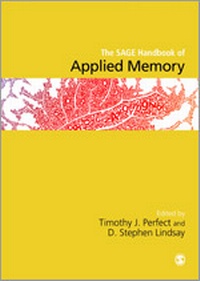
The SAGE Handbook of Applied Memory
1st Edition
Published on 18. December 2013
752 pages
978-1-4462-9698-1 (ISBN)
Description

A fabulous collection of essays on memory in the real world. The leading scholars have been assembled to produce a volume that is intellectually rich, up-to-date, and truly important.
- Elizabeth F. Loftus, Distinguished Professor, University of California, Irvine
"An invaluable resource for anyone wishing to access the current state of knowledge of, or contemplating research into, the growing area of applied memory research."
- Graham Davies, Editor, Applied Cognitive Psychology
The SAGE Handbook of Applied Memory is the first of its kind to focus specifically on this vibrant and progressive field. It offers a broad and comprehensive coverage of recent theoretical and empirical research advances in the psychology of memory as they apply to a range of applied issues, and offers advanced students and researchers the opportunity to survey the literature in the psychology of memory across a range of applied domains.
Arranged into four sections: Everyday Memory; Social and Individual Differences in Memory; Subjective Experience of Memory; and Eyewitness Memory, this handbook provides a comprehensive summary and evaluation of scientific memory research as well as theory in a broad range of applied topics including those in cognitive, forensic and experimental psychology.
Brought together by world-leading scholars from across the globe, The SAGE Handbook of Applied Memory will be of great interest to all advanced students and academics with an interest in all aspects of applied memory.
- Elizabeth F. Loftus, Distinguished Professor, University of California, Irvine
"An invaluable resource for anyone wishing to access the current state of knowledge of, or contemplating research into, the growing area of applied memory research."
- Graham Davies, Editor, Applied Cognitive Psychology
The SAGE Handbook of Applied Memory is the first of its kind to focus specifically on this vibrant and progressive field. It offers a broad and comprehensive coverage of recent theoretical and empirical research advances in the psychology of memory as they apply to a range of applied issues, and offers advanced students and researchers the opportunity to survey the literature in the psychology of memory across a range of applied domains.
Arranged into four sections: Everyday Memory; Social and Individual Differences in Memory; Subjective Experience of Memory; and Eyewitness Memory, this handbook provides a comprehensive summary and evaluation of scientific memory research as well as theory in a broad range of applied topics including those in cognitive, forensic and experimental psychology.
Brought together by world-leading scholars from across the globe, The SAGE Handbook of Applied Memory will be of great interest to all advanced students and academics with an interest in all aspects of applied memory.
Reviews / Votes
This is a fabulous collection of essays on memory in the real world. The leading scholars have been assembled to produce a volume that is intellectually rich, up-to-date, and truly important. -- Elizabeth F. Loftus This Handbook is an invaluable resource for anyone wishing to access the current state of knowledge of, or contemplating research into, the growing area of applied memory research. Its chapters are authored by leading international researchers who have been brought together to share their insights within its pages. -- Graham Davies Spectacular collection! ... This is a handbook that I will buy. -- Professor Don ReadAll prices
More details
Language
English
Place of publication
London
United Kingdom
Target group
Professional and scholarly
ISBN-13
978-1-4462-9698-1 (9781446296981)
Copyright in bibliographic data and cover images is held by Nielsen Book Services Limited or by the publishers or by their respective licensors: all rights reserved.
Schweitzer Classification
Other editions
Additional editions
Timothy J. Perfect | D. Stephen Lindsay
The SAGE Handbook of Applied Memory
Book
12/2013
1st Edition
SAGE Publications Ltd
€201.00
Shipment within 15-20 days
Persons
Tim Perfect is Professor of Experimental Psychology at Plymouth University, UK. He received his PhD from the University of Manchester in 1989, and worked at Liverpool and Bristol Universities before joining Plymouth University in 1999. His research focuses on theory and application in long-term memory. He has been on the editorial boards of Memory, and Applied Cognitive Psychology, and is on the governing boards of the Society for Applied Research in Memory and Cognition, and the Experimental Psychology Society. He has also co-edited 3 other books: Models of Cognitive Aging, Applied Metacognition, and The Handbook of Applied Cognition, 2nd edition. D. Stephen (Steve) Lindsay is Professor of Psychology at the University of Victoria, British Columbia, Canada. He received a BA from Reed College in 1981 and a PhD from Princeton University in 1987. Most of his research explores the cognitive processes by which individuals attribute thoughts, images, and feelings to particular sources (e.g., memory, knowledge, inference). He served as Editor of Journal of Experimental Psychology: General from 2002 to 2007, and recently began a term as an Associate Editor of Psychological Science. Prior to co-editing this volume, he co-edited two other books on human memory. He is also a glutton (ambiguity intended).
Content
PART ONE: Everyday Memory
Memory for people: integration of face, voice, name, and biographical information. - Bennett L. Schwartz
Memory for Pictures and Actions - Neil W. Mulligan
Prospective Memory and Aging: When It Becomes Difficult and What You Can Do About It. - Gilles O. Einstein & Mark A. McDaniel
Memory Source Monitoring Applied - D. Stephen Lindsay
Spatial Memory: From Theory to Application - Douglas H. Wedell & Adam T. Hutcheson
Working memory beyond the laboratory - Jackie Andrade
False Memory - Eryn J. Newman & Maryanne Garry
Forgetting - Colleen M. Kelley
Memory and Emotion - Klaus Fiedler and Mandy Hutter
Effects of Environmental Context on Human Memory - Steven M. Smith
The Testing Effect - Kathleen B. McDermott, Kathleen M. Arnold, & Steven M. Nelson
Breakdowns in everyday memory functioning following moderate-to-severe Traumatic Brain Injury (TBI) - Eli Vakil
PART TWO: Social and individual differences in memory
Sociocultural and functional approaches to autobiographical memory - Robyn Fivush & Theodore E. A. Waters
What Everyone Knows About Aging and Remembering Ain't Necessarily So - Michael Ross & Emily Schryer
The Effects of Self-Reference on Memory: A Conceptual and Methodological Review of Inferences Warranted by the Self-Reference Effect - Stanley B. Klein & Christopher R. Nelson
Putting the Social Back Into Human Memory - William Hirst, Alin Coman & Dora Coman
When I think of you: Memory for persons and groups - Natalie A. Wyer
Memory, attitudes, and persuasion - Geoffrey Haddock
Consumer memory dynamics: Effects of branding and advertising on formation, stability and use of consumer memory - Shanker Krishnan & Lura Forcum
What Do Lay People Believe about Memory? - Sean M. Lane and Tanya Karam-Zanders
Autobiographical Memory Dynamics in Survey Research - Robert F. Belli
Individual differences in remembering - Colin M. MacLeod, Tanya R. Jonker, and Greta James
Experts' Superior Memory: From Accumulation of Chunks to Building Memory Skills that Mediate Improved Performance and Learning - K. Anders Ericsson and Jerad H. Moxley
PART THREE: Subjective experience of memory
Memory Complaints in Adulthood and Old Age - Christopher Hertzog and Ann Pearman
Understanding People's Metacognitive Judgments: An Isomechanism Framework and Its Implications for Applied and Theoretical Research - John Dunlosky and Sarah K. Tauber
Metacognitive Control of Study - Janet Metcalfe
Metacognitive Control of Memory Reporting - Morris Goldsmith, Ainat Pansky and Asher Koriat
Involuntary autobiographical memories in daily life and in clinical disorders - Dorthe Berntsen & Lynn A.Watson
Epistemic Feelings and Memory - Chris J.A. Moulin & Celine Souchay
PART FOUR: Eyewitness memory
Eyewitness Recall: An Overview of Estimator-Based Research - Paer Anders Granhag, Karl Ask & Erik Mac Giolla
Interviewing Witnesses - Ronald P. Fisher, Nadja Schreiber Compo, Jillian Rivard, & Dana Hirn
Estimating the Reliability of Eyewitness Identification - Tim Valentine
System-based Research on Eyewitness Identification - Scott D. Gronlund and Curt A. Carlson
Social Influences on Eyewitness Memory - Amy Bradfield Douglass & Lorena Bustamante
Young children's eyewitness memory. - Gabrielle Principe, Andrea Follmer Greenhoot & Stephen J. Ceci
The Older Eyewitness - James C. Bartlett
Eliciting Verbal and Nonverbal Cues to Deceit by Outsmarting the Liars - Aldert Vrij
Memory for people: integration of face, voice, name, and biographical information. - Bennett L. Schwartz
Memory for Pictures and Actions - Neil W. Mulligan
Prospective Memory and Aging: When It Becomes Difficult and What You Can Do About It. - Gilles O. Einstein & Mark A. McDaniel
Memory Source Monitoring Applied - D. Stephen Lindsay
Spatial Memory: From Theory to Application - Douglas H. Wedell & Adam T. Hutcheson
Working memory beyond the laboratory - Jackie Andrade
False Memory - Eryn J. Newman & Maryanne Garry
Forgetting - Colleen M. Kelley
Memory and Emotion - Klaus Fiedler and Mandy Hutter
Effects of Environmental Context on Human Memory - Steven M. Smith
The Testing Effect - Kathleen B. McDermott, Kathleen M. Arnold, & Steven M. Nelson
Breakdowns in everyday memory functioning following moderate-to-severe Traumatic Brain Injury (TBI) - Eli Vakil
PART TWO: Social and individual differences in memory
Sociocultural and functional approaches to autobiographical memory - Robyn Fivush & Theodore E. A. Waters
What Everyone Knows About Aging and Remembering Ain't Necessarily So - Michael Ross & Emily Schryer
The Effects of Self-Reference on Memory: A Conceptual and Methodological Review of Inferences Warranted by the Self-Reference Effect - Stanley B. Klein & Christopher R. Nelson
Putting the Social Back Into Human Memory - William Hirst, Alin Coman & Dora Coman
When I think of you: Memory for persons and groups - Natalie A. Wyer
Memory, attitudes, and persuasion - Geoffrey Haddock
Consumer memory dynamics: Effects of branding and advertising on formation, stability and use of consumer memory - Shanker Krishnan & Lura Forcum
What Do Lay People Believe about Memory? - Sean M. Lane and Tanya Karam-Zanders
Autobiographical Memory Dynamics in Survey Research - Robert F. Belli
Individual differences in remembering - Colin M. MacLeod, Tanya R. Jonker, and Greta James
Experts' Superior Memory: From Accumulation of Chunks to Building Memory Skills that Mediate Improved Performance and Learning - K. Anders Ericsson and Jerad H. Moxley
PART THREE: Subjective experience of memory
Memory Complaints in Adulthood and Old Age - Christopher Hertzog and Ann Pearman
Understanding People's Metacognitive Judgments: An Isomechanism Framework and Its Implications for Applied and Theoretical Research - John Dunlosky and Sarah K. Tauber
Metacognitive Control of Study - Janet Metcalfe
Metacognitive Control of Memory Reporting - Morris Goldsmith, Ainat Pansky and Asher Koriat
Involuntary autobiographical memories in daily life and in clinical disorders - Dorthe Berntsen & Lynn A.Watson
Epistemic Feelings and Memory - Chris J.A. Moulin & Celine Souchay
PART FOUR: Eyewitness memory
Eyewitness Recall: An Overview of Estimator-Based Research - Paer Anders Granhag, Karl Ask & Erik Mac Giolla
Interviewing Witnesses - Ronald P. Fisher, Nadja Schreiber Compo, Jillian Rivard, & Dana Hirn
Estimating the Reliability of Eyewitness Identification - Tim Valentine
System-based Research on Eyewitness Identification - Scott D. Gronlund and Curt A. Carlson
Social Influences on Eyewitness Memory - Amy Bradfield Douglass & Lorena Bustamante
Young children's eyewitness memory. - Gabrielle Principe, Andrea Follmer Greenhoot & Stephen J. Ceci
The Older Eyewitness - James C. Bartlett
Eliciting Verbal and Nonverbal Cues to Deceit by Outsmarting the Liars - Aldert Vrij
