

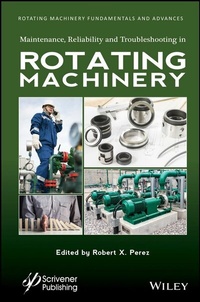
Maintenance, Reliability and Troubleshooting in Rotating Machinery
Description

This broad collection of current rotating machinery topics, written by industry experts, is a must-have for rotating equipment engineers, maintenance personnel, students, and anyone else wanting to stay abreast with current rotating machinery concepts and technology.
Rotating machinery represents a broad category of equipment, which includes pumps, compressors, fans, gas turbines, electric motors, internal combustion engines, and other equipment, that are critical to the efficient operation of process facilities around the world. These machines must be designed to move gases and liquids safely, reliably, and in an environmentally friendly manner. To fully understand rotating machinery, owners must be familiar with their associated technologies, such as machine design, lubrication, fluid dynamics, thermodynamics, rotordynamics, vibration analysis, condition monitoring, maintenance practices, reliability theory, and other topics.
The goal of the "Advances in Rotating Machinery" book series is to provide industry practitioners a time-savings means of learning about the most up-to-date rotating machinery ideas and best practices. This three-book series will cover industry-relevant topics, such as design assessments, modeling, reliability improvements, maintenance methods and best practices, reliability audits, data collection, data analysis, condition monitoring, and more.
Volume one began the series by focusing on design and analysis. Volume two continues the series by covering important machinery reliability concepts and offering practical reliability improvement ideas. Best-in-class production facilities require exceptional machinery reliability performance. In this volume, exceptional machinery reliability is defined as the ability of critical rotating machines to consistently perform as designed, without degradation or failure, until their next scheduled overhaul. Readers will find this volume chock-full of practical ideas they can use to improve the reliability and efficiency of their machinery.
Maintenance, Reliability and Troubleshooting in Rotating Machinery covers, among many other topics:
* General machinery reliablity advice
* Understanding failure data
* Design audits and improvement ideas
* Maintenace best practices
* Analyzing failures
More details
Other editions
Additional editions
Person
Robert X. Perez is a mechanical engineer with more than 40 years of rotating equipment experience in the petrochemical industry. He has worked in petroleum refineries, chemical facilities, and gas processing plants. He earned a BSME degree from Texas A&M University at College Station, an MSME degree from the University of Texas at Austin and holds a Texas PE license. Mr. Perez has written numerous technical articles for magazines and conferences proceedings and has authored five books and coauthored four books covering machinery reliability, including several books also available from Wiley-Scrivener.
Content
Preface xvii
Acknowledgements xix
Part I: General Reliability Advice 1
1 Machinery Reliability Management in a Nutshell 3 By Robert X. Perez
Criticality 4
Environmental Consequences 6
Safety Consequences 6
Equipment History 7
Safeguards 12
Compressor Operating Limits 12
Compressor Flow Limits 12
Critical Speeds 14
Horsepower Limits 15
Temperatures 16
Layers of Machinery Protection 19
Machinery Reliability Assessment Example 20
Background 20
History 22
Safeguards 22
Conclusion 22
Closing Remarks 23
2 Useful Analysis Tools for Tracking Machinery Reliability 25 By Robert X. Perez
Commonly Used Metrics for Spared Machinery 28
Mean Time to Repair (MTTR) 28
Mean Time Between Failure (MTBF) 28
Additional Reliability Assessment Tools for Spared Machines 29
Pareto Charts & 80-20 Rule 33
Cumulative Failure Trends 33
Metrics for Critical Machines 36
Availability 37
Critical Machine Events 38
Process Outage Trends 38
Process Outage Related to Machinery Outages 40
Planned Maintenance Percentage (PMP) 41
Reliability Analysis Capabilities of your CMMS Software 43
3 Improving the Effectiveness of Plant Operators 45 By Julien LeBleu
Look, Listen and Feel 47
Applying Look, Listen, and Feel Techniques to Troubleshooting 47
Why the Operator's Input is Important to the Troubleshooting Process 47
Operator Tools 48
Understanding the Equipment - Pumps, Seals and Sealing Support Systems 50
Centrifugal Pump Relationships to Remember 51
Positive Displacement Pump Relationships to Remember 52
Mechanical Seals 54
Capital Projects 55
Writing Quality Work Request 55
Procedures (Procedures and Decision Trees) 56
Must Give Operators Feedback 56
Must be Required to Use their Training 58
Discipline 58
Conclusion 59
Appendix A References 59
4 Spare Parts Strategies for Optimizing Rotating Machinery Availability 61 By Robert X. Perez
Some Stocking Examples 67
Capital Spares 70
Insurance Spares 71
Analyzing Spare Part Inventories Using Monte Carlo Simulations 72
Closing 72
Some Definitions Related to Spare Parts 73
5 Switch-Over Methodology and Frequency Optimization for Plant Machinery 75 By Abdulrahman Alkhowaiter
Machinery Switchover Frequency Optimization Benefits 76
Time-Dependent Issues Involved in Setting Switchover Frequency for Standby Machines 76
Frequent Switchover Introduces the Following Negative Impact to Rotating Equipment 79
Calculation of Start-Stop Damaging Cycles for A, B
Configured Equipment: See Definitions Below for More Information 81
Definitions 82
Examples of Short Start-Stop Intervals in Process Machinery 83
Philosophy of Reliability-Centered Switchover Strategy 84
Part II: Design Audits and Improvement Ideas 87
6 Evaluating Centrifugal Pumps in Petrochemical Applications 89 By Robert X. Perez
Crude Oil Processing 92
Desalting 94
Crude Oil Distillation 94
Properties of Distillation and Fractionator Fractions 98
Defining NPSHr, NPSH3, and NPSH Margin 101
Natural Gas Processing: NGL Processing 101
Centrifugal Pump Design Audits 104
Design Standards 105
The Materials of Construction 107
The Hydraulic Fit 108
The NPSH Margin 110
Seal and Seal Flush Design 111
Challenging Pump Applications 113
Pumps Operating in Parallel 114
Pump Liquids with Low Densities 117
Low NPSH Services 120
How an Impeller's Suction Specific Speed Affects the Required NPSH 122
Pumps Handling a Liquid with Varying Densities 124
Slurry Pumps 125
FCC Slurry Pumps 127
Bottoms Pumps 127
Hot Pumps with Galling Tendencies 130
Starting Hot Pumps 131
High Temperature Concerns 132
Gaskets 132
O-Rings 135
How Processing Issues Can Affect Pump Reliability 136
Summary 138
Acknowledgement 139
References 139
7 Practical Ways to Improve Mechanical Seal Reliability 141 By Robert X. Perez
Seal Reliability Tracking 142
MTBR Data from Across the Industry 143
Reliability Tracking Tools 144
Bad Actors 145
Mechanical Seal Best Practices 150
Improved Mechanical Seal Support System Designs 153
Reducing Potential Leak Points 154
Simplifying Operation and Maintenance 155
Building Better Seal Support Systems 157
Common Mechanical Sealing Design Challenges 157
Sealing Light Hydrocarbon Liquids 157
Sealing Hazardous Organic NESHAP Liquids 159
Buffer Gas Absorption 160
Excessive Solids 160
Seal Cooler Issues in Hot Applications 162
Piping Plan 21 162
Advantages 163
Disadvantages 163
Piping Plan 23 164
Advantages 165
Disadvantages 165
Common Considerations for Flush Plans 165
General Seal Piping Plan Recommendations 166
Ways to Improve Seal Reliability Performance 167
Seal Failure Analysis 167
Common Seal Failure Modes 168
Seal Failure Inspection Notes 174
Possible Causes 175
Meeting with Manufacturer 175
Writing the Seal Failure Report with Recommendations 175
Post-Analysis Activities 175
Justifying Seal Upgrades 175
Closing Thoughts 179
References 180
8 Proven Ways to Improve Steam Turbine Reliability 181 By Robert X. Perez and David W. Lawhon
Repairs versus Overhauls 181
Expected Lifetimes of Steam Turbines and Their
Components 181
Common Failure Modes 184
Steam Turbine Leaks 184
Bearing and Lubrication Failures 184
Governor Failures and Sticking T&T Valves 184
Improvement Reliability by Design 185
Acknowledgements 187
9 General Purpose Steam Turbine Reliability Improvement Case Studies 189 By Abdulrahman Alkhowaiter
Governor Valve Packing Gland Leakage: Sealing & Reliability Improvements 190
Steam Turbines Carbon Seals Upgrade to Mechanical Seals 192
Typical Benefits of Dry Gas Seal in a 1500 HP Turbine 193
Modification of GP Turbines for Fast Start without Slow Rolling 195
How the GP Turbine Fast Startup Modification Works 195
Dry Flexible Metal Coupling Upgrade with Split Spacer, for Short Coupled Turbines with Insufficient ength Coupling Spacers 196
General Purpose Lube Oil System Upgrade for Self-Contained Bearing Housings to Eliminate Overheating & Bearing Failures 198
Governor and Trip System Upgrade from Hydraulic to Electronic-Pneumatic 198
Governor Requirements 198
Electronic Governor with Pneumatic Actuator & Pneumatic Trip System 199
Governor and Trip Requirements 200
Overview of All-Electronic Trip and Overspeed Protection System 201
Outboard Bearing Improved Flex Foot: Higher Turbine Reliability & Lower Vibration 201
Results 203
Part III: Maintenance Best Practices 205
10 Rotating Machinery Repair Best Practices 207 By Robert X. Perez
World-Class Reliability Performance Should be the Goal of Every Repair Facility 207
Cutting Corners = Unreliability 208
The Importance of Alignment 209
Alignment Tolerances 210
Alternative Alignment Guidelines 210
Alignment Calculation Example 211
Rotor Balance 211
Imperial Units 212
Metric Units 213
Static Unbalance 213
Dynamic Unbalance 213
Balancing 213
Common Causes of Rotor Unbalance 214
Balancing Grades 215
The Importance of Fit, Clearance & Tolerance 217
Fits, Clearances and Tolerances 217
Tolerance 217
Clearance 218
Coupling Hub Fits 219
Keyed Interference Fits 219
Keyless Interference Fits 219
Effects of Excessive Looseness 220
Rotating Element Looseness 221
Effects of Internal Looseness 222
Structural Looseness 223
As Found and As Left Measurements 223
Closing Thoughts 225
References 225
11 Procedures + Precision = Reliability 227 By Drew Troyer
12 The Top 10 Behaviors of Precision-Maintenance Technicians 231 By Drew Troyer
13 Optimizing Machinery Life Cycle Costs through Precision and Proactive Maintenance 235 By Drew Troyer
Precision Maintenance 101 235
Life-Extension Equations 237
Worked Example 238
Life Cycle Costs 239
Considering Energy Consumption 239
Life Cycle Inventory Analysis 242
Justifying Precision Maintenance 242
Estimating the Benefits 242
Now for the Cost-Benefit Analysis 245
14 Optimum Reference States for Precision Maintenance 253 By Drew Troyer
Fasteners 254
Lubrication 255
Alignment 257
Balance 258
Flab Management 260
Conclusion 261
15 Writing Effective Machinery Work Order Requests 263 By Drew Troyer
Part IV: Analyzing Failures 269
16 Improving Machinery Reliability by Using Root Cause Failure Analysis Methods 271 By Robert X. Perez
Introduction 271
What Is a Root Cause Failure Analysis? 272
Root Cause Failure Analysis Example #1: Ill-Advised Bearing Replacement 273
History 273
Corrective Measures 273
Comments 273
Root Cause Failure Analysis Example #2: Reciprocating Compressor Rod Failure 274
Background 274
Physical Root Cause 274
Latent Root Causes 274
Comments 275
RCFA Steps 275
Step 1: Define the Problem 275
Step 2: Gather Data/Evidence 276
Identifying the Physical Root Cause of the Primary Failure 276
Fatigue Example: Fin-Fan Cooler Shaft Failures 279
Preserving Machine Data 282
Step 3: Ask Why and Identify the Causal Relationships Associated with the Defined Problem 283
Causal Chains 283
Bearing Failure Sequence of Events with Descriptions 284
Five Why RCFA Example 286
Cause Mapping 287
Cause Map Example #2 289
Single Root Cause versus Multiple Causes 290
Cause Mapping Steps 290
Inhibitors to Effective Problem Solving 297
When Is a Root Cause Failure Analysis Justified? 297
RCFA Levels 300
Closing Thoughts 301
Appendix A 301
No Magic Allowed 301
Identifying Sequence of Events and Causal Chains 301
5-Why Method of Investigation 304
Advice on Failure Sequences 306
Appendix B 307
Analyzing Component Failure Mechanisms 307
Common Mechanical Failure Modes 309
Foreign Object Damage (FOD) 309
Stress Corrosion Cracking 309
Erosion 310
Cavitation 310
Hydrogen Embrittlement 310
Galling 311
Fretting 311
Hot Corrosion (Gas Turbines) 312
Common Hydrodynamic Bearing Failure Modes 313
Rolling Element Bearing Failure Characteristics 318
Tips for Analyzing Mechanical Seal Failures 320
Common Seal Failure Modes 321
Appendix C 323
Common Machinery Failure Modes 323
Pluggage 325
Erosive Wear 326
Fatigue 326
Compressor Blade Fatigue Example 327
Hydrodynamic Bearing Failure Examples 328
Rubbing 329
Unique Failure Modes 330
References 331
17 Investigation and Resolution of Repetitive Fractionator Bottom Pump Failures 333 By Abdulrahman Alkhowaiter
Introduction 333
List of Additional Failure Inherent Causes to Be Rectified 334
Key Shop and Field Pump Measurements 336
Conclusion 340
Actual Findings 340
Effect of Improvements on Pump Radial Shaft Vibration 342
Reference 342
18 Reliability Improvements Made to 6000 KW Water Injection Pumps Experiencing Wear Ring Failures 343 By Abdulrahman Alkhowaiter
Summary 343
Sequence of Events 344
New Design Proposal of Eliminating Grub Screws or Flash Butt Welding 346
Example: Wear ring ID = 8.0 inches. Apply Taper Fit Principle 346
Upgrade Options 347
Detailed Analysis of Problem & Solution Related to All Pump Wear Rings 348
Discussion on Reliability Improvements Added to Achieve High Reliability 349
The Five Root Causes of Machinery Failure 350
Design Errors 350
Manufacturing Errors: None Found 351
User Specification Errors 351
User Maintenance Errors: None Found 351
About the Editor 353
About the Contributors 355
Index 357
1
Machinery Reliability Management in a Nutshell
By Robert X. Perez
How to Think Like a Machinery Reliability Professional
Figure 1.1 Managing the risk associated with a site's process machinery is a key role of a machinery reliability engineer.
An important role of a machinery reliability professional is to evaluate reliability performance of site machinery and provide clear feedback and recommendations to the owners to ensure process reliability goals are met (Figure 1.1). My aim here is to give the reader a sense of how machinery reliability professionals approach the assessment of site assets. By briefly covering the key machinery factors used in my evaluations, I hope to shine a light on the evaluation process. My process requires that each machine's criticality, history, and current site safeguards be carefully reviewed and evaluated. Only when this process has been completed can a machinery reliability engineer provide useful feedback that will hopefully have a positive impact on the site's overall reliability.
Criticality
The first step in a machinery assessment is to determine how the machine fits into the process, i.e., 1) What is the machine's function? 2) Is it unspared or spared? 3) If multiple machines are installed, then you must ask: Is there any standby capacity? A typical equipment description may look like this: A 2500 hp, multistage centrifugal hydrogen recycle compressor is unspared. If the compressor goes down unexpectedly, then there will be an immediate upset of the process, leading quickly to a unit shutdown. During this step, it is vital that you understand key machinery details, such as:
- Are you dealing with a dynamic, i.e., centrifugal, machine or a positive displacement machine?
- What are the types of bearings being used? Are the bearings fluid film bearings or rolling element bearings? How is lubrication delivered? Do the bearings require an external lubrication system?
- What are the types of seals being used?
- Is the train variable speed?
- How is the flow controlled?
- What are the current machinery alarms and trips and is condition monitoring equipment installed?
A thorough understanding of the machinery's construction and performance is required to conduct an in-depth reliability assessment.
Next, we need to ask, if the machine goes down or fails catastrophically, what are the consequences? A consequence is an undesirable effect related to a machine's failure or unavailability. Consequences fall into four basic categories: economic consequences related to process losses, environmental consequences, safety consequences, and economic consequences of machinery damage.
Table 1.1 lists typical economic consequences related to machinery operating in high-value processes. For example, a brief outage of one of several installed machines represents a low consequence event. However, if the same unit is down for several weeks, a significant economic loss could be experienced if production had to be curtailed for an extended time. The highest economic consequence is related to an extended outage of a single, spared machine. There is therefore a wide range of economic consequences related to process machinery. The goal of a machinery reliability engineer is to dole out plant resources so that extremely high and high consequence events are rarely seen.
Table 1.1 Economic consequence ratings of process losses related to machinery in high-value processes.
Equipment arrangement Brief outage of one machine (<24 hours) Multiday outage of one machine (<1 week) Extended outage of one machine (>>1 week) Single, unspared machine Medium Consequence High Consequence Extremely High Consequence Multiple partial capacity machines (no standby capacity) Low Consequence Medium Consequence High Consequence Multiple machines with one or more standby spares Extremely Low Consequence Low Consequence Medium ConsequenceA common question is: What is the difference between consequence and risk? Machinery professionals generally define risk as probability x consequence or rate of occurrence (l) x consequence, i.e., Risk = P x C or ? x C. For example, if the consequence of an event is $1,000,000 and the event occurs once every 5 years, then the economic risk is $1,000,000 x 0.2 = $200,000 per year. When quantifying machinery risk, we normally use "rate of Occurrence (?)" because machine failures can easily be tallied and converted into a failure rate. When it comes to rare failure events, we might have to review industry wide data or talk to equipment manufacturers to obtain realistic values. Using "rate of occurrence" risk equations for risk, we can see that to reduce a machine's risk level we must either, 1) reduce the frequency of occurrence for high consequence events, or 2) reduce the impact of high consequence events through the use of safeguards.
In addition to economic consequences, there are also environmental and safety consequences. Here are definitions for high- and medium-level events in these two categories:
Environmental Consequences
High - A major product release caused by machinery failure that impacts the community.
Medium - A significant product released caused by a machinery failure.
Safety Consequences
High - A major release of a toxic or flammable material caused by a machinery failure that impacts the community.
Medium - A significant release of a toxic or flammable material caused by a machinery failure could harm plant personnel.
Finally, we must consider economic consequences of machinery damage. In general, we know that larger process machines are more expensive to repair if they fail catastrophically than smaller process machines. For this reason, it is common to rank the economic consequences related to catastrophic failure in terms of a machine's rated horsepower. Perhaps, a machine rated below 200 hp can be considered to represent a low economic consequence if it fails catastrophically, a machine rated between 200 hp and 2000 hp can be considered to represent a medium economic consequence if it fails catastrophically, and a machine rated above 2000 hp can be considered to represent a high economic consequence if it fails catastrophically.
Consequences are additive, which means we can tally up all the various consequence to arrive at a cumulative consequence level. Let's continue with the example compressor at the start of this section and list all the consequences:
A 2500 hp, multistage centrifugal hydrogen recycle compressor is unspared. If the compressor goes down, then there is an immediate upset of the process leading quickly to a unit shut down. There are three categories of consequences related to a failure:
Economic consequences related to process losses:
Multiday Outage (<1 week) = High Consequence
Extended Outage (>>1 week) = Extremely High Consequence
Safety consequences:
A significant release of a toxic or flammable material caused by a machinery failure could harm plant personnel = Medium Economic consequences of machinery damage
Table 1.2 Summary of potential failure consequences of interest.
Type of consequence Low consequence Medium consequence High consequence Extremely high consequence Process Loss X X Environmental X Safety Machine Damage XSince the compressor is rated at over 2000 hp, the economic consequences of a catastrophic failure are high.
We can now summarize our risk assessment, as seen in Table 1.2, and conclude the highest consequences are associated with process losses. Our summary only contains significant consequences of interest.
Machines associated with potential high consequence events are considered critical machines, while those associated with low consequence events are considered non-critical machines. In our example, the extreme consequences are related to extended outages and catastrophic machine damage. It makes sense to label this machine a high criticality machine in your listing of plant assets. When you are done with your site assessment, you should have a listing of all your machines along with their criticality ratings. If you force-rank the list, the machines at the top of the list should be your highest priority in terms of potential impact on the plant.
Equipment History
The second step of a rotating machinery reliability assessment is to review the machine's operating history. A historical review means to 1) review the history of site failures, and 2) discuss operating issues with plant personnel. The goal of this step is to determine the predominant failures modes associated with the machine in order to better understand which failure...
