

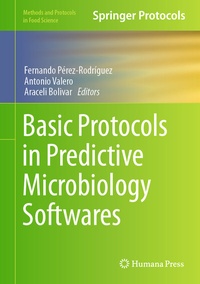
Basic Protocols in Predictive Microbiology Softwares
Description

This volume provides an overview of the existing predictive microbiology software tools, describing the main characteristics of use and application. Chapters will guide readers through tool features and functionalities, and specific case studies. Written in the format of the Methods and Protocols in Food Science series, the chapters include an introduction to the respective topic, list necessary materials and reagents, detail well established and validated methods for readily reproducible laboratory protocols and contain notes on how to avoid or solve typical problems.
Authoritative and cutting-edge, Basic Protocols in Predictive Microbiology Softwares aims to ensure successful results in the further study of this vital field.
More details
Other editions
Additional editions
Persons
Content
The role of predictive microbiology software tools in enhancing food safety and quality.- Development and validation of microbial inactivation models using bioinactivation4.- The USDA integrated Pathogen Modeling Program (iPMP) and Pathogen Modeling Program.- Experimental design for predictive models in microbiology depending on environmental variables.- Simulating Bacterial Growth and Thermal Inactivation with the Sym'Previus tool.- Praedicere Possumus applied to foodborne pathogens.- Conducting a microbiological risk assessment using MicroHibro toolbox.- FDA-iRISK Protocol.- Food Safety Knowledge Lab (FSK-Lab) - a software supporting efficient and harmonized exchange of data and models in food safety.- Using FSK-Lab to join models in quantitative microbiological risk assessment.- A guided process for validating product shelf-life with predictive software tools: A case study of cured-raw meat by using MicroHibro.- Predictive modelling and calibration for process control in the meat industry: a Staphylococcus aureus case study.- Identification of microbial hazards in foods and establishment of critical limits.
