

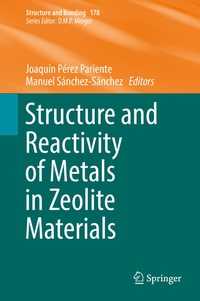
Structure and Reactivity of Metals in Zeolite Materials
Description

This volume provides the reader with the most up-to-date and relevant knowledge on the reactivity of metals located in zeolite materials, either in framework or extra-framework positions, and the way it is connected with the nature of the chemical environment provided by the host. Since the first report of the isomorphous substitution of titanium in the framework of zeolites giving rise to materials with unusual catalytic properties, the incorporation of many other metals have been investigated with the aim for developing catalysts with improved performance in different reactions. The continuous expansion of the field, both in the variety of metals and zeolite structures, has been accompanied by an increasing focus on the relationship between the reactivity of metal centers and their unique chemical environment.
The concepts covered in this volume are of interest to people working in the field of inorganic and physical chemistry, catalysis and chemical engineering, but alsofor those more interested in theoretical approaches to chemical reactivity. In particular the volume is useful to postgraduate students conducting research in the design, synthesis and catalytic performance of metal-containing zeolites in both academic and application contexts.
More details
Other editions
Additional editions
Persons
Joaquin Pérez Pariente.
Ph. D. Degree in Chemistry in 1984. Since 1986, researcher at the Institute of Catalysis and Petroleum Chemistry of CSIC, Spain.
Research Interests: Synthesis, characterization and catalytic performance of microporous molecular sieves (zeolites and aluminophosphates) and ordered mesoporous materials. Design of rational strategies for the control of the acidity of zeolites. Study of the interactions between zeolites and occluded structure directing agents for enhancing the catalytic properties of these materials. Metal-substituted (Ti in particular) molecular sieves for selective oxidations. Design of zeolite materials for improving catalytic performance in hydrocarbon transformations. Development of natural zeolite-based materials for fluoride removal from drinking waters. Since 2002, activity in the study and teaching of the history of chemistry.
Scientific output: about 230 SCI papers; 6 books, four of them co-authored; 28 patents, 3 under commercial use; 12 PhD thesis.
Awards: Member of the Spanish Royal Academy of Pharmacy since 2006. Doctor Honoris Causa by Universidad Autónoma Metropolitana de México in 2014.
Director of the Instituto de Catálisis y Petroleoquímica (CSIC) in the period 22/12/2005- 28/01/2014.Manuel Sánchez-Sánchez
Career summary: Ph. D. Degree in Chemistry in 2000 at the ITQ (UPV-CSIC) in Valencia, Spain. Post-doctoral stays at the University of Cambridge (2001-2002) and The Royal Institution of Great Britain (2002-2004) in London, UK, financed by Marie-Curie Individual Fellowship. 'Ramon y Cajal' Tenure track researcher and lecturer (2004-2008) at the Rey Juan Carlos University, Madrid, Spain, financied Ramon y Cajal contract. Since 2008, staff researcher at the Institute of Catalysis and Petroleum Chemistry of CSIC, Madrid, Spain.
Research interests: Synthesis, characterization and catalytic performance of metal-doped inorganic microporousmaterials (zeolites and aluminophosphates). Design and sustainable synthesis of Metal-Organic Frameworks (MOFs). Different applications of MOFs including heterogenoeus catalysis, photocatalysis, enzyme immbolization and drug delivery. Ti-zeolites as heterogeneous catalysts in selective oxidations. Advanced characterization of porous materials by means of solid-state NMR, synchrotron-based techniques and high-resolution microscopies (AFM and TEM).Scientific output: 50 SCI papers; 1 book; 3 patents; 2 supervised PhD thesis. Participant in 15 national or international public financing projects and 6 more projects financed by private companies.
