

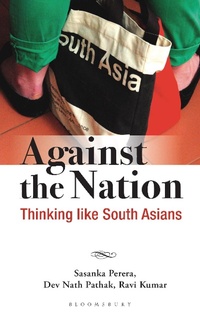
Against the Nation
Thinking Like South Asians
1st Edition
Published on 18. July 2019
280 pages
978-93-88630-24-5 (ISBN)
Description

Against the Nation invites readers to explore South Asia as a place and as an idea with a sense of reflection and nuance rather than submitting to conventional understanding of the region merely in geopolitical terms. The authors take the readers across a vast terrain of prospects like visual culture, music, film, knowledge systems and classrooms, myth and history as well as forms of politics that offer possibilities for reading South Asia as a collective enterprise that has historical precedents as well as untapped ideological potential for the future.
More details
Edition
1. Auflage
Language
English
Place of publication
New Delhi
India
ISBN-13
978-93-88630-24-5 (9789388630245)
Copyright in bibliographic data and cover images is held by Nielsen Book Services Limited or by the publishers or by their respective licensors: all rights reserved.
Schweitzer Classification
Other editions
Additional editions
Book
07/2019
Bloomsbury Academic India
€116.50
Available (delivery time upon request)
Persons
Sasanka Perera teaches Sociology at South Asian University and is the founding professor of the university's Department of Sociology. He has researched on the thematic issues of contemporary visual art in Sri Lanka, violence and memory, religion and politics. He is the Editor of Society and Culture in South Asia. Some of his recent publications include Warzone Tourism in Sri Lanka: Tales from Darker Places in Paradise(2016), Violence and the Burden of Memory (2015), Culture and Politics in South Asia: Performative Communication (co-edited, 2018) and Sociology and Social Anthropology in South Asia: Histories and Practices (co-edited, 2018).
Dev Nath Pathak teaches Sociology at South Asian University and is a founding faculty member of the university's Department of Sociology. His current research interests include popular culture (music, cinema and performance) and South Asian studies. He is Reviews Editor of Society and Culture in South Asia (the journal of Department of Sociology, South Asian University, co-published with SAGE India). Some of his recent publications include Living & Dying: Meanings in Maithili Folklore (2018), Another South Asia! (2018), Culture and Politics in South Asia: Performative Communication (co-edited, 2017) and Sociology and Social Anthropology in South Asia: Histories and Practices (co-edited, 2018).
Ravi Kumar teaches Sociology at South Asian University and is a founding faculty member of the university's Department of Sociology. He is also Associate Editor of Society and Culture in South Asia and serves on the editorial board of The Journal of Critical Education Policy Studies and Critical Education. Some of his recent publications include Contemporary Readings in Marxism: A Critical Introduction (2016), Neoliberalism, Critical Pedagogy and Education (2016), Social Movements: Transformative Shifts and Turning Points (2014), Education and the Reproduction of Capital: Neoliberal Knowledge and Counterstrategies (2012) and Sociology and Social Anthropology in South Asia: Histories and Practices (co-edited, 2018).
Dev Nath Pathak teaches Sociology at South Asian University and is a founding faculty member of the university's Department of Sociology. His current research interests include popular culture (music, cinema and performance) and South Asian studies. He is Reviews Editor of Society and Culture in South Asia (the journal of Department of Sociology, South Asian University, co-published with SAGE India). Some of his recent publications include Living & Dying: Meanings in Maithili Folklore (2018), Another South Asia! (2018), Culture and Politics in South Asia: Performative Communication (co-edited, 2017) and Sociology and Social Anthropology in South Asia: Histories and Practices (co-edited, 2018).
Ravi Kumar teaches Sociology at South Asian University and is a founding faculty member of the university's Department of Sociology. He is also Associate Editor of Society and Culture in South Asia and serves on the editorial board of The Journal of Critical Education Policy Studies and Critical Education. Some of his recent publications include Contemporary Readings in Marxism: A Critical Introduction (2016), Neoliberalism, Critical Pedagogy and Education (2016), Social Movements: Transformative Shifts and Turning Points (2014), Education and the Reproduction of Capital: Neoliberal Knowledge and Counterstrategies (2012) and Sociology and Social Anthropology in South Asia: Histories and Practices (co-edited, 2018).
Content
Preface and Acknowledgements
Beginnings: Against the Nation and Thinking Like South Asians
I. 'Official' Imaginings of South Asia and Its Contradictions
1. SAARC Setbacks and Thinking beyond the Boundaries of Its Nation States
2. Seeing Like South Asians: Moving beyond Narrow National Frames
3. The Idea of South Asia: Beyond the Intellectual Dependence on the Statist Perspective
4. Anxieties of SAARC: An Experiential Reading through South Asian University
5. South Asia: Between Dream and Actuality
II. 'Unofficial' Reimagining of South Asia
6. Beyond History, against the Present: Preliminary Thoughts on Reimagining 'South Asia'
7. An Emotive-Intellectual Inclination to another South Asia!
8. Localising South Asia, Theoretically
9. 'South Asia' as an Idea and a Problem of Modernity
III. Towards a South Asian Knowledge System
10. In Defence of 'Area Studies' in South Asia
11. Reclaiming Social Sciences and Humanities: Notes from South Asia
12. Anthropological South Asia: Thinking through Utopias Amidst Intellectual Hegemonies
13. Universities, Classrooms and Intellectuals: The Struggle to Create a South Asian Knowledge System
14. Buddhist Categories, Contemporary World and Sociology: Incomplete Thoughts towards Possibilities of Social Theory and Modes of Thinking in South Asia
15. Bringing the Thinking of Jiddu Krishnamurti into Politics
16. Thinking of Myth and Folklore in the Twenty-first Century
IV. South Asia in Popular Politics
17. Online South Asia and Its Mediated Politics
18. A Melodramatic South Asia: Perusing a Performative-scape
19. In the Frame of the Popular Cinema Despite the Hegemony of Hindi
20. The Sound of Silence: Of the Shrinking Public Sphere in South Asia
21. Reformulating South Asia: Artists' Travels and Possibilities of a New Cartography
22. The Cultural Politics of Hatred in South Asia
Index
About the Authors
Beginnings: Against the Nation and Thinking Like South Asians
I. 'Official' Imaginings of South Asia and Its Contradictions
1. SAARC Setbacks and Thinking beyond the Boundaries of Its Nation States
2. Seeing Like South Asians: Moving beyond Narrow National Frames
3. The Idea of South Asia: Beyond the Intellectual Dependence on the Statist Perspective
4. Anxieties of SAARC: An Experiential Reading through South Asian University
5. South Asia: Between Dream and Actuality
II. 'Unofficial' Reimagining of South Asia
6. Beyond History, against the Present: Preliminary Thoughts on Reimagining 'South Asia'
7. An Emotive-Intellectual Inclination to another South Asia!
8. Localising South Asia, Theoretically
9. 'South Asia' as an Idea and a Problem of Modernity
III. Towards a South Asian Knowledge System
10. In Defence of 'Area Studies' in South Asia
11. Reclaiming Social Sciences and Humanities: Notes from South Asia
12. Anthropological South Asia: Thinking through Utopias Amidst Intellectual Hegemonies
13. Universities, Classrooms and Intellectuals: The Struggle to Create a South Asian Knowledge System
14. Buddhist Categories, Contemporary World and Sociology: Incomplete Thoughts towards Possibilities of Social Theory and Modes of Thinking in South Asia
15. Bringing the Thinking of Jiddu Krishnamurti into Politics
16. Thinking of Myth and Folklore in the Twenty-first Century
IV. South Asia in Popular Politics
17. Online South Asia and Its Mediated Politics
18. A Melodramatic South Asia: Perusing a Performative-scape
19. In the Frame of the Popular Cinema Despite the Hegemony of Hindi
20. The Sound of Silence: Of the Shrinking Public Sphere in South Asia
21. Reformulating South Asia: Artists' Travels and Possibilities of a New Cartography
22. The Cultural Politics of Hatred in South Asia
Index
About the Authors
