

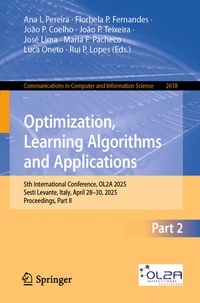
Optimization, Learning Algorithms and Applications
Description

The two-volume set CCIS 2617 and 2618 constitutes the refereed post-conference proceedings of the 5th International Conference on Optimization, Learning Algorithms and Applications, OL2A 2025, held in Sesti Levante, Italy, during April 28-30, 2025.
The 38 revised full papers presented in these proceedings were carefully reviewed and selected from 92 submissions. The papers are organized in the following topical sections:
Part I: Optimization; Optimization in Control Systems Design; Artificial Intelligence in Healthcare and Medicine; and Deep Learning.
Part II: Optimization in the SDG context; Machine Learning; and Machine Learning and Artificial Intelligence in Robotics.
More details
Other editions
Additional editions
Content
.-
Optimization in the SDG context
.
.- Application of Continuous and Periodic Review Models to Optimize Inventory Management in Dynamic Demand Scenarios.
.- Social Context in Fake News Diffusion.
.- Integrating Renewable Energy into Sustainability Metrics: a multicriteria decision.
.- A Secure Architecture for Supply-chain Orders Exchange between Textile and Clothing Companies.
.-
Machine Learning
.
.- Partial Knowledge Predictive Models for Hydrocarbon Storage.
.- Districting Methods for Water Distribution Network.
.- Enhancing Soil Organic Carbon Prediction: A Machine Learning Approach with Outlier Removal.
.- A Personalized Math Learning Experience with Clustering and Random Forest Algorithms.
.- Macroeconomics' Forecasting using Machine Learning Approaches by Policy Makers: A Case Study Analysis.
.- TI-FPCA: Effective and Interpretable Dimensionality Reduction with Transform-Invariant Functional Principal Component Analysis.
.- Prediction of Average Power Produced by Wind Turbines Using MLP Neural Networks.
.- OML-AD: Online Machine Learning for Anomaly Detection in Time Series Data.
.-
Machine Learning and Artificial Intelligence in Robotics
.
.- AI-Powered Tutoring for Personalized Learning.
.- Markerless Geometric Inspection Planning based on Greedy Algorithm with Registration Stability Constraint.
.- Comparing RL Policies for Robotic Pusher.
.- Reward-function design for Discrete and Continuous Mapless Navigation.
.- Object Classification using 2D-LiDAR and YOLO for Robot Navigation.
