

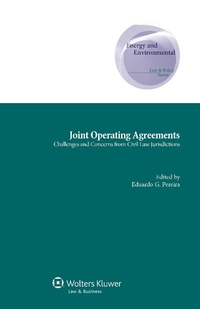
Joint Operating Agreements
Challenges and Concerns from Civil Law Jurisdictions
Published on 23. July 2015
362 pages
978-90-411-5935-9 (ISBN)
Description

Historically oil and gas upstream activities were developed in common law jurisdictions. In the same manner the first model form of Joint Operating Agreements (JOAs) was developed in 1956 by the American Association of Professional Landmen. This historical model form provided the industry with guidance for future generations of JOAs.
Although the JOAs were initially used in common law jurisdictions (US, Canada, UK, etc.) later on it was used in civil law jurisdictions throughout South America, Africa, Europe and Asia. There is no JOA model available in the industry to address all of the requirements from a large variety of civil law perspectives. The Norwegian and Greenlandic authorities offer their own JOA models, which are suitable within these jurisdictions. The AIPN JOA model form 2012 issued a short guidance note for civil law issues. Although this initiative was very much welcomed by the industry, it was not possible to provide extensive guidance on every detail and provide advice on exactly what your JOA provisions should look like at the very end. Therefore, the main issue for the petroleum industry is the fact that large upstream investments could be done based on a contract that might not be enforceable in a civil law jurisdiction.
This book analyses the main issues that a JOA might face within seventeen civil jurisdictions with large oil and gas reserves or at least large potential (including but not limited to Angola, Argentina, Brazil, China, France, Holland, Indonesia, Kazakhstan, Mexico, Mozambique, Norway, Russia, Uzbekistan, Venezuela, etc.). It is a unique and valuable publication for practitioners, legal counsel, businessmen, and academics involved in the upstream industry around the world.
Although the JOAs were initially used in common law jurisdictions (US, Canada, UK, etc.) later on it was used in civil law jurisdictions throughout South America, Africa, Europe and Asia. There is no JOA model available in the industry to address all of the requirements from a large variety of civil law perspectives. The Norwegian and Greenlandic authorities offer their own JOA models, which are suitable within these jurisdictions. The AIPN JOA model form 2012 issued a short guidance note for civil law issues. Although this initiative was very much welcomed by the industry, it was not possible to provide extensive guidance on every detail and provide advice on exactly what your JOA provisions should look like at the very end. Therefore, the main issue for the petroleum industry is the fact that large upstream investments could be done based on a contract that might not be enforceable in a civil law jurisdiction.
This book analyses the main issues that a JOA might face within seventeen civil jurisdictions with large oil and gas reserves or at least large potential (including but not limited to Angola, Argentina, Brazil, China, France, Holland, Indonesia, Kazakhstan, Mexico, Mozambique, Norway, Russia, Uzbekistan, Venezuela, etc.). It is a unique and valuable publication for practitioners, legal counsel, businessmen, and academics involved in the upstream industry around the world.
More details
Other editions
Additional editions
Book
07/2015
Kluwer Law International
€264.88
Shipment within 10-20 days
Content
- Intro
- Halftitle Page
- Energy and Environmental Law & Policy Series Supranational and Comparative Aspects
- Title Page
- Copyright Page
- Editor
- Contributors
- Summary of Contents
- Table of Contents
- INTRODUCTION-Eduardo G. Pereira
- CHAPTER 1 Working with Joint Operating Agreements in Civil Law Jurisdiction: Angola-Patrícia Rosário & Paolo Esposito
- §1.01 Angolan Legal System
- [A] Legal Sources
- [B] Judicial System
- [C] Civil Code
- [D] Contract Law
- [E] Freedom of Contract and Good Faith
- [F] Best and Reasonable Efforts
- [G] Representations and Warranty
- [H] Privity of Contract
- [I] Language Requirement
- §1.02 Relationship of the Parties
- [A] Partnership (AIPN Article 3)
- [B] Agency (AIPN Articles 4.1, 4.3, 4.5)
- [C] Fiduciary Duties
- §1.03 Exclusion or Limitation of Liabilities
- [A] Negligence, Gross Negligence and Willful Misconduct
- [B] Indirect and Direct Losses
- [C] Environmental Liability
- [D] Financial CAP
- §1.04 Default Remedies
- [A] Forfeiture (Liquidated Damages versus Penal Clauses) (AIPN Article 8.4)
- [B] Withering Clauses (AIPN Article 8.4.G)
- [C] Buy-Out (AIPN Article 8.4.F)
- [D] Securities (AIPN Articles 1.1 and 13.8)
- §1.05 Exclusive Operations
- [A] Sole Risk and Non-consent (AIPN Articles 7.4, 7.5)
- [B] Trust (AIPN Exhibit E Sections 4.1-4.5)
- [C] Operatorship (AIPN Articles 4.9-4.12)
- §1.06 Exit and Disposal
- [A] Assignment (AIPN Articles 4.9-4.12)
- [B] Withdrawal (AIPN Articles 13.1-13.3)
- §1.07 Force Majeure
- [A] Force Majeure
- [B] Frustration
- §1.08 Economic Equilibrium
- [A] Hardship
- [B] Excessive Burden
- §1.09 Host Government Instrument
- [A] Operatorship
- [B] Assignment
- [C] Liabilities
- §1.10 Conclusions
- CHAPTER 2 Working with Joint Operating Agreements in Civil Law Jurisdiction: Argentina-Tomas Lanardonne & Pablo Rueda
- §2.01 Introduction
- §2.02 Background
- [A] General Overview of Argentina's Constitutional System
- [B] Overview of Relevant Principles of Argentine Civil Law
- [1] Principle of Contractual Freedom (Free Will)
- [2] Principle of Good Faith
- [3] Best and Reasonable Efforts
- [4] Duty to Mitigate
- [5] Privity of Contract
- [6] Representations and Warranties
- [7] Indemnities
- [8] Liability Regime
- [a] Liability in Torts
- [b] Contractual Liability
- [c] Who Has the Burden of Proof?
- [d] Are the Parties Able to Limit Their Liability by Contract?
- §2.03 Relationship of Parties under JOAs
- §2.04 Liabilities and Indemnities under Argentine JOAs
- [A] Gross Negligence
- [B] Wilful Misconduct
- §2.05 Remedies for Default
- [A] Transfer of Hydrocarbons of a Defaulting Party
- [B] The 'Forfeiture' and 'Buy-Out' Clauses
- §2.06 Force Majeure
- §2.07 Economic Equilibrium
- §2.08 Permits and Concessions
- [A] Assignment
- [B] Withdrawal
- [C] Rights and Obligations of Holders of Exploration and Exploitation Rights
- CHAPTER 3 Working with Joint Operating Agreements in Civil Law Jurisdiction: The Brazil Case-Jose Virgilio Lopes Enei & Daniel Szyfman
- §3.01 Introduction
- [A] The E&P Business as Part of the Oil Industry
- [B] Basic Features of a JOA
- [C] Comparing the 2012 and 2002 AIPN JOA Model
- [D] Relevant Nuances of the Brazilian Legal System
- [1] Legal System
- [2] Different Realities
- [3] Reading into Contracts
- [4] Arbitration and Enforcement
- [5] Terms of Art
- Representations and Warranties
- [6] Relationship of the Parties: Partnership, Agency and Fiduciary Duties
- §3.02 Exploring Potential Brazilian Law Issues in the 2012 JOA Model
- [A] Host Government Instrument
- Consortium
- [B] Exclusion or Limitation of Operator's Liability
- [C] Default and Remedies
- [D] Exclusive Operations
- [E] Exit and Disposal
- [F] Force Majeure
- [G] Hardship
- [H] Anti-bribery and Corruption
- §3.03 Conclusion
- CHAPTER 4 Working with Joint Operating Agreements in Civil Law Jurisdiction: China-Dirk Walker, Leslie Zhang Dina Yin & Huang Jingchun
- §4.01 Introduction
- §4.02 Distinction between Civil Law and Common Law Systems
- [A] Legislation: Constitution, Civil Code and Further Regulations
- [1] General Overview of China's Legal System
- [2] Overview of Authorities and Legislation Governing the Oil and Gas Industry in China
- [B] Roles of Judges and Scholars
- [1] Role of Judges
- [2] Role of Scholars
- [C] Contractual Terms and Conditions under PRC Law
- [1] Freedom of Contract
- [2] Good Faith
- [3] Best and Reasonable Efforts
- [4] Privity of Contract
- [5] Representations and Warranties
- [6] Indemnity
- [7] Gross Negligence
- [8] Willful Misconduct
- §4.03 Relationship of Parties under Chinese Petroleum Contracts and JOA
- [A] Does a Petroleum Contract Create Partnership between the Parties?
- [B] Does a Petroleum Contract or JOA Create an Agency between the Parties?
- [C] Does a Petroleum Contract Create Fiduciary Duties between the Parties?
- §4.04 Exclusion or Limitation of Liability
- §4.05 Default Remedies
- §4.06 Exclusive Operations
- §4.07 Exit and Disposal
- §4.08 Force Majeure
- §4.09 Economic Equilibrium
- §4.10 Petroleum License
- [A] Granting Authority
- [B] Licensee
- [C] Granting Instrument: Two Types of Petroleum License
- [D] Term of Petroleum License
- [E] Mining Right Rental Fee
- [F] Minimum Expenditure Requirements for Exploration License Holder
- [G] Assignment
- [H] Liabilities
- CHAPTER 5 Working with Joint Operating Agreements in Civil Law Jurisdiction: France-Ramin Hariri
- §5.01 The Mining Code
- §5.02 Mining Titles
- §5.03 JOAs
- §5.04 Distinction between the Civil Law and Common Law System
- [A] Legislation: Constitution, Civil Code and Further Regulations
- §5.05 The Role of Judges and Scholars
- §5.06 Contractual Terms and Conditions
- [A] Freedom of Contract
- [B] Good Faith
- [C] Best Efforts and Performance Obligation (obligation de moyen et obligation de résultat)
- [D] Privity of Contract
- [E] Representation and Warranty (déclarations et garanties?)
- §5.07 Relationship of the Parties
- [A] Partnership
- [B] Agency
- [1] Operator's Contractual Liability vis-à-vis the Non-operators
- [2] Operator's Contractual Liability vis-à-vis Third Parties
- §5.08 Exclusion or Limitation of Liability
- [A] Exclusion or Limitation of Liability
- [1] General Principle
- [2] Limits
- §5.09 Environmental Liability
- §5.10 Default Remedies (compensation en cas de défaut)
- [A] Specific Performance (exécution forcée)
- [B] Damages
- [C] Clause pénale
- [D] Securities
- [E] Termination of the JOA
- [F] Withering Provision / Buy Out
- §5.11 Exclusive Operation
- [A] Sole Risk and Non-consent
- [B] Concept of Trust: Approvals
- §5.12 Exit and Disposal
- [A] Assignment: Withdrawal
- §5.13 Force Majeure
- §5.14 Economic Equilibrium: Imprévision
- §5.15 Host Government Instruments
- [A] Operatorship
- [B] Assignment
- [C] Liabilities
- CHAPTER 6 Working with Joint Operating Agreements in Civil Law Jurisdiction: Indonesia-Madjedi Hasan
- §6.01 Indonesia Legal System
- [A] Laws and Regulations
- [B] Judiciary
- [C] Civil Code
- [D] Contract Law
- [E] Freedom of Contract and Good Faith
- [F] Best and Reasonable Efforts
- [G] Representation and Warranty
- [H] Privity of Contract
- [I] Indonesian Language Requirement
- §6.02 Relationship of the Parties
- [A] Partnership (AIPN Article 3)
- [B] Agency (AIPN Articles 4.1, 4.3, 4.5)
- [C] Fiduciary Duty (AIPN Articles 4.2, 4.4)
- §6.03 Exclusion or Limitation of Liabilities
- [A] Negligence, Gross Negligence and Willful Misconduct (AIPN Article 4.6)
- [B] Indirect and Direct Losses (AIPN Article 4.6)
- [C] Environmental Liability (AIPN Articles 6.5, 6.6, 10)
- [D] Financial Cap (AIPN Article 4.6)
- §6.04 Default Remedies
- [A] Forfeiture (Liquidated Damages versus Penal Clauses) (AIPN Article 8.4)
- [B] Withering Clauses (AIPN Article 8.4.G)
- [C] Buy-Out (AIPN Article 8.4.F)
- [D] Securities (AIPN Articles 1.1 and 13.8)
- §6.05 Exclusive Operations
- [A] Sole Risk and Non-consent (AIPN Articles 7.4, 7.5)
- [B] Concept of Trust (AIPN Exhibit E Sections 4.1-4.5)
- [C] Operatorship (AIPN Articles 4.9-4.12)
- §6.06 Exit and Disposal
- [A] Assignment (AIPN Articles 4.9-4.12)
- [B] Withdrawal (AIPN Articles 13.1-13.3)
- §6.07 Force Majeure
- [A] Force Majeure (AIPN Article 16)
- [B] Frustration
- §6.08 Economic Equilibrium
- [A] Hardship
- [B] Excessive Burden
- §6.09 Host Government Instrument
- [A] Operatorship (AIPN Articles 4.11, 4.12)
- [B] Assignment (AIPN Article 12)
- [C] Liabilities (AIPN Articles 14.1, 14.2)
- §6.10 Conclusions
- CHAPTER 7 Working with Joint Operating Agreements in Civil Law Jurisdiction: Kazakhstan-Zulfiya Akchurina, Sulukhan Mukhamejanova & Maxim Burak
- §7.01 Introduction
- §7.02 Distinction between Civil Law and Common Law System
- [A] Legislation: Constitution, Civil Code and Further Regulations
- [1] General Overview of Kazakhstan's Legal System
- [2] Constitution
- [3] Civil Code
- [4] Overview of Authorities and Legislation Governing the Oil and Gas Industry in Kazakhstan
- [B] Role of Judges and Scholars
- [1] Role of Judges
- [2] Role of Scholars
- [C] Contractual Terms and Conditions
- [1] Freedom of Contract
- [2] Good Faith
- [3] Best and Reasonable Efforts
- [4] Privity of Contract
- [5] Representation and Warranty
- §7.03 Relationship of the Parties
- [A] Partnership
- [B] Agency
- [C] Fiduciary Duties
- §7.04 Exclusion or Limitation of Liability
- [A] Negligence, Gross Negligence and Willful Misconduct
- [B] Indirect and Direct Losses
- [C] Environmental Liability
- [D] Financial Cap
- §7.05 Default Remedies
- [A] Forfeiture (Liquidated Damages versus Penal Clauses)
- [B] Withering Provision
- [C] Buy-Out
- [D] Securities
- §7.06 Exclusive Operation
- [A] Sole Risk and Non-consent
- [B] Concept of Trust
- [C] Operatorship
- §7.07 Exit and Disposal
- [A] Assignment
- [B] Withdrawal
- §7.08 Force Majeure
- [A] Force Majeure
- [B] Frustration
- §7.09 Economic Equilibrium
- [A] Hardship
- [B] Excessive Burden
- §7.10 Host Government Instrument
- [A] Operatorship
- [B] Assignment
- [C] Liabilities
- §7.11 Conclusion
- CHAPTER 8 Working with Joint Operating Agreements in Civil Law Jurisdiction:Mexico-Miriam Grunstein Dickter
- §8.01 Distinction between Civil Law and Common Law System
- [A] Legislation: Constitution, Civil Code and Further Regulations
- [B] Role of Judges and Scholars
- [C] Contractual Terms and Conditions
- [1] Freedom of Contract
- [2] Good Faith
- [3] Best and Reasonable Efforts
- [4] Privity of Contract
- [5] Warranties
- §8.02 Relationship of the Parties
- [A] Partnership
- [B] Agency
- [C] Fiduciary Duties
- §8.03 Limitation of Liability
- [A] Negligent, Gross Negligence and Wilful Misconduct
- [1] Immediate and Indirect Negligence
- [2] Gross, Ordinary and Slight Negligence
- [B] Direct and Indirect Losses
- [C] Environmental Liability
- [D] Financial Caps
- §8.04 Default Remedies
- [A] Forfeiture (Liquidated Damages versus Penal Clauses)
- [B] Withering Provision
- [C] Buy-Out
- [D] Securities
- §8.05 Exclusive Operation
- [A] Sole Risk and Non-consent
- [B] Concept of Trust
- [C] Operatorship
- §8.06 Exit and Disposal
- [A] Assignment
- [B] Withdrawal
- §8.07 Force Majeure
- [A] Force Majeure and Frustration
- §8.08 Economic Equilibrium
- [A] Hardship and Excessive Burden
- §8.09 Host Government Instrument
- [A] Operatorship
- [B] Assignment
- [C] Liabilities
- §8.10 Conclusions
- CHAPTER 9 Working with Joint Operating Agreements in Civil Law Jurisdiction: Mozambique-Ricardo Néry
- §9.01 Distinction between Civil Law and Common Law System
- [A] Legislation: Constitution, Civil Code and Further Regulations
- [1] Mozambique Constitution
- [2] Mozambique Civil Code (Decree Law No. 47344 of November 25, 1966)
- [3] Mozambique Commercial Code (Decree No. 2/2005 of December 27, 2005)
- [4] Investment Law (Law No. 3/93 of June 24, 1993)
- [5] Mining Law (Law No. 20/2014 of August 18, 2014)
- [6] Petroleum Law (Law No. 21/2014 of August 18, 2014)
- [B] Role of Judges and Scholars
- [1] Supreme Court
- [2] Court of Appeals
- [3] Provincial Courts
- [4] District Courts
- [C] Contractual Terms and Conditions (Freedom of Contract, Good Faith, Best and Reasonable Efforts, Privity of Contract, Representation and Warranty)
- [1] Freedom of Contract
- [2] Good Faith
- [3] Best and Reasonable Efforts
- [4] Privity of Contracts
- [5] Representation and Warranties
- §9.02 Relationship of the Parties
- [A] Partnership
- [B] Agency
- §9.03 Exclusion or Limitation of Liability
- [A] Legal Regime on Civil Liability
- [B] Liability for Unlawful Acts
- [1] Ownership of the Right to Compensation
- [C] Environmental Liability
- §9.04 Default Remedies
- §9.05 Exclusive Operation
- §9.06 Exit and Disposal
- [A] Assignment
- [B] Withdrawal
- [1] Right of Withdrawal
- [2] Partial or Complete Withdrawal
- [3] Rights
- §9.07 Force Majeure
- §9.08 Economic Equilibrium
- §9.09 Host Government Instrument
- CHAPTER 10 Working with Joint Operating Agreements in Civil Law Jurisdiction: The Netherlands-Jaap Jan Trommel & Lisa Schoenmakers
- §10.01 Dutch Legal System
- §10.02 Relationship between the Parties to the Joint Operating Agreement
- §10.03 Limitation of Liability
- §10.04 Default and Remedies
- §10.05 Exclusive Operation
- §10.06 Exit and Disposal
- §10.07 Force Majeure and Frustration
- §10.08 Economic Equilibrium
- §10.09 Host Government Instrument
- CHAPTER 11 Working with Joint Operating Agreements in Civil Law Jurisdiction: Norway-Tonje P. Gormley
- §11.01 Distinction between Civil Law and Common Law System
- §11.02 Relationship of the Parties
- §11.03 Exclusion or Limitation of Liability
- §11.04 Default Remedies
- §11.05 Exclusive Operation
- §11.06 Exit and Disposal
- §11.07 Force Majeure
- §11.08 Economic Equilibrium
- §11.09 Host Government Instrument
- CHAPTER 12 Working with Joint Operating Agreements in Civil Law Jurisdiction: Poland-Piotr Pszczel
- §12.01 Distinction between Civil Law and Common Law System
- [A] Legislation: Constitution, Civil Code and Further Regulations
- [1] Polish Legal System
- [2] The Relevant Legislation
- [B] Role of Judges and Scholars
- [C] Contractual Terms and Conditions (Freedom of Contract, Good Faith, Best and Reasonable Efforts, Privity of Contract, Representation and Warranty)
- [1] Privity of Contract
- [2] Representations and Warranties
- §12.02 Relationship of the Parties
- [A] Partnership
- [B] Agency
- §12.03 Exclusion or Limitation of Liability
- §12.04 Default Remedies
- §12.05 Exclusive Operation
- §12.06 Exit and Disposal
- [A] Change of Operator
- [B] Change of Non-operator
- [C] Change of Non-operator (inside Change)
- §12.07 Force Majeure
- [A] Force Majeure
- §12.08 Economic Equilibrium
- §12.09 Host Government Instrument
- [A] Operatorship
- CHAPTER 13 Working with Joint Operating Agreements in Civil Law Jurisdiction: Portugal-Patrícia Rosário & Paolo Esposito
- §13.01 Portuguese Legal System
- [A] Legal Sources
- [B] Judicial System
- [C] Civil Code
- [D] Contract Law
- [E] Freedom of Contract and Good Faith
- [F] Best and Reasonable Efforts
- [G] Representations and Warranty
- [H] Privity of Contract
- [I] Portuguese Language Requirement
- §13.02 Relationship of the Parties
- [A] Partnership (AIPN Article 3)
- [B] Agency (AIPN Articles 4.1, 4.3, 4.5)
- [C] Fiduciary Duties
- §13.03 Exclusion or Limitation of Liabilities
- [A] Negligence, Gross Negligence and Willful Misconduct
- [B] Indirect and Direct Losses
- [C] Environmental Liability
- [D] Financial CAP
- §13.04 Default Remedies
- [A] Forfeiture (Liquidated Damages versus Penal Clauses) (AIPN Article 8.4)
- [B] Withering Clauses (AIPN Article 8.4.G)
- [C] Buy-Out (AIPN Article 8.4.F)
- [D] Securities (AIPN Articles 1.1 and 13.8)
- §13.05 Exclusive Operations
- [A] Sole Risk and Non-consent (AIPN Articles 7.4, 7.5)
- [B] Trust (AIPN Exhibit E Sections 4.1-4.5)
- [C] Operatorship (AIPN Articles 4.9-4.12)
- §13.06 Exit and Disposal
- [A] Assignment (AIPN Articles 4.9-4.12)
- [B] Withdrawal (AIPN Articles 13.1-13.3)
- §13.07 Force Majeure
- [A] Force Majeure
- [B] Frustration
- §13.08 Economic Equilibrium
- [A] Hardship
- [B] Excessive Burden
- §13.09 Host Government Instrument
- [A] Operatorship
- [B] Assignment
- [C] Liabilities
- §13.10 Conclusions
- CHAPTER 14 Working with Joint Operating Agreements in Civil Law Jurisdiction: Russia-Alexander Marchenko, Kseniya Lopatkina & Jon Hines
- §14.01 Introduction
- §14.02 Russia's Civil Law Framework
- [A] Constitution, Civil Code and Further Regulation
- [B] Roles of Judges and Scholars
- [C] Contractual Terms and Conditions
- §14.03 Relationships of the Parties
- §14.04 Exclusion or Limitation of Liability
- §14.05 Default Remedies
- [A] Forfeiture (Liquidated Damages versus Penal Clauses)
- [B] Withering Provision
- [C] Buy-Out
- [D] Security
- §14.06 Exclusive Operation
- §14.07 Exit and Disposal
- [A] Assignment
- [B] Withdrawal
- §14.08 Force Majeure
- §14.09 Economic Equilibrium
- Frustration
- §14.10 Host Government Instrument
- CHAPTER 15 Working with Joint Operating Agreements in Civil Law Jurisdiction: The Republic of Turkey-Mehmet Suat Kayikçi
- §15.01 Distinction between the Civil Law and the Common Law System
- [A] Legislation: The Constitution, the Civil Code and Other Regulations
- [1] Turkish Constitution
- [2] Turkish Civil Code ('TCiC')
- [3] Turkish Code of Obligations ('TCO')
- [4] Turkish Code of Commerce ('TCoC')
- [5] Turkish Petroleum Act ('TPA')
- [B] Role of Judges and Scholars
- [C] Contractual Terms and Conditions
- [1] Freedom of Contract
- [2] Good Faith
- [3] Best and Reasonable Efforts
- [4] Privity of Contracts
- [5] Representation and Warranty
- §15.02 Relationship of the Parties
- [A] Partnership
- [B] Agency
- [C] Fiduciary Duties
- §15.03 Exclusion or Limitation of Liability
- [A] Negligent, Gross Negligent and Wilful Misconduct
- [B] Indirect and Direct Losses
- [C] Environmental Liability
- [D] Financial Cap
- §15.04 Default Remedies
- [A] Forfeiture (Liquidated Damages versus Penal Clauses)
- [B] Withering Provision
- [C] Buy-Out
- [D] Securities
- §15.05 Exclusive Operation
- [A] Sole Risk and Non-consent
- [B] Concept of Trust
- [C] Operatorship
- §15.06 Exit and Disposal
- [A] Assignment
- [B] Withdrawal
- §15.07 Force Majeure
- [A] Force Majeure
- [B] Frustration
- §15.08 Economic Equilibrium
- [A] Hardship
- [B] Excessive Burden
- §15.09 Host Government Instruments
- [A] Operatorship
- [B] Assignment
- [C] Liabilities
- CHAPTER 16 Working with Joint Operating Agreements in Civil Law Jurisdiction: Uzbekistan-Kamilla Khamraeva & Umid Aripdjanov
- §16.01 Distinction between Civil Law and Common Law System
- [A] Legislation: Constitution, Civil Code and Further Legislation
- [B] Role of Judges and Scholars
- [C] Contractual Terms and Conditions
- §16.02 Relationship of the Parties
- [A] Assignment or Power of Attorney (Articles 817-825 of the Civil Code)
- [B] Commission (Articles 832-848 of the Civil Code)
- §16.03 Limitation of Liability
- §16.04 Default Remedies
- §16.05 Exclusive Operation
- §16.06 Exit and Disposal
- §16.07 Force Majeure
- §16.08 Economic Equilibrium
- §16.09 Host Government Instrument
- CHAPTER 17 Working with Joint Operating Agreements in Civil Law Jurisdiction: Venezuela-Carlos Bellorin & Federico Jagenberg
- §17.01 Introduction
- §17.02 Non-associated Gas
- §17.03 Distinction between Civil Law and Common Law System
- [A] Role of Judges and Scholars
- [B] Contractual Terms and Conditions (Freedom of Contract, Good Faith, Best and Reasonable Efforts, Privity of Contract, Representation and Warranty)
- [1] Freedom of Contract
- [2] Good Faith
- [3] Best and Reasonable Efforts
- [4] Privity of Contract
- §17.04 Relationship of the Parties
- [A] Partnership
- [1] Agency
- §17.05 Exclusion or Limitation of Liability
- [A] Negligent, Gross Negligent and Willful Misconduct
- [B] Indirect and Direct Losses
- [C] Environmental Liability
- [D] Financial Cap
- §17.06 Default Remedies
- [A] Payment on Behalf the Defaulting Party with Interest
- [1] Introductory Comment regarding the Following Default Remedies
- [B] Forfeiture
- [C] Withering Provision
- [1] Before the Date of Start of Operations of the Upgrader
- [2] After the Date of Start of Operations of the Upgrader
- [D] Parent Company Guarantee
- §17.07 Exclusive Operation
- [A] Sole-Risk and Non-consent
- [B] No Interfering and Liabilities
- [C] Operatorship
- §17.08 Exit and Disposal
- [A] Assignment
- [B] Change of Control
- [C] Right of First Refusal
- [D] Withdrawal
- §17.09 Force Majeure
- [A] Force Majeure
- [B] Frustration
- §17.10 Economic Equilibrium
- §17.11 Host Government Instrument
- [A] Operatorship
- [B] Assignment
- Appendix: Guidance Notes to AIPN 2012 Model Joint Operating Agreement
- Energy and Environmental
- Back Cover
