

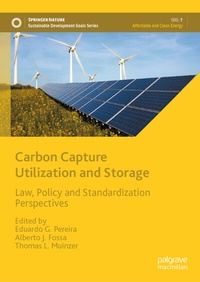
Carbon Capture Utilization and Storage
Description

This book delves into how carbon capture, utilization, and storage (CCUS) technologies might help accelerate the worldwide transition to sustainable energy while meeting Paris Agreement targets. This comprehensive handbook examines how governments, businesses, and society may effectively implement CCUS programs to cut carbon emissions and promote economic development.
The book begins with basic ideas and exposes readers to CCUS technologies and their critical role in reaching net-zero emissions by 2050. It investigates successful CCUS installations from various countries and suggests prospects for host governments and energy firms.
The book combines technical innovation and carbon neutrality initiatives, while also addressing regulatory frameworks and normative factors that are critical for wider acceptance. With climate change mitigation at its core, the book offers pragmatic recommendations for policymakers and industry leaders on how to employ CCUS for sustainable development, making it a valuable resource for environmental researchers, energy professionals, and policymakers working toward a low-carbon economy.
More details
Other editions
Additional editions
Persons
Eduardo G. Pereira is Research Fellow at University of São Paulo, Brazil.
Alberto J. Fossa is Research Fellow at University of São Paulo, Brazil.
Thomas L. Muinzer is Reader in Energy Transition Law at University of Aberdeen, Scotland.
Content
INTRODUCTION.- CLIMATE CHANGE, JUST ENERGY TRANSITION AND SUSTAINABLE DEVELOPMENT.- DEVELOPMENTS AND EVOLUTION OF CCUS TECHNOLOGIES: A REVIEW.- FINANCIAL CONSIDERATIONS FOR CCUS DEVELOPMENTS.- THE CONNECTION AND ROLE BETWEEN CCUS AND NET ZERO.- CCU-BASED PRODUCTS AND THEIR TECHNOLOGICAL ROUTES.- SOCIAL PERCEPTION AND ACCEPTANCE OF CCS AND CCU TECHNOLOGIES: A COMPARISON THROUGH A SOCIO-TECHNICAL APPROACH.- CCUS: LEGAL DEVELOPMENTS, POLICIES AND CHALLENGES.- STANDARDIZATION ISSUES RELATED TO CCUS.- CCUS IN AUSTRALIA.- CCUS IN BRAZIL.- CCUS IN CANADA.- CCUS IN INDONESIA.- CCUS IN CHINA.- CCUS IN NIGERIA.- CCUS IN THE NETHERLANDS.- CCUS IN NORWAY.- CCUS IN QATAR.- CCUS IN TRINIDAD AND TOBAGO.- CCUS IN THE UAE.- CCUS IN THE UNITED KINGDOM.- CCUS IN THE UNITED STATES OF AMERICA.- CONCLUSION.
