

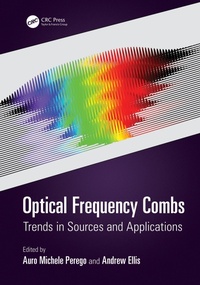
Optical Frequency Combs
Trends in Sources and Applications
1st Edition
Published on 27. November 2024
350 pages
978-1-040-09058-9 (ISBN)
Description

"Optical Frequency Combs: Trends in Sources and Applications" offers an overview of the recent advances on the physics, sources, and applications of optical frequency comb technology - one of the most exciting and fast developing research fields in photonics.
The book aims at showcasing recent advances through contributions by key players in a multifaceted research ecosystem, and at the same time at providing a valuable service to the community, by offering an as much comprehensive as possible review which, at the same time, highlights challenges to be solved and promising future directions.
The main topics covered include: (i) an overview of different platforms for optical frequency combs generation as fibre lasers, quantum cascade lasers, integrated microresonators and waveguides, fibre resonators, electro-optic modulators and nonlinear fibres, multicore fibres; (ii) a selection of applications in different technologies including sensing, spectroscopy, precision metrology and optical clocks, microscopy, radio-frequency generation, distance ranging, and optical communications; (iii) a diverse range of physical methods for frequency comb generation such as modulation, laser mode-locking techniques, dissipative solitons and parametric gain in nonlinear resonators, nonlinear spectral broadening and supercontinuum formation in waveguides.
This book will be a valuable resource for academics, researchers, and postgraduate students working and interested in the field of optical frequency combs, and more broadly in photonic technologies too.
Key Features:
? Edited by authorities in the field, with chapter contributions from subject area leading experts in academia and industry.
? Up-to-date with the latest technological developments, applications, and fundamental research from the field.
? Describes comb properties depending on source and generation platform, and comb specifications matching to application needs.
The book aims at showcasing recent advances through contributions by key players in a multifaceted research ecosystem, and at the same time at providing a valuable service to the community, by offering an as much comprehensive as possible review which, at the same time, highlights challenges to be solved and promising future directions.
The main topics covered include: (i) an overview of different platforms for optical frequency combs generation as fibre lasers, quantum cascade lasers, integrated microresonators and waveguides, fibre resonators, electro-optic modulators and nonlinear fibres, multicore fibres; (ii) a selection of applications in different technologies including sensing, spectroscopy, precision metrology and optical clocks, microscopy, radio-frequency generation, distance ranging, and optical communications; (iii) a diverse range of physical methods for frequency comb generation such as modulation, laser mode-locking techniques, dissipative solitons and parametric gain in nonlinear resonators, nonlinear spectral broadening and supercontinuum formation in waveguides.
This book will be a valuable resource for academics, researchers, and postgraduate students working and interested in the field of optical frequency combs, and more broadly in photonic technologies too.
Key Features:
? Edited by authorities in the field, with chapter contributions from subject area leading experts in academia and industry.
? Up-to-date with the latest technological developments, applications, and fundamental research from the field.
? Describes comb properties depending on source and generation platform, and comb specifications matching to application needs.
More details
Edition
1. Auflage
Language
English
Place of publication
London
United Kingdom
Publishing group
Taylor & Francis Ltd
Target group
College/higher education
Professional and scholarly
Illustrations
4 Tables, black and white; 99 Line drawings, black and white; 69 Halftones, black and white; 168 Illustrations, black and white
ISBN-13
978-1-040-09058-9 (9781040090589)
Copyright in bibliographic data and cover images is held by Nielsen Book Services Limited or by the publishers or by their respective licensors: all rights reserved.
Schweitzer Classification
Other editions
Additional editions
Book
approx. 07/2026
1st Edition
CRC Press
€66.00
Not yet published
Book
11/2024
1st Edition
CRC Press
€259.80
Shipment within 10-20 days
Persons
Auro Michele Perego received a B.Sc. and an M.Sc. in Physics from Universita degli Studi dell'Insubria (Como, Italy) and a PhD degree in Electrical Engineering from Aston University (Birmingham, UK) in 2018. He is currently a Royal Academy of Engineering Research Fellow at the Aston Institute of Photonic Technologies, where he leads his independent research group. His main research interests live at the interface between applied physics and photonic engineering and include optical frequency combs, the physics of modelocking and light pulses generation in lasers, parametric amplification, optical sensing, and the study of instabilities and solitons in nonlinear optical systems.
Andrew Ellis received the B.Sc. degree in physics with a minor in mathematics from the University of Sussex, Brighton, U.K., in 1987 and his Ph.D. degree from The University of Aston in Birmingham, U.K., in 1997 for his study on all optical networking beyond 10 Gbit/s. He previously worked for British Telecom Research investigating the use of optical amplifiers and advanced modulation formats in optical networks, the Corning Research Centre on optical component characterization and the Tyndall National Institute in Cork, Ireland. He interests include the evolution of core and metro networks. He is now Professor of Optical Communications at Aston University where he is also deputy director of the Institute of Photonics Technologies (AIPT). Prof. Ellis is a Fellow of the Optical Society of America.
Andrew Ellis received the B.Sc. degree in physics with a minor in mathematics from the University of Sussex, Brighton, U.K., in 1987 and his Ph.D. degree from The University of Aston in Birmingham, U.K., in 1997 for his study on all optical networking beyond 10 Gbit/s. He previously worked for British Telecom Research investigating the use of optical amplifiers and advanced modulation formats in optical networks, the Corning Research Centre on optical component characterization and the Tyndall National Institute in Cork, Ireland. He interests include the evolution of core and metro networks. He is now Professor of Optical Communications at Aston University where he is also deputy director of the Institute of Photonics Technologies (AIPT). Prof. Ellis is a Fellow of the Optical Society of America.
Content
Introduction.
Auro Michele Perego and Andrew D. Ellis
Chapter 1: Optical frequency combs from supercontinuum generation in integrated photonics.
Camille-Sophie Bres and Christian Lafforgue
Chapter 2: Integrated lithium niobate optical frequency combs.
Armandas Balcytis, Andy Boes, Thach Nguyen, ?Guanghui Ren, Toby Mitchell and Arnan Mitchell
Chapter 3: Soliton Frequency Combs in Microresonators.
Shuangyou Zhang, Toby Bi and Pascal Del'Haye
Chapter 4: Semiconductor Device based Optical Frequency Comb Generation.
Prince M. Anandarajah and Aleksandra Kaszubowska-Anandarajah
Chapter 5: Quantum Cascade Laser frequency combs.
Giacomo Scalari and Jerome Faist
Chapter 6: Fibre-based Optical Frequency Combs.
Dennis Christian Kirsch, Igor Kudelin and Maria Chernysheva
Chapter 7: Optical frequency combs in fibre resonators.
Auro M. Perego, Matteo Conforti, Arnaud Mussot and Misha Sumetsky
Chapter 8: All-fibre frequency agile triple-frequency comb light source.
Eve-Line Bancel, Debanuj Chatterjee, Etienne Genier, Rosa Santagata, Matteo Conforti, Alexandre Kudlinski, Geraud Bouwmans, Olivier Vanvincq, Damien Labat and Arnaud Mussot
Chapter 9: Spectroscopy with electro-optic dual frequency combs.
Alexandre Parriaux, Kamal Hammani and Guy Millot
Chapter 10: Optical Frequency Combs in the 2 ?m Waveband for Dual Comb Spectroscopy.
Eoin Russell and Fatima C. Garcia Gunning
Chapter 11: Dual-Comb Ranging.
Hollie Wright and Derryck T. Reid
Chapter 12: Dual-comb microscopy.
Takeshi Yasui, Eiji Hase, Katsuhiko Mizuno, Takeo Minamikawa and Hirotsugu Yamamoto
Chapter 13: Electro-Optic Sampling-Based Timing and Synchronization with Optical Frequency Combs.
Jungwon Kim and Changmin Ahn
Chapter 14: Optical Frequency Combs Applications for Synchronous Transmission.
Zichuan Zhou and Zhixin Liu
Chapter 15: Integrated optical frequency combs and their applications - An industry perspective.
Frank Smyth
Chapter 16: Optical frequency combs for optical clocks.
Marc Fischer, Gabrielle Thomas, Michael Mei, and Ronald Holzwarth
Auro Michele Perego and Andrew D. Ellis
Chapter 1: Optical frequency combs from supercontinuum generation in integrated photonics.
Camille-Sophie Bres and Christian Lafforgue
Chapter 2: Integrated lithium niobate optical frequency combs.
Armandas Balcytis, Andy Boes, Thach Nguyen, ?Guanghui Ren, Toby Mitchell and Arnan Mitchell
Chapter 3: Soliton Frequency Combs in Microresonators.
Shuangyou Zhang, Toby Bi and Pascal Del'Haye
Chapter 4: Semiconductor Device based Optical Frequency Comb Generation.
Prince M. Anandarajah and Aleksandra Kaszubowska-Anandarajah
Chapter 5: Quantum Cascade Laser frequency combs.
Giacomo Scalari and Jerome Faist
Chapter 6: Fibre-based Optical Frequency Combs.
Dennis Christian Kirsch, Igor Kudelin and Maria Chernysheva
Chapter 7: Optical frequency combs in fibre resonators.
Auro M. Perego, Matteo Conforti, Arnaud Mussot and Misha Sumetsky
Chapter 8: All-fibre frequency agile triple-frequency comb light source.
Eve-Line Bancel, Debanuj Chatterjee, Etienne Genier, Rosa Santagata, Matteo Conforti, Alexandre Kudlinski, Geraud Bouwmans, Olivier Vanvincq, Damien Labat and Arnaud Mussot
Chapter 9: Spectroscopy with electro-optic dual frequency combs.
Alexandre Parriaux, Kamal Hammani and Guy Millot
Chapter 10: Optical Frequency Combs in the 2 ?m Waveband for Dual Comb Spectroscopy.
Eoin Russell and Fatima C. Garcia Gunning
Chapter 11: Dual-Comb Ranging.
Hollie Wright and Derryck T. Reid
Chapter 12: Dual-comb microscopy.
Takeshi Yasui, Eiji Hase, Katsuhiko Mizuno, Takeo Minamikawa and Hirotsugu Yamamoto
Chapter 13: Electro-Optic Sampling-Based Timing and Synchronization with Optical Frequency Combs.
Jungwon Kim and Changmin Ahn
Chapter 14: Optical Frequency Combs Applications for Synchronous Transmission.
Zichuan Zhou and Zhixin Liu
Chapter 15: Integrated optical frequency combs and their applications - An industry perspective.
Frank Smyth
Chapter 16: Optical frequency combs for optical clocks.
Marc Fischer, Gabrielle Thomas, Michael Mei, and Ronald Holzwarth
