

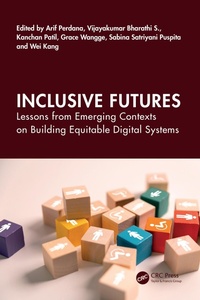
Inclusive Futures
Lessons from Emerging Contexts on Building Equitable Digital Systems
1st Edition
Published on 29. January 2026
634 pages
978-1-040-54893-6 (ISBN)
Description

This book offers a comprehensive analysis of the role of diversity, equity, and inclusion (DEI) in the technology sector from a global perspective. Comprising seven in-depth chapters, the book highlights inherent biases within technology and strategies for constructing inclusive products and services. It takes on a forward-looking outlook on the future of DEI in technology, visualizing a world in which technology functions as a unifying force for positive social transformation.
The authors examine DEI and their significance across different regions, to enhance readers' awareness and understanding. This increased understanding is crucial for professionals and policymakers to make informed decisions that foster an inclusive technological environment. The book equips the readers with knowledge to identify and address these biases in technology, including algorithms, datasets, and user interfaces, through an in-depth study of such biases. This is particularly valuable for technology developers, designers, and companies that aim to create fair and unbiased technology products and services. Through the global and local case studies and empirical research, readers learn valuable insights to developing inclusive technology products and services that cater to a diverse range of users. This book also addresses recruitment practices and cultural changes necessary within tech organizations to cultivate a diverse and inclusive workforce. The topic of how technology can bridge the digital divide and empower underrepresented communities is studied, providing new ideas for such initiatives in the future.
This book serves as a valuable resource for practitioners involved in the development of technology, hiring in the technology sector and leaders involved in policymaking of ethical and regulatory aspects of DEI in technology.
The authors examine DEI and their significance across different regions, to enhance readers' awareness and understanding. This increased understanding is crucial for professionals and policymakers to make informed decisions that foster an inclusive technological environment. The book equips the readers with knowledge to identify and address these biases in technology, including algorithms, datasets, and user interfaces, through an in-depth study of such biases. This is particularly valuable for technology developers, designers, and companies that aim to create fair and unbiased technology products and services. Through the global and local case studies and empirical research, readers learn valuable insights to developing inclusive technology products and services that cater to a diverse range of users. This book also addresses recruitment practices and cultural changes necessary within tech organizations to cultivate a diverse and inclusive workforce. The topic of how technology can bridge the digital divide and empower underrepresented communities is studied, providing new ideas for such initiatives in the future.
This book serves as a valuable resource for practitioners involved in the development of technology, hiring in the technology sector and leaders involved in policymaking of ethical and regulatory aspects of DEI in technology.
More details
Edition
1. Auflage
Language
English
Place of publication
London
United Kingdom
Publishing group
Taylor & Francis Ltd
Target group
College/higher education
Professional and scholarly
Illustrations
29 Tables, black and white; 71 Line drawings, black and white; 27 Halftones, black and white; 98 Illustrations, black and white
File size
339,43 MB
ISBN-13
978-1-040-54893-6 (9781040548936)
Copyright in bibliographic data and cover images is held by Nielsen Book Services Limited or by the publishers or by their respective licensors: all rights reserved.
Schweitzer Classification
Other editions
Additional editions
Arif Perdana | Vijayakumar Bharathi S | Kanchan Patil
Inclusive Futures
Lessons from Emerging Contexts on Building Equitable Digital Systems
Book
approx. 01/2026
1st Edition
CRC Press
€281.40
Not yet published
Arif Perdana | Vijayakumar Bharathi S | Kanchan Patil
Inclusive Futures
Lessons from Emerging Contexts on Building Equitable Digital Systems
Book
approx. 01/2026
1st Edition
CRC Press
€78.60
Not yet published
Persons
Arif Perdana is an Associate Professor at Monash University and Director of the Action Lab Indonesia, specializing in digital strategy and data science. With over two decades of experience spanning academia and industry, he has worked with institutions such as the University of Queensland, Aarhus University, and the Singapore Institute of Technology. His research explores responsible AI, blockchain, machine learning, and digital transformation in finance, education, and healthcare. Arif has secured major funding from institutions including Bank Indonesia and the Singapore Government, published in leading journals, and trained over 700 professionals across 150 organizations in Singapore and Indonesia.
Vijayakumar Bharathi S. is a Professor at Symbiosis Centre for Information Technology, Symbiosis International (Deemed University). He holds postgraduate degrees in Commerce and Management and a PhD in Computer Science from Symbiosis International, specializing in ERP risk assessment for SMEs. A member of the SAP Academic Alliance Board for Asia Pacific and Japan, he is a global SAP trainer for S4 HANA, ECC6.0, and ByD across multiple countries. His expertise includes intelligent ERP, SAP Analytics Cloud, design thinking, and blockchain applications. He collaborates with SAP headquarters in Germany and contributes to global pilot projects for SAP curriculum development.
Kanchan Patil is Deputy Director and Professor at Symbiosis Centre for Information Technology. She holds a Doctorate in Management and a Master's in Marketing Management from the University of Pune, with a background in Electronics and Telecommunications Engineering. With over 21 years of experience in academia, research, and administration, her teaching spans Industry 4.0, digital transformation, IoT, and marketing. An approved PhD guide, she has secured research grants, published in Scopus and Web of Science journals, and presented at IIMs and IIT Delhi. She also leads faculty and management development programs and is a recipient of multiple education leadership awards.
Grace Wangge is an Associate Professor in Public Health at Monash University, Indonesia, where she leads the Master of Public Health program. A medical doctor and epidemiologist, she earned her MD from Universitas Indonesia and PhD in Pharmacoepidemiology from Utrecht University, followed by a postdoctoral fellowship at Harvard Medical School/ Brigham and Women's Hospital. Since returning to Indonesia in 2014, her research has focused on public health policy, community medicine, nutrition, and pharmacovigilance. She has advised national health initiatives, including the G20 Health Working Group, and continues to explore digital health governance and health science communication in the Indonesian context.
Sabina Satriyani Puspita is an Assistant Professor and Interim Course Coordinator for the Public Policy and Management program at Monash University, Indonesia, where she also serves as Deputy Director of the Monash Herb Feith Indonesian Engagement Centre. She joined Monash in 2022 as a Research Fellow at the Institute for Advanced Research. Sabina's research examines democratisation, political institutions, social movements, gender politics, and sustainable communities, with a focus on Southeast and Northeast Asia. She earned her PhD in comparative politics and international relations from Northwestern University, USA, and previously worked as a policy analyst at Indonesia's Ministry of Education.
Wei Kang is a Senior Lecturer in Accounting and Finance at Anglia Ruskin University's Faculty of Business and Law, where she also directs the postgraduate accounting and finance program. Her expertise spans finance, sustainable development, and fintech innovations, with a particular focus on their role in advancing environmental and social impact. Wei actively bridges academia and industry, collaborating on initiatives to influence sustainability policies and practices. Her research interests include organisational behaviour, international business, and gender in entrepreneurship. She holds advanced degrees in finance and is committed to preparing graduates for evolving challenges in global finance and sustainability.
Vijayakumar Bharathi S. is a Professor at Symbiosis Centre for Information Technology, Symbiosis International (Deemed University). He holds postgraduate degrees in Commerce and Management and a PhD in Computer Science from Symbiosis International, specializing in ERP risk assessment for SMEs. A member of the SAP Academic Alliance Board for Asia Pacific and Japan, he is a global SAP trainer for S4 HANA, ECC6.0, and ByD across multiple countries. His expertise includes intelligent ERP, SAP Analytics Cloud, design thinking, and blockchain applications. He collaborates with SAP headquarters in Germany and contributes to global pilot projects for SAP curriculum development.
Kanchan Patil is Deputy Director and Professor at Symbiosis Centre for Information Technology. She holds a Doctorate in Management and a Master's in Marketing Management from the University of Pune, with a background in Electronics and Telecommunications Engineering. With over 21 years of experience in academia, research, and administration, her teaching spans Industry 4.0, digital transformation, IoT, and marketing. An approved PhD guide, she has secured research grants, published in Scopus and Web of Science journals, and presented at IIMs and IIT Delhi. She also leads faculty and management development programs and is a recipient of multiple education leadership awards.
Grace Wangge is an Associate Professor in Public Health at Monash University, Indonesia, where she leads the Master of Public Health program. A medical doctor and epidemiologist, she earned her MD from Universitas Indonesia and PhD in Pharmacoepidemiology from Utrecht University, followed by a postdoctoral fellowship at Harvard Medical School/ Brigham and Women's Hospital. Since returning to Indonesia in 2014, her research has focused on public health policy, community medicine, nutrition, and pharmacovigilance. She has advised national health initiatives, including the G20 Health Working Group, and continues to explore digital health governance and health science communication in the Indonesian context.
Sabina Satriyani Puspita is an Assistant Professor and Interim Course Coordinator for the Public Policy and Management program at Monash University, Indonesia, where she also serves as Deputy Director of the Monash Herb Feith Indonesian Engagement Centre. She joined Monash in 2022 as a Research Fellow at the Institute for Advanced Research. Sabina's research examines democratisation, political institutions, social movements, gender politics, and sustainable communities, with a focus on Southeast and Northeast Asia. She earned her PhD in comparative politics and international relations from Northwestern University, USA, and previously worked as a policy analyst at Indonesia's Ministry of Education.
Wei Kang is a Senior Lecturer in Accounting and Finance at Anglia Ruskin University's Faculty of Business and Law, where she also directs the postgraduate accounting and finance program. Her expertise spans finance, sustainable development, and fintech innovations, with a particular focus on their role in advancing environmental and social impact. Wei actively bridges academia and industry, collaborating on initiatives to influence sustainability policies and practices. Her research interests include organisational behaviour, international business, and gender in entrepreneurship. She holds advanced degrees in finance and is committed to preparing graduates for evolving challenges in global finance and sustainability.
Content
Part 1: Reframing the Discourse on DEIB 1- DEI: Is it going to DIE?, Parul Gupta and Smita Barik 2- A Literature Review on the Role of Digital Technologies in Addressing Social and Economic Inequities Part 2: Addressing Embedded Bias in Digital Systems 3- Inclusive AI: Mitigating Algorithmic Discrimination for a Fairer Society 4- Augmenting Humanity Through Strategic Artificial Intelligence Applications in DEIB 5- Generative AI and Non-binary representation 6-AI Art and Gender: A Metamodernist Exploration of Biases and Possibilities Part 3: Designing Inclusive Digital Products and Ecosystems 7- Building Inclusive Technology Products and Services: Insights from Financial Inclusion Efforts in India and Beyond 8- Bridging Technology Gaps in Algorithmic Trading: An Integrated Framework for Retail Traders 9- Healthcare Equity Through Technology: The eSanjeevani Journey 10- The Safety Algorithm: How Safetipin Translates Women's Experiences into Urban Policy 11- Benchmarking SDG-Related Initiatives: Categorizing Corporate Activities and Exploring Digital Technology Integration Part 4: Workforce Transformation and Digital Capability Building 12- Empowered by Diversity: Building Inclusive Tech Workforces through DEIB 13- The Citizen Development Culture: Cultivating an Inclusive and Empowered Digital Workforce 14- Equitable Protection in Digital Spaces: Examining Cybersquatting in India Through a DEIB Lens Part 5: Technology and Marginalised Communities 15- When COVID-19 hits: The digital divide widens, and vulnerable communities are left behind 16- E-Learning as a Pathway to Equity and Inclusion in Afghanistan 17- Bridging Divides: Technology as a Catalyst for Empowering Underrepresented Communities in India 18- Technology, Trust, and Transformation: bKash's Role in Inclusive Finance and Women's Empowerment 19- Technology as an Equaliser in Kasikorn Bank's Inclusive Banking Strategy 20- Aligning Blockchain with Legal Constructs for Strategic Governance Part 6: Embedding DEIB in Digital Foundations 21- Operationalising Diversity, Equity, Inclusion, and Belonging in the Foundations of Digital Infrastructure
