

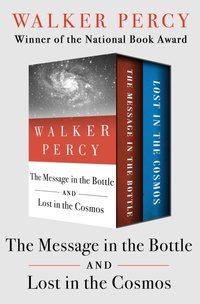
The Message in the Bottle and Lost in the Cosmos
Published on 22. May 2018
860 pages
978-1-5040-5401-0 (ISBN)
Description

Two fascinating philosophical inquiries from the "dazzlingly gifted"
New York Times-bestselling and National Book Award-winning author of
The Moviegoer (
USA Today).
Winner of the National Book Award for The Moviegoer, the Southern writer Walker Percy possessed "an intellectual range and rigor few American novelists can match" ( The New York Times Book Review). In these two provocative works, Percy manages to be perceptive and playful as he more directly explores the philosophical foundations of his groundbreaking fiction.
The Message in the Bottle: In these profound and passionate essays that "have a way of quickening the spirit and cleansing the sight," Percy looks to language to answer the question of who we are as humans ( The New Republic). He posits that the act of assigning meaning by naming things makes humans unique. Percy develops a theory of language through the example of Helen Keller being stimulated by the feel of water along with the sign for water, and explores questions such as why other animals don't talk and why humans in technologically advanced, materially comfortable societies are so sad.
"A delight... a pleasure to read." -Larry McMurtry, The Washington Post Book World
Lost in the Cosmos: "Charming, whimsical, slyly profound," Lost in the Cosmos is a one-of-a-kind mix of self-help parody and philosophical speculation ( The New York Times). Filled with quizzes, essays, short stories, and diagrams, Percy's guide is a laugh-out-loud spin on a familiar genre that also pushes readers to serious contemplation of life's biggest questions, such as: "Why is it no other species but man gets bored?" and "Explain why Moses was tongue-tied and stagestruck before his fellow Jews but had no trouble talking to God."
"A mock self-help book designed not to help but to provoke; a chapbook to inveigle us into thinking about who we are and how we got into this mess." - Los Angeles Times Book Review
Winner of the National Book Award for The Moviegoer, the Southern writer Walker Percy possessed "an intellectual range and rigor few American novelists can match" ( The New York Times Book Review). In these two provocative works, Percy manages to be perceptive and playful as he more directly explores the philosophical foundations of his groundbreaking fiction.
The Message in the Bottle: In these profound and passionate essays that "have a way of quickening the spirit and cleansing the sight," Percy looks to language to answer the question of who we are as humans ( The New Republic). He posits that the act of assigning meaning by naming things makes humans unique. Percy develops a theory of language through the example of Helen Keller being stimulated by the feel of water along with the sign for water, and explores questions such as why other animals don't talk and why humans in technologically advanced, materially comfortable societies are so sad.
"A delight... a pleasure to read." -Larry McMurtry, The Washington Post Book World
Lost in the Cosmos: "Charming, whimsical, slyly profound," Lost in the Cosmos is a one-of-a-kind mix of self-help parody and philosophical speculation ( The New York Times). Filled with quizzes, essays, short stories, and diagrams, Percy's guide is a laugh-out-loud spin on a familiar genre that also pushes readers to serious contemplation of life's biggest questions, such as: "Why is it no other species but man gets bored?" and "Explain why Moses was tongue-tied and stagestruck before his fellow Jews but had no trouble talking to God."
"A mock self-help book designed not to help but to provoke; a chapbook to inveigle us into thinking about who we are and how we got into this mess." - Los Angeles Times Book Review
More details
Person
Walker Percy (1916-1990) was one of the most prominent American writers of the twentieth century. Born in Birmingham, Alabama, he was the oldest of three brothers in an established Southern family that contained both a Civil War hero and a U.S. senator. Acclaimed for his poetic style and moving depictions of the alienation of modern American culture, Percy was the bestselling author of six fiction titles-including the classic novel
The Moviegoer (1961), winner of the National Book Award-and fifteen works of nonfiction. In 2005,
Time magazinenamed
The Moviegoer one of the best English-language books published since 1923.
Content
- Cover Page
- Title Page
- Contents
- The Message in the Bottle
- Title Page
- Table of Contents
- 1 The Delta Factor
- 2 The Loss of the Creature
- 3 Metaphor as Mistake
- 4 The Man on the Train
- 5 Notes for a Novel About the End of the World
- 6 The Message in the Bottle
- 7 The Mystery of Language
- 8 Toward a Triadic Theory of Meaning
- 9 The Symbolic Structure of Interpersonal Process
- 10 Culture the Antinomy of the Scientific Method
- 11 Semiotic and A Theory of Knowledge
- 12 Symbol, Consciousness, and Intersubjectivity
- 13 Symbol as Hermeneutic in Existentialism
- 14 Symbol as Need
- 15 A Theory of Language
- Bibliography
- Lost in the Cosmos
- Title Page
- Table of Contents
- (1) The Amnesic Self
- (2) The Self as Nought
- The Self as Nought (II)
- (3) The Nowhere Self
- (4) The Fearful Self
- (5) The Fearful Self (II)
- (6) The Fearful Self (III)
- (7) The Misplaced Self
- (8) The Promiscuous Self
- (9) The Envious Self
- (10) The Bored Self
- (11) The Depressed Self
- (12) The Impoverished Self
- A Semiotic Primer of the Self
- (13) The Transcending Self
- (14) The Orbiting Self
- (15) The Exempted Self
- (16) The Lonely Self
- (17) The Lonely Self (II)
- (18) The Demoniac Self
- A Space Odyssey (I)
- (19) The Self Marooned in the Cosmos
- A Space Odyssey (II)
- (20) The Self Marooned in the Cosmos
- Author's Note
- A Biography of Walker Percy
- Copyright Page
