

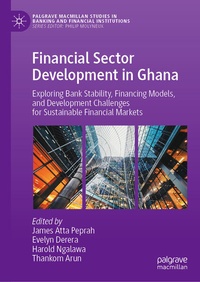
Financial Sector Development in Ghana
Description

This book investigates factors that contribute to the development of an efficient financial sector in Ghana. While sustainable finance has long been known to propel economic growth and development, and while many African countries have taken initiatives to develop integrated frameworks of their financial sectors that tackle developmental challenges, scholars and policymakers have always grappled with understanding of factors that enhance performance of the financial sector. In this book, an expert team of authors examines the financial landscape, central bank policies, competition, financial innovation, financial inclusion and banking stability in Ghana, while also exploring how financing models such as enterprise finance and microfinance can be more effective in sustaining financial markets. The authors discuss how Ghana can build fortified institutions, regulatory frameworks, and productive capacity to strengthen the financial sector and foster pathways that will enhance economicdevelopment. Empirical and scientific evidence give this book a unique approach that is both qualitative and quantitative.
More details
Other editions
Additional editions
Persons
James Atta Peprah is an Associate Professor of Economics in the Department of Applied Economics, School of Economics, University of Cape Coast, Ghana. His research focuses on development economics, financial markets and institutions, microfinance, economic growth and development, and SME development.
Evelyn Derera is an Associate Professor of Entrepreneurship in the School of Management, Information Technology and Governance, University of KwaZulu-Natal, South Africa; and Associate of the Institute of Bankers in Zimbabwe. She previously held positions in the banking sector, specialising in Private Banking.
Harold Ngalawa is a Professor of Economics in the School of Accounting, Economics and Finance, and the Macroeconomics Research Unit, University of KwaZulu-Natal, South Africa. His research focus is on monetary theory and practice, deposit insurance, banking instability, structural asymmetries and policy failure.
Thankom Arun is a Professor of Global Development and Accountability, University of Essex, UK; Professor Extraordinaire at Stellenbosch University, South Africa; Research fellow at IZA, Germany; Fellow of the Academy of Social Sciences; and Fellow of the Royal Society of Arts, Manufactures and Commerce.
Content
Chapter 1. Introduction.- Chapter 2. What Really Drives Financial Sector Development in Ghana?.- Chapter 3. Harnessing Financial Innovation for Financial Inclusion in Ghana.- Chapter 4. Financial Inclusion and Monetary Policy Effectiveness in Ghana.- Chapter 5. Gendered Financial Behaviour in Ghana: A Comparative Study with South Africa.- Chapter 6. Bank Competition and Financial Sector Stability in Ghana.- Chapter 7. Macroeconomic Determinants of Banking Instability in Ghana.- Chapter 8. Financial Dualism in Ghana: The Implications for Monetary Policy on Loan Variations.- Chapter 9. Revisiting MSMEs financing through banking reform processes: Assessing the Ghanaian legal experiences.- Chapter 10. Effectiveness of credit risks management policies used by Ghanaian commercial banks in agricultural financing.- Chapter 11. Evaluation of lending methodologies used by Ghanaian banks to extend credit to SMEs.
