

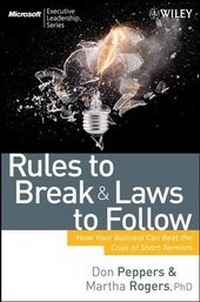
Rules to Break and Laws to Follow
Description

Reviews / Votes
"Harnessing the power of connected customers and networked employees is now the key to success and that's what this book is all about." (Bookviews.com, April 2008)More details
Other editions
Additional editions
Persons
Content
Chapter 1
False Assumptions
The year is 1886. Gottlieb Daimler has just unhooked the horses from the front of a stagecoach and installed an engine in the back. He has created the first four-wheel automobile. But it's noisy, smelly, and smoky—mostly an oddity.1 Daimler's company soon joined with Karl Benz and, early in the 1900s, the story goes, financial planners at the new Daimler Benz company attempted to forecast the eventual size of the world market for cars, looking ahead seven to ten decades. After careful analysis, they predicted that in another century there would be perhaps 1 million cars in use worldwide.
But this forecast, as audacious as it must have sounded at the time, was woefully inadequate, because by the year 2000, more than 600 million cars were already in use around the world. Nearly 60 million new cars were manufactured in that year alone.
Granted, this was a very long-term forecast, but still: How could Daimler's finance people have missed the number by a factor of nearly 1,000? It wasn't the time lapse that created the error. Nor was it sloppy calculation, nor the fact that in those days they had no electronic calculators or spreadsheet programs. Their error was due to a completely false assumption.
The planners predicted that in a hundred years, the world population of chauffeurs would be about a million, and this would be a de facto limitation on the growth of the horseless carriage industry. Their prediction about the world population of chauffeurs was surprisingly close to the mark, but their assumption that all cars would have to be operated by chauffeurs was dead wrong. The error was not in the accuracy of the measurement but in a false assumption about what they measured.
Assumptions just like this one—just as carefully and accurately measured and every bit as fallacious—are every day corroding decisions about what truly limits the growth of businesses—maybe yours.
Like Bell forecasting that the market for telephones would be limited by the availability of human operators to make the connections, or IBM's Tom Watson famously predicting that the world would never need more than about five large computers, it's not hard to be blinded by the current business model. Even when the model is for a brand-new product category.
For most of a century now, three unspoken assumptions have underpinned businesses' efforts to grow, meet financial goals, and make shareholders happy. But these three assumptions about how a business creates value are false, and we call them “Rules to Break.”
Rules to Break
1. The best measure of success for your business is current sales and profit.
2. With the right sales and marketing effort, you can always get more customers.
3. Company value is created by offering differentiated products and services.
What, are these Peppers and Rogers people nuts? Who could quarrel with the idea that the surest, most reliable indicator of any business's success is when sales and profit tick upward in the current period? When sales aren't that great, more effective marketing is what you need, right? Bring in more customers until you push the numbers up. And we all know that the most reliable way to do this is to offer products and services that have a clear point of difference, compared to competitors.
No, no, no. No to all of the above. These Rules to Break are really just assumptions about how business works, at the most basic level. They probably aren't written down anywhere in your strategy document, but they have almost certainly backed up your thinking and your company's actions for as long as you remember.
The problem is, each of these assumptions is dead wrong.
More than that. If you operate according to these false assumptions, not only will your business fail to create much value, but you'll also soon find yourself trapped in a Crisis of Short-Termism. Everything you do will be so furiously centered on making today's numbers that you will become increasingly blinded to everything else. Businesses swept up by this crisis find that even as they try to do the right thing for their shareholders, they end up destroying value rather than creating it. So while these Rules to Break may look no more dangerous than ordinary common sense, in truth they're deadly.
A “Perfect Storm” of New Technologies
Once upon a time, perhaps during the age of mass marketing but before the World Wide Web, these rules served as reasonable guides for running a successful business. But a number of new technologies have introduced capabilities and influences on business that have together created what you might call a “perfect storm” of radical change. Customers share their experiences electronically with millions of other customers. Business is transacted at the speed of wireless email. And the lowliest employee can leap tall corporate hierarchies with a single click. The technology of business has changed so radically that the old accepted wisdoms just don't work anymore.
In their place we're going to propose a whole new way of thinking about how to create real shareholder value in today's competitive environment, operating with today's technologies. As we explain the nuances of our proposed new way of thinking, we'll introduce 12 Laws to Follow— guidelines to ensure that your business can surmount the Crisis of Short-Termism smothering so many businesses today. No one knows how long these Laws to Follow will adequately guide your decisions, but one thing is certain: If you want to succeed, starting tomorrow morning and stretching out at least into the future we are capable of imagining today, then you'll have to start by standing the old assumptions on their collective head, because they've already become more destructive than helpful.
Which begs the question: If the Rules to Break are so wrong, why are they so widely accepted? Why is it that so many businesses pursue their goals this way, in just the way their executives learned in the MBA program, the same way they've always done it?
Imitation, Circular Mills, and Mythbusting
In a word: imitation. Imitation is one of life's most important defense mechanisms. Young deer learn to survive predators by imitating older deer that have survived predators. Birds learn to fly, wolves learn to hunt, beavers learn to build dams, and human beings learn to walk, talk, play, work, and flirt all by imitating others of their species.
Businesses, too, grow stronger and faster by carefully observing what has worked before and then imitating other successful businesses. Case studies, best practices, benchmarking, competitive reviews—call it what you want, there is no question that one company's success often becomes the object of imitation by others. (Listen, we believe imitation can be a good thing, in general. In fact, we're hoping you bought this book precisely because so many other people did.)
The problem is that imitation is so powerful, as both a learning tool and a survival mechanism, that when things get a bit out of kilter, the drive to imitate can sometimes lead to irrational and even self-destructive behavior. Army ants, for instance, are genetically programmed to follow each other in packs in order to find food, each army ant traipsing along in the footsteps of the ants in front of it. But occasionally naturalists have observed “circular mills” of army ants. These are battalions of several thousand ants that have somehow become separated from the main army, doubled back on each other, and are now marching around in a closed circle, because the leading foragers have chanced on the tail end of their own battalion and have begun following it.
When ants get themselves into circular mills, they will march around and around and around until they all die of weakness and starvation, literally imitating each other to death.
It seems to us that businesses have gotten into a kind of circular mill themselves—with each following the other in applying these three false assumptions despite the fact that these principles are no longer producing real growth. Most executives sense that business growth has become more difficult, yet their response to this challenge is to redouble their efforts and to apply these same false assumptions all the more diligently.
Businesses are doing the wrong things, for the wrong reasons, but doing them better, faster, more efficiently—even though what they are doing is based on assumptions as wrong as the belief 100 years ago that only a professional chauffeur would ever have the skills necessary to operate a motorcar.
The result is that businesses are following each other around and around, army-ant style, in a futile search for growth.
Crisis of Short-Termism: The Mother of All Problems
In our travels, we often ask chief executives and other decision makers what their biggest challenges are. We know this isn't a scientific poll, and we get a whole boatload of answers, but there is absolutely no question that the single most frequently cited problem is some form of this dilemma:
How can we do what's right for the company when the pressure to make our current-period numbers is so great?
The Crisis of Short-Termism is so all-consuming for businesses that it embodies many other problems, as well. Deep in our guts...
