

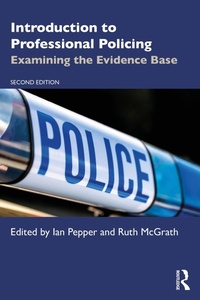
Introduction to Professional Policing
Examining the Evidence Base
2nd Edition
Published on 11. June 2025
282 pages
978-1-040-36807-7 (ISBN)
Description

Policing is a dynamic profession with increasing demands and complexities placed upon police officers, staff and volunteers who provide a 24-hour service across a diverse range of communities. Written by experts in policing higher education from across both academic and professional practice, this book equips aspiring or newly appointed police officers, staff and volunteers with the knowledge and understanding to deal with the significant and often complex challenges they face daily.
This second edition of Introduction to Professional Policing explores a number of the core underpinning knowledge requirements identified as themes within the ever-evolving National Policing Curriculum (NPC) and Police Constable Entry Routes (PCER), while also informing those embarking on leadership development. These include:
Community and neighbourhood policing
Counter-terrorism
Digital policing
Ethics, equality, diversity and inclusion
Evidence-based policing
Maintaining professional standards
Police leadership
Problem solving and problem-oriented policing
Victims and protecting the vulnerable
Volunteers in policing
This edition has been reviewed and significantly updated in line with the dynamic and ongoing demands faced by operational policing and therefore the associated knowledge requirements for policing education and training. The book is refocused on the learning requirements contained within the range of entry routes now available in to policing, as well as the professional development of those serving as police staff and volunteers. This includes new chapters providing insights into community and neighbourhood policing, problem solving and volunteers in policing.
At the end of each chapter the student finds a case study, reflective questions and an extensive reference list, all of which reinforces students' knowledge and furthers their professional development. Written in a clear and direct style, this book supports aspiring police officers, newly appointed police officers, direct entry detectives, community support officers, special constables and police staff. It will also be of interest to those embarking on a leadership journey within policing and anyone wanting to learn more about the profession of policing. It is essential reading for students taking a professional policing degree or commencing any of the police constable entry routes.
This second edition of Introduction to Professional Policing explores a number of the core underpinning knowledge requirements identified as themes within the ever-evolving National Policing Curriculum (NPC) and Police Constable Entry Routes (PCER), while also informing those embarking on leadership development. These include:
Community and neighbourhood policing
Counter-terrorism
Digital policing
Ethics, equality, diversity and inclusion
Evidence-based policing
Maintaining professional standards
Police leadership
Problem solving and problem-oriented policing
Victims and protecting the vulnerable
Volunteers in policing
This edition has been reviewed and significantly updated in line with the dynamic and ongoing demands faced by operational policing and therefore the associated knowledge requirements for policing education and training. The book is refocused on the learning requirements contained within the range of entry routes now available in to policing, as well as the professional development of those serving as police staff and volunteers. This includes new chapters providing insights into community and neighbourhood policing, problem solving and volunteers in policing.
At the end of each chapter the student finds a case study, reflective questions and an extensive reference list, all of which reinforces students' knowledge and furthers their professional development. Written in a clear and direct style, this book supports aspiring police officers, newly appointed police officers, direct entry detectives, community support officers, special constables and police staff. It will also be of interest to those embarking on a leadership journey within policing and anyone wanting to learn more about the profession of policing. It is essential reading for students taking a professional policing degree or commencing any of the police constable entry routes.
More details
Edition
2nd edition
Language
English
Place of publication
London
United Kingdom
Publishing group
Taylor & Francis Ltd
Target group
College/higher education
Illustrations
3 Tables, black and white; 3 Line drawings, black and white; 3 Illustrations, black and white
File size
4,50 MB
ISBN-13
978-1-040-36807-7 (9781040368077)
Copyright in bibliographic data and cover images is held by Nielsen Book Services Limited or by the publishers or by their respective licensors: all rights reserved.
Schweitzer Classification
Other editions
Additional editions
Book
06/2025
2nd Edition
Routledge
€63.90
Shipment within 10-20 days
Book
06/2025
2nd Edition
Routledge
€207.90
Shipment within 10-20 days

Introduction to Professional Policing
Examining the Evidence Base
Book
06/2025
Routledge
Unfortunately, price unknown
Available (delivery time upon request)
Persons
Ian Pepper is a professor in policing at the International Centre for Policing and Security, University of South Wales, and an advisor on higher education within policing nationally. Ian is a former principal lecturer in policing, senior lecturer in crime scene and forensic science, police trainer, crime scene investigator (CSI) and fingerprint officer. He has been a team leader at the National Training Centre for Scientific Support to Crime Investigation and has designed and delivered education and training to crime scene investigators and police officers worldwide. Ian has undertaken additional academic roles including chair of the QAA/College of Policing subject benchmark statement for policing, visiting professor in professional practice at the University of Sunderland and invited visiting scholar at the University of Central Florida, USA. With research interests focused on policing higher education, police leadership and volunteering in policing, Ian has authored and edited a range of journal articles and policing publications.
Ruth McGrath teaches on the BSc Crime and Investigation course at Teesside University, and more recently became course leader of the BSc Professional Policing. Before this Ruth served with Cleveland Police where she experienced a range of operational roles, including uniformed policing, investigation, roads policing and custody officer. As a detective she was engaged in major crime investigations and completed a six-month secondment to a national unit based at New Scotland Yard. During her service she was also a police trainer and an A1 NVQ Assessor. Ruth has taught and managed numerous policing programmes at Teesside University including the Police Foundation Degree. With a special interest in policing higher education, Ruth has authored several journal articles and contributed to a published volume.
Ruth McGrath teaches on the BSc Crime and Investigation course at Teesside University, and more recently became course leader of the BSc Professional Policing. Before this Ruth served with Cleveland Police where she experienced a range of operational roles, including uniformed policing, investigation, roads policing and custody officer. As a detective she was engaged in major crime investigations and completed a six-month secondment to a national unit based at New Scotland Yard. During her service she was also a police trainer and an A1 NVQ Assessor. Ruth has taught and managed numerous policing programmes at Teesside University including the Police Foundation Degree. With a special interest in policing higher education, Ruth has authored several journal articles and contributed to a published volume.
Content
Introduction
Ian Pepper and Ruth McGrath
1. Ethics, Equality, Diversity and Inclusion
Eifion Swinnerton-Gismondi
2. Maintaining Professional Standards and Reflective Practice
Dominic A. Wood
3. Criminology and Criminal Justice
Anne Lodge
4. The Role of the Police as a Public Authority
Angela King and Annabelle James
5. Evidence-Based Policing
Helen Selby-Fell and Ian Pepper
6. Communication Skills, Decision-making and Managing Conflict
Ruth McGrath, Ian Pepper, Mark Thornton
7. Problem Oriented Policing/Problem Solving
Jane Baxendale
8. Community and neighbourhood policing - the shifting sands
Mollie Rennoldson
9. Policing Vulnerability: Attrition, rape and domestic abuse
Emma Williams, Jennifer Norman, Katy Barrow-Grint
10. Counter-Terrorism: The Front line
Peter Williams
11. Digital Policing
Benjamin Findlay, Shawn Robertson and Harry Stewart
12. Volunteers in Policing
Colin Rogers
13. An Introduction to Coaching and Mentoring
David Taylor
14. Leadership
Ian Pepper, Rick Ruddell , Ross Wolf and Christopher D. O'Connor
Ian Pepper and Ruth McGrath
1. Ethics, Equality, Diversity and Inclusion
Eifion Swinnerton-Gismondi
2. Maintaining Professional Standards and Reflective Practice
Dominic A. Wood
3. Criminology and Criminal Justice
Anne Lodge
4. The Role of the Police as a Public Authority
Angela King and Annabelle James
5. Evidence-Based Policing
Helen Selby-Fell and Ian Pepper
6. Communication Skills, Decision-making and Managing Conflict
Ruth McGrath, Ian Pepper, Mark Thornton
7. Problem Oriented Policing/Problem Solving
Jane Baxendale
8. Community and neighbourhood policing - the shifting sands
Mollie Rennoldson
9. Policing Vulnerability: Attrition, rape and domestic abuse
Emma Williams, Jennifer Norman, Katy Barrow-Grint
10. Counter-Terrorism: The Front line
Peter Williams
11. Digital Policing
Benjamin Findlay, Shawn Robertson and Harry Stewart
12. Volunteers in Policing
Colin Rogers
13. An Introduction to Coaching and Mentoring
David Taylor
14. Leadership
Ian Pepper, Rick Ruddell , Ross Wolf and Christopher D. O'Connor
