

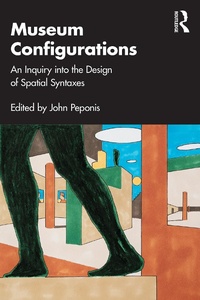
Museum Configurations
An Inquiry Into The Design Of Spatial Syntaxes
1st Edition
Published on 19. December 2023
294 pages
978-1-003-82857-0 (ISBN)
Description

Museum Configurations demonstrates how museum space functions cognitively and communicatively and questions whether it can be designed to provide a rich embodied experience, situating displays and their public in felicitous dialogue.
Including contributions from authors working in the disciplines of architecture, psychology, museum studies, history and the visual arts, this volume addresses an interdisciplinary audience. The analysis of a wealth of examples shows how the voices of architects, curators and exhibition designers enter into dialogue and invite visitors to make their own connections between physical, cognitive and affective space. Considering how the layout of museums facilitates movement and orientation so that visitors may devote their attention to displays, the book questions what kinds of visual attention characterizes museum experiences and how the design of museum space can support them. In the context of an often dematerialized, atomized, and dissipating contemporary culture, the book proposes that museums can function as shared space that supports enjoyment and learning without being overly didactic.
Museum Configurations focuses upon the functions and aims of the design of space. This makes the book particularly interesting to academics and students working in exhibition design and museum architecture, as well as to exhibition designers, curators, and architects.
Including contributions from authors working in the disciplines of architecture, psychology, museum studies, history and the visual arts, this volume addresses an interdisciplinary audience. The analysis of a wealth of examples shows how the voices of architects, curators and exhibition designers enter into dialogue and invite visitors to make their own connections between physical, cognitive and affective space. Considering how the layout of museums facilitates movement and orientation so that visitors may devote their attention to displays, the book questions what kinds of visual attention characterizes museum experiences and how the design of museum space can support them. In the context of an often dematerialized, atomized, and dissipating contemporary culture, the book proposes that museums can function as shared space that supports enjoyment and learning without being overly didactic.
Museum Configurations focuses upon the functions and aims of the design of space. This makes the book particularly interesting to academics and students working in exhibition design and museum architecture, as well as to exhibition designers, curators, and architects.
Reviews / Votes
"Museum Configurations compiles a wealth of knowledge that was previously scattered across research outputs, including events such as the International Space Syntax Symposium, for example. This singular aspect represents a significant contribution to the fields of space syntax and museum studies. Peponis' edited volume may disappoint those expecting to learn specific concepts, units of measurement, and analytical procedures relating to space syntax, but it is precisely this theoretical and empirical approach that allows both specialized audiences and broader publics to engage with the rich discussions... Furthermore, the book includes recent developments and unexplored ideas, making it thought-provoking. Despite its broad disciplinary scope, the book is fundamentally a resource for scholars operating within the fields of space syntax, network analysis, and social studies... The balance between synthesizing existing knowledge and analysing current museological trends positions Museum Configurations as one of the most comprehensive publications on the socio-spatial study of museums buildings so far."~ Livia Nobrega, Programa de Pos-Graduacao em Arquitetura e Urbanismo, Universidade Federal da Paraiba (PPGAU/UFPB); Departamento de Arquitetura e Urbanismo, Universidade Federal de Pernambuco (DAU/UFPE), Brasil. Museum & Society, November 2024. 22(3) 263-5 (c) 2024, Livia Nobrega. ISSN 1479-8360.
More details
Edition
1. Auflage
Language
English
Place of publication
London
United Kingdom
Publishing group
Taylor & Francis Ebooks
Target group
College/higher education
Professional and scholarly
Illustrations
79 Halftones, black and white; 79 Illustrations, black and white
ISBN-13
978-1-003-82857-0 (9781003828570)
Copyright in bibliographic data and cover images is held by Nielsen Book Services Limited or by the publishers or by their respective licensors: all rights reserved.
Schweitzer Classification
Other editions
Additional editions
Book
12/2023
1st Edition
Routledge
€63.70
Shipment within 10-20 days
Book
12/2023
1st Edition
Routledge
€206.80
Shipment within 10-20 days
Person
John Peponis is Professor of Architecture at the Georgia Institute of Technology, USA.
Content
1. Museums as spatial configurations; 2. The dialectic of the enlightenment museum: Edifice, edification, and dissolution; 3. Movement, visibility, and the states of museum experience; 4. Intelligibility and the structures of freedom; 5. A stimulating museum space: 'Glancing away' and engaging working memory in-between exhibits; 6. Narrative, dramaturgy and spatial choreography: movement and subjectivity in museum configurations; 7. Spacing collections. Space syntax and a museum yet to come; 8. Navigating museum space: Mapping, syntax, and metaphor; 9. Designing the syntax of museum space in the studio; 10. Postscript: What more can museum architecture do?.
