

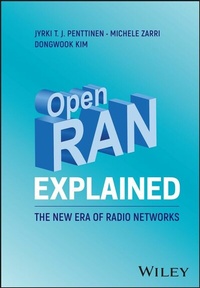
Open RAN Explained
Description

A pioneering outline of the concepts that enhance 5G capabilities to revolutionize the telecommunications industry.
Open radio-access network, or Open RAN, is a type of network architecture in which baseband and radio unit components from different suppliers can operate seamlessly in concert. Advances in network communication were, until recently, hampered by the proprietary network operations of each mobile operator; the advent of 5G, however, with its service-based architecture model, has finally opened the door to the expansion of connectivity on the Open RAN model. This transformation promises to define the future of mobile network architecture.
Open RAN Explained is among the first books dedicated to this groundbreaking technology. Its comprehensive but accessible summary of current and future developments in Open RAN promises to facilitate network deployment and device design, as well as to provide a handy reference for network professionals in a range of different fields. The result is a must-read volume for anyone looking to understand the future of wireless communication.
Open RAN Explained readers will also find:
- In-depth description of the challenges and opportunities of network modularization
- Analysis conversant with the latest release specifications of the O-RAN Allliance, GSMA OP/TIP, and other key emerging technologies
- Authors working at the leading edge of 5G network communications
Open RAN Explained is ideal for network operators, network element and device manufacturers, telecommunications researchers, and advanced students, as well as industry-adjacent figures such as regulators, consultants, and marketing professionals.
Jyrki T. J. Penttinen is Senior Technology Manager, North America, GSMA. He has worked in mobile telecommunication since 1994. Since then, he has worked with Nokia and Giesecke+Devrient Mobile Security, and has experience in research and operational activities for both radio and core network domains, including planning, optimization, measurements, system architectures, and services. He is currently focusing on 5G, designing guidelines for the North American and Caribbean mobile network operators.
Michele Zarri is an independent management consultant. He started his career in Fujitsu R&D working on layer 1 of WCDMA before moving to Deutsche Telekom representing the company in 3GPP. Michele served two terms as 3GPP TSG SA WG1 chairman and has been rapporteur of several specifications and work items. In 2015, Michele joined the GSMA as technical director of the 5G projects.
Dongwook Kim is Specifications Manager of the 3GPP, the secretary of 3GPP CT3 working group, and the work plan coordinator of 3GPP TSG CT. He has worked in the industry for 11 years and his past employers include Korea Telecom (KT), GSM Association (GSMA), and Telecom Infra Project (TIP). His career has focused on promoting latest telecom technologies and serving as the industry think tank.
More details
Other editions
Additional editions

Persons
Jyrki T. J. Penttinen is Senior Technology Manager, North America, GSMA. He has worked in mobile telecommunication since 1994. Since then, he has worked with Nokia and Giesecke+Devrient Mobile Security, and has experience in research and operational activities for both radio and core network domains, including planning, optimization, measurements, system architectures, and services. He is currently focusing on 5G, designing guidelines for the North American and Caribbean mobile network operators.
Michele Zarri is an independent management consultant. He started his career in Fujitsu R&D working on layer 1 of WCDMA before moving to Deutsche Telekom representing the company in 3GPP. Michele served two terms as 3GPP TSG SA WG1 chairman and has been rapporteur of several specifications and work items. In 2015, Michele joined the GSMA as technical director of the 5G projects.
Dongwook Kim is Specifications Manager of the 3GPP, the secretary of 3GPP CT3 working group, and the work plan coordinator of 3GPP TSG CT. He has worked in the industry for 11 years and his past employers include Korea Telecom (KT), GSM Association (GSMA), and Telecom Infra Project (TIP). His career has focused on promoting latest telecom technologies and serving as the industry think tank.
Content
Author Biographies xiii
Preface xv
Acknowledgments xix
Abbreviations xxi
1 Introduction 1
1.1 Overview 1
1.2 Readiness of the Ecosystem 2
1.2.1 Virtualization 2
1.2.2 Industry Forums 3
1.2.3 Statistics 4
1.2.4 Path Toward Open RAN Networks 5
1.2.5 Security Aspects 7
1.2.6 Commercial Deployments 7
1.3 Focus and Contents 7
References 9
2 Open RAN: Journey from Concept to Development 11
2.1 Overview 11
2.2 Requirements 11
2.3 Standards 12
2.3.1 3GPP 12
2.3.2 O-RAN Alliance 14
2.3.3 Telecom Infra Project 18
2.3.4 Collaboration of Organizations 22
2.4 Open Source and Open RAN 23
References 25
3 Evolution of the RAN 27
3.1 Architecture of a Mobile Communications System 27
3.1.1 System-Level Overview 27
3.1.2 User Equipment 27
3.1.3 Radio Access Network 28
3.1.4 Core Network 29
3.2 Components and Structure of the RAN 29
3.2.1 The Radio Base Station 29
3.2.2 RAN Service Area 30
3.3 RAN Enhancements from Early Mobile System to 4G 33
3.3.1 Introduction 33
3.3.2 RAN Key Performance Indicators 34
3.3.3 Early Mobile System Radio Access Networks 34
3.3.4 The Evolved Universal Terrestrial Radio Access Network 35
3.3.4.1 Baseband Unit and Remote Radio Head Split 36
3.3.4.2 Fronthaul Protocol Evolution 36
3.3.4.3 X2 Interface Between Base Stations 37
3.3.4.4 User Plane Control Plane Separation 38
3.4 Role of Information Technology in the Evolution of the RAN in 5G and Open RAN 40
3.4.1 Introduction 40
3.4.2 Virtualization 40
3.4.3 Cloudification 42
3.4.4 Software-defined Networking 44
3.5 RAN Evolution in 5G 46
3.5.1 The Next-Generation Radio Access Network 46
3.5.2 gNB Split Architecture 47
3.5.2.1 Rationale for Split Architecture 47
3.5.2.2 Split Architecture Topology Options 49
3.5.3 Fronthaul Evolution: eCPRI 50
3.6 Evolution of the Base Station Architecture 52
3.6.1 Overview 52
3.6.2 Distributed RAN 52
3.6.3 Centralized RAN 53
3.6.4 Virtualized RAN (vRAN) 55
3.6.4.1 Concept 55
References 56
4 O-RAN Alliance Architecture 59
4.1 High-Level Objectives of the O-RAN Alliance Architecture 59
4.2 O-RAN Alliance Work on 4G 59
4.2.1 Laying the Ground for a Multi-vendor Environment 59
4.2.2 Standalone and Non-standalone 5G 60
4.2.3 The O-eNB and 4G Interfaces Profiling 61
4.2.3.1 O-eNB 61
4.2.3.2 X2 and W1 Profiling 62
4.3 O-RAN 5G Architecture 63
4.3.1 Architecture Overview 63
4.3.2 O-RAN Alliance Architecture Network Components 64
4.3.2.1 O-RAN Central Unit (O-CU) 64
4.3.2.2 O-RAN Distributed Unit (O-DU) 64
4.3.2.3 O-RAN Radio Unit (O-RU) 65
4.3.2.4 Service Management and Orchestration Framework 65
4.3.2.5 O-Cloud 65
4.3.2.6 RAN Intelligent Controller 65
4.3.3 Interfaces 65
4.3.3.1 3GPP-Defined Interfaces 65
4.3.3.2 O-RAN Alliance-Defined Interfaces 66
4.4 O-RAN Alliance Architecture Innovation 66
4.4.1 O-RAN Alliance Two-Pronged Approach 66
4.4.2 Open Fronthaul 67
4.4.3 Stricter Approach to RAN Functional Split 67
4.4.3.1 Introduction 67
4.4.3.2 The NG-RAN Radio Resource Management 69
4.4.3.3 Functional Split of the Physical Layer Between O-DU and O-RU 71
4.5 Service Management and Orchestration Framework 74
4.6 O-Cloud 74
4.7 Real-Time Intelligent Controller 77
4.7.1 Non-Real-Time RIC 78
4.7.1.1 Non-Real-Time RIC Architecture Principles 78
4.7.1.2 R1 Services 79
4.7.2 Near-Real-Time RIC 79
4.8 Open Fronthaul 81
4.8.1 Addressing the Technical Challenges of the 5G Fronthaul 81
4.8.2 User Plane and Control Plane 84
4.8.3 Synchronization Plane 84
4.8.4 Management Plane 85
References 85
5 TIP - Commercialization of Open RAN 87
5.1 Overview 87
5.2 Fundamental: Requirements and Test Plans 88
5.2.1 OpenRAN Overview 88
5.2.2 OpenRAN Releases 89
5.2.2.1 Overview of OpenRAN Releases 89
5.2.2.2 RU 90
5.2.2.3 DU/CU 91
5.2.2.4 RIA 92
5.2.2.5 SMO 93
5.3 Testing and Validation, Marketplace 94
5.3.1 Rationale 94
5.3.2 The Process 94
5.3.3 Achievements 95
5.4 Experience of OpenCellular 96
References 97
6 Open RAN Use Cases 99
6.1 Introduction 99
6.2 Open RAN as Enabling Foundation 99
6.2.1 Overview 99
6.2.2 Customer Experience 99
6.2.2.1 QoE Optimization 99
6.2.2.2 Signaling Storm Protection 100
6.2.3 Facilitating 5G Component Technologies 102
6.2.3.1 Overview 102
6.2.3.2 Massive MIMO Beamforming Optimization 102
6.2.3.3 MU-MIMO Optimization 103
6.2.3.4 Traffic Steering 104
6.2.3.5 Dynamic Spectrum Sharing 105
6.2.3.6 Local Indoor Positioning 107
6.2.3.7 Energy Saving 107
6.2.4 Network Slicing 108
6.2.4.1 Overview 108
6.2.4.2 QoS-Based Resource Optimization 108
6.2.4.3 RAN Slice Service Level Assurance 109
6.2.4.4 Multi-vendor Slice 110
6.2.4.5 NSSI Resource Allocation Optimization 112
6.2.5 Network as a Service and RAN Sharing 113
6.2.5.1 NaaS: Concept and Deployment 113
6.2.5.2 Application to RAN Sharing 114
6.2.5.3 Sharing of O-RUs 115
6.3 Connected Mobility 117
6.3.1 Overview 117
6.3.2 Rationale 117
6.3.3 Specific Use Cases 118
6.3.3.1 V2X 118
6.3.3.2 UAV 120
6.3.3.3 Railway Communications 123
6.4 Private Networks 126
6.4.1 Overview 126
6.4.2 Introduction to Private Network 126
6.4.2.1 Definition 126
6.4.2.2 Rationale 127
6.4.3 Role of Open RAN 128
6.4.4 Applications 129
6.4.4.1 Smart City 129
6.4.4.2 Industry 129
6.5 Potential for the Future 130
6.5.1 Key Differentiators of Open RAN Revisited 130
6.5.2 Potential Use Cases 130
References 131
7 Open RAN Security Aspects 135
7.1 General 135
7.2 User Equipment 135
7.2.1 SIM 135
7.2.2 Device 136
7.3 Current Security Landscape 136
7.3.1 Overview 136
7.3.2 Open RAN Work on Security 137
7.3.2.1 Context and O-RAN Specifications 137
7.3.2.2 O-RAN Security Requirements 138
7.3.2.3 O-RAN Security Protocols Specification 139
7.3.2.4 O-RAN Security Threat Modeling and Remediation Analysis 140
7.3.2.5 O-RAN Study on Security for O-Cloud 140
7.3.2.6 O-RAN Study on Security for Application Lifecycle Management 142
7.3.2.7 O-RAN Study on Security Log Management 143
7.3.2.8 O-RAN Study on Security for Service Management and Orchestration 143
7.3.2.9 O-RAN Study on Security for Shared O-RU 144
7.3.2.10 O-RAN Study on Security for Near-Real-Time RIC and xApps 145
7.3.2.11 Complementing Material 146
7.3.3 Industry and Government Entities 147
7.3.3.1 Open RAN MoU 147
7.3.3.2 NIS 147
7.3.3.3 EU 147
7.3.3.4 FCC 147
7.4 New Threats 149
7.4.1 Overview 149
7.4.2 Machine Learning 149
7.4.3 Open Interfaces 150
7.4.4 Open-Source SW 150
7.4.5 Supply Chain 151
7.4.6 Misconfiguration 152
7.4.7 Low Product Quality 152
7.4.8 Lack of Access Controls 152
7.4.9 Other Risks 153
7.5 O-RAN Interface Protection Aspects 154
7.5.1 General 154
7.5.2 Protection of Interfaces 154
7.5.3 Mutual Authentication 154
7.5.4 Security Aspects for Near-Real-Time RIC 155
7.5.5 Security Aspects of Non-Real-Time RIC 156
7.5.6 Trusted Certificate Authorities 156
References 157
8 Open RAN Deployment Considerations 161
8.1 The Evolution of the RAN Deployment Strategy 161
8.2 Analysis of the Functional Split of the Base Station and Performance 164
8.2.1 Need for Multiple Splits 164
8.2.2 High-Level Split - Option 2 164
8.2.3 O-RAN Alliance Split 7-2x 165
8.2.4 Small Cell Split 165
8.2.5 Low-Level Split - Option 8 166
8.3 Service-Based Planning Aspects 166
8.3.1 New 5G Services and Planning 166
8.3.2 Challenge of Operators 167
8.3.2.1 General 167
8.3.2.2 Multi-vendor Integration 167
8.3.2.3 Cost Challenges 168
8.3.2.4 Performance 169
8.3.2.5 Skillset and Experience 169
8.3.3 Challenge of Vendors 170
8.3.4 Considerations in Brownfield and Greenfield Scenarios 171
8.3.4.1 Brownfield Deployment 171
8.3.4.2 Greenfield Deployment 172
8.4 Testing and Measurements 173
8.4.1 General 173
8.4.2 New Methods and Challenges in Open RAN Testing 176
8.4.3 Conformance and Interoperability Testing 178
8.4.3.1 General 178
8.4.3.2 Case Study: DoCoMo 179
8.4.3.3 Case Study: Vodafone 180
8.4.3.4 Recommendations from the Field 181
8.4.4 Test Laboratories 181
8.4.5 Testing and Open RAN Multi-vendor Integration 182
8.4.5.1 General 182
8.4.5.2 Open RU Testing 183
8.4.5.3 Open DU Testing 183
8.4.5.4 Open CU Testing 184
8.4.5.5 Open RIC Testing 184
8.4.6 Other Measurement Considerations 184
8.5 Optimization 184
8.5.1 Traditional Optimization and New Technologies 184
8.5.2 AI/ML in Open RAN 185
8.5.3 Open RAN and Evolution Toward AI-native Network 186
8.6 Transition to Open RAN 188
8.6.1 The Path to an Open RAN Compliant Network 188
8.6.2 Coexistence of Deployed RAN with Open RAN Components 189
8.6.3 Multi-vendor RAN 191
8.6.4 Open RAN Equipment Lifecycle 191
8.6.5 Open RAN Performance 192
8.7 Moving Toward the Future Access Agnostic Network: Nonterrestrial Open RAN Scenarios 192
8.7.1 General 192
8.7.2 Frontend 192
8.7.3 Polarization 193
8.7.4 MIMO 193
8.7.5 Open RAN in Satellite Communications 194
8.7.5.1 NG-RAN Impacts, Transparent Satellite 195
8.7.5.2 NG-RAN Impacts, gNB Processed Payload 195
8.7.5.3 Impacts of the Open RAN 195
8.7.5.4 Impacts on Measurements 196
References 196
Index 199
Preface
The primary intention of the standardization of the mobile communications systems is to ensure as good interoperability between the system components as practically feasible. This principle has provided the mobile network operators with means to design and deploy their networks relying upon different equipment vendor solutions for the radio and core segments. Nevertheless, in practice, the network components within the radio access network (RAN) have been typically so tightly integrated by each vendor that it has been all but impossible to mix and match different radio network equipment providers' solutions within the same RAN.
Industry has thus decided to put further efforts, building upon the 3GPP specifications, to extend the current architectures to cover more standardized interfaces also within the RAN itself. This allows operators to disaggregate the RAN into a set of interoperable components. Such disaggregation has in turn facilitated the emergence of totally new stakeholders that are no longer required to be able to provide the full RAN stack but can instead focus on some of its components. The abstraction of these contact points makes the new RAN environment more transparent and interoperable and can have a positive impact on the business of all the involved parties in terms of increased number of available solutions as well as potentially bring more innovation. Operators are provided with more options to choose from to evolve their radio access segment as well as deploy bespoke solutions for some specific scenarios.
The new environment is still in relatively initial phase regardless of the very active efforts the telco industry has invested to evolve the concept, but the Open RAN is getting increasingly real now. There are already several examples of practical deployments, while the standardization efforts continue detailing adequate solutions. The effort is not, however, completely straightforward, and some challenges will require more time to be successfully addressed. For example, new RAN component concepts such as Radio Intelligent Controller (RIC) is not expected to reach its full potential initially, while operators learn how to leverage the underlying machine learning models and various use cases that artificial intelligence solutions can bring. Moreover, the move toward virtualization of the RAN will require operators to become familiar with orchestration strategies.
Evolved measurement techniques, testing, and processes are needed to ensure the new concept works adequately prior to production and deployment while ensuring adequate performance through the rest of the lifetime of the networks. It is important to note that RAN often accounts for around 70% of the CAPEX of a typical operator.
Yet another challenge, regardless of the increasing number of references becoming public, has been the lack of concrete publications detailing the concept, its more concrete possibilities and challenges, and the ways to deploy the Open RAN in practice.
This book answers to the need by presenting the Open RAN concept based on the latest specifications and information sources and walks the readers through some of the very key aspects that the ecosystem needs to understand in the functioning, deployment, and operation of the Open RAN-based networks.
This effort to summarize sufficiently and concretely the essential between single covers has been challenging due to such fast pace of the development and the lack of adequate references. Our author team is extremely happy to share the result in a form of this book which we hope to serve the ecosystem in our efforts to make sense out of the complex and oftentimes rather fragmented public information sources.
This book is thus a result of rather long exploration of the environment and root sources such as key specifications of the 3GPP and Open RAN Alliance. We hope this effort benefits the mobile communications ecosystem to learn more about the Open RAN, the topic that has rather realistic prospects to become a highly significant - perhaps even elemental - part of the modern telecom systems, and that is expected to work as important driver for generating new business through evolving ecosystem and new stakeholders.
"Mobile telecommunication systems have been an integral part of people's lives for such a long time that only few of us would really like to return to the era of sole fixed telephony. Having seen the development of the wireless industry from many points of view since 1980s through technical engineering career, starting off with radio network measurements of the very first generation, and working posteriorly with operators, manufacturers, security and roaming providers, and membership organizations, I have been fortunate to witness some of the key breakthrough moments of the wireless industry. Some examples include the commercialization of the 2G in Finland back in 1991, the standardization of the first truly IP-based mobile data service, General Packet Radio Service (GPRS), the pre-commercial field testing of the 3rd Generation UMTS (Universal Mobile Telecommunications System), and the takeover of the 4G LTE that currently represents the dominating radio technology. This journey is becoming increasingly interesting as the 5G, which I started to research from the specifications prior to its commercial readiness, is maturing firmly and starts offering advanced features and functions such as network slicing and other 5G SA capabilities also in practice.
Based on these personal experiences, I realize the development of mobile communication systems is a constant effort that materializes in cycles of each decade as completely new generation becomes commercially available. Each new generation tackle important lessons learned that the ecosystem has gained through the previous ones. I also reckon that - apart from the actual deployment and commercial start of the new generation - it is hard to think of much more significant and groundbreaking moments than the gradual availability of the Open RAN concept. This new concept has also provided a fantastic opportunity to learn and share latest knowledge, including the security and testing specifications of the Open RAN Alliance.''
Jyrki T. J. Penttinen, Atlanta, Georgia, USA, 2023
"I have been involved in mobile standardization for more than 20 years and I am sure that the rise of the Open RAN "movement" will be remembered as a major milestone along with the creation of 3GPP, the selection of WCDMA as radio technology for 3G, the battle between LTE and WiMAX during the design of 4G and the introduction of service based architecture in 5G.
Besides addressing well-known shortcomings of the existing RAN architecture, Open RAN drive to transfer to tangible benefits of virtualization, separation of hardware and software and disaggregation that have proven their worth in the IT world, creates the premises for establishing a healthier supply chain, foster innovation and ultimately make the RAN more affordable. A cheaper, better RAN will bring societal benefits such as reducing the digital divide as well as economic benefits by unlocking new commercial opportunity.
While the jury is still out as to whether all these promises will materialize and challenges will be overcome, it is clear that the efforts of TIP and O-RAN Alliance have not gone unnoticed and acted as a wake-up call for the established vendors who might have been too slow in adopting new technologies and paradigms.
Moving forward, the most desirable outcome from my point of view is that the principles, components and specifications developed in Open RAN converge in 3GPP avoiding a divergence of mobile communication system standards that may damage in the long run the economies of scale and pace of innovation. Precedents exist of ideas generated outside the "mainstream" that were contributed to and implemented in 3GPP: the IP Multimedia Subsystem initially devised by 3G. IP and the RAN split first introduced by X-RAN being notable examples. Such convergence of Open RAN and 3GPP would also create the best premises for the development of a successful, global, open 6G."
Michele Zarri, London, UK, 2023
"Modular architecture and separation of integrated layers is already prevalent in our lives. From Lego in toys to our personal computers, we often mix and match components to build what we want when we want it and how we want it to be. It is no surprise that I witnessed, in the start of my career, similar work in the core network side starting with Network Function Virtualization (NFV), leading to a great success that is still on-going within the Industry Specification Group NFV at ETSI. This shows that the principles and the trend of Open RAN is not as complicated and strange as it initially seems, it is the quest of the network operator (whether it be traditional network operators or emerging alternative network models in the 5G era) to flexibly and optimally deploy and operate its network.
However, openness can be tricky in that the user/customer needs a degree of knowledge to fully exploit the potential. Taking the Lego example, an average child playing with the toy will not be able to build a gigantic and magnificent masterpiece that you would find in Lego Land, let alone the Lego toy series that manias display in their glass cupboards. In this respect, I believe that this book will set a stepping stone for you to be able to play with Open RAN like the Lego manias do with their Lego toys. Of course, you should not limit yourself to Open RAN per se as mobile networks is a much...
