

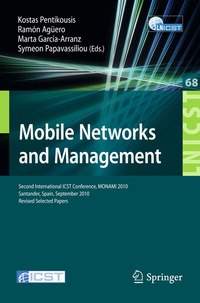
Mobile Networks and Management
Second International ICST Conference, MONAMI 2010, Santander, Spain, September 22-24, 2010, Revised Selected Papers
Published on 2. February 2012
XIV, 358 pages
978-3-642-21444-8 (ISBN)
Description

This book constitutes the thoroughly refereed post-conference proceedings of the Second International ICST Conference on Mobile Networks and Management, MONAMI 2010, held in Santander, Spain in September 2010. The 29 revised full papers presented were carefully reviewed and selected for inclusion in the proceedings. The papers are organized in topical sections on routing and virtualization, autonomic networking, mobility management, multiaccess selection, wireless network management, wireless networks, and future research directions.
More details
Other editions
Additional editions
Kostas Pentikousis | CALVO RAMON AGUERO | Marta García-Arranz
Mobile Networks and Management
Second International ICST Conference, MONAMI 2010, Santander, Spain, September 22-24, 2010, Revised Selected Papers
Book
05/2011
Springer
€53.49
Shipment within 7-9 days
Content
- Title
- Preface
- Executive Committee
- Table of Contents
- Part I: Routing and Virtualization
- Generic Connectivity Architecture for Mobility and Multipath Flow Management in the Future Internet
- Introduction
- State of Art
- Generic Connectivity Architecture
- Overview and Terminology
- Naming and Addressing
- Generic Connection Setup
- Mobility, Multipath and Multicast in the Generic Connectivity Architecture
- Simulation Tool Implementation
- Simulated Scenario
- QoS Constrained Multipath Approach
- Adaptive Error and Flow Control Selection
- Dynamic Flow Management
- Simulation Results
- Adaptive Error Correction Mechanisms
- Flexible Multipath Flow Management
- Conclusion and Outlook
- References
- Using BGP-4 to Migrate to a Future Internet
- Introduction
- AS Compartments
- Traffic Engineering in AS Compartments
- Towards a Practical Implementation
- Fallback Scenario
- Simulation Results
- Conclusion
- Related Work
- EU Disclaimer
- References
- Revisiting the Impact of Traffic Engineering Techniques on the Internet's Routing Table
- Introduction
- BGP-4 and Traffic Engineering
- Current Best Practises to Control the Inbound Traffic
- Assessing the Room for Optimisation in the Internet's Core Routing Table
- A Routing Table Compression Algorithm for the Internet
- Status Quo
- An Alternative Traffic Engineering Architecture for IP
- Advantages
- Historical Evolution
- Related Work
- Conclusion and Further Work
- References
- End-to-End Performance Evaluation of Virtual Networks Using a Prototype Implementation
- Introduction
- Network Virtualization Architecture of the Future Internet
- VNet Management Prototype
- VNet Manager
- VNet Agent
- Scenarios and Test-Beds
- Wireless Scenario
- Wired Scenario
- Performance Results and Analysis
- Conclusions
- References
- Part II: Autonomic Networking
- Addressing Stability in Future Autonomic Networking
- Introduction
- An Overview of the Generic Autonomic Network Architecture
- Stability Issues in Autonomic Networking
- Designing for Stability
- Stable Autonomic Behaviours Design through Game Theory - From Theory to Theory
- Addressing Stability in an Architectural Level - From Theory to Practice
- Model-Based Techniques
- Addressing Stability at Runtime
- Autonomic-Aware Metrics to Infer and Self-assess Stability
- Concluding Remarks
- References
- An Empirical Evaluation of a Shim6 Implementation
- Introduction
- Shim6 Host-Based IPv6 Multihoming
- Testbed
- Shim6 Testbed
- Explicit Congestion Notification
- Results
- LinShim6
- Comments on ECN
- Conclusion
- References
- Future Autonomic Cooperative Networks
- Introduction
- Cooperative Transmission
- Autonomic Cooperative Networking
- Conclusion
- References
- An Autonomic Monitoring Framework for QoS Management in Multi-service Networks
- Introduction
- Related Work
- Framework Architecture
- Design Objectives
- Architecture Overview
- Framework Evaluation
- Conclusions
- References
- Part III: Mobility Management
- Safetynet Version 2, a Packet Error Recovery Architecture for Vertical Handoffs
- Introduction
- Overview of the SafetyNet Protocol
- Problem Statement
- Redundancy Packet Bicasting Scheme
- Related Work
- Conclusion
- References
- A Mechanism for Vertical Handover Based on SAW Using IEEE 802.21
- Introduction
- Related Work
- Background
- IEEE 802.21
- SAW - Simple Additive Weight
- Handover Protocol and Proposed Decision Algorithm
- IEEE 802.21 Handover Protocol
- Handover Decision Algorithm (HDA)
- Performance Evaluation
- Simulator Implementation
- Simulation Results
- Conclusion
- References
- Proactive Vertical Handover Optimizations in the 3GPP Evolved Packet Core
- Introduction
- Background
- Concept
- Testbed, Results and Evaluation
- Conclusions
- References
- Key Distribution Mechanisms for IEEE 802.21-Assisted Wireless Heterogeneous Networks
- Introduction
- Key Distribution for Media Independent Handoff
- General Architecture
- Media Independent Authentication Process
- Push Key Distribution
- Reactive Pull Key Distribution
- Proactive Pull Key Distribution
- Deployment Implications
- Remarks on Performance
- Conclusions
- References
- Part IV: Multiaccess Selection
- Optimum Selection of Access Networks within Heterogeneous Wireless Environments Based on Linear Programming Techniques
- Introduction
- Related Work
- Optimization Problem Modeling
- Design and Implementation of a Tool to Solve the Optimization Problem
- Scenario Description
- Discussion of Results
- Conclusions
- References
- On the Empirical Analysis of Handover Latency Reduction by Means of Multi-RAT Devices: A Prototypical Approach
- Introduction and Objectives
- Related Work
- Mobilia Architecture
- Demonstration Setup
- Use Case 1: End-User Initiated Handover
- Use Case 2: Network Initiated Handover
- Results
- Conclusions
- References
- On the Performance of Static Inter-cell Interference Coordination in Realistic Cellular Layouts
- Introduction
- Description of Static ICIC Strategies
- Experiments Description
- Simulation Scenario
- System Model and Methodology
- Performance Metrics
- Analysis of Numerical Results
- Conclusions and Future Work
- References
- Location-Based Ubiquitous Context Exchange in Mobile Environments
- Introduction
- Context Services
- Context Architectures
- Context Proximity
- The Model
- Prototype
- Implementation
- Preliminary Results
- Preliminary Analysis
- Conclusions
- References
- Part V: Wireless Network Management
- Energy Efficiency of Dynamic Interface Selection Mechanisms in Wireless Ad-Hoc Networks
- Introduction
- Universal Convergence Layer
- Power-Aware Optimization Based on Dynamic Outbound Interface Selection
- Dynamic Interface Selection Mechanisms Power Efficiency Assessment
- Conclusions
- References
- Ubiquitous Computing by Utilizing Semantic Interoperability with Item-Level Object Identification
- Introduction
- Background
- Ubiquitous Computing
- Object Identification with RFID
- Semantic Interoperability and Smart-M3
- The Use of Item-Level Object Identification with Smart-M3
- System Model
- Novel Applications Using Combined Item-Level Object Identification and Smart-M3
- Implementation
- Conclusions and Future Work
- References
- Manager Selection over a Hierarchical/Distributed Management Architecture for Personal Networks
- Introduction
- Distributed/Hierarchical Management of Personal Networks
- Problem Statement
- Connectivity of Random Network Deployments
- Discussion of Results
- Conclusions
- References
- OLSRp: Predicting Control Information to Achieve Scalability in OLSR Ad Hoc Networks
- Introduction and Motivation
- Optimized Link State Routing Protocol
- Experimental Setup
- Analysis of Control Information Repetition
- Our Proposal: OLSRp
- Related Work
- Conclusions and Future Work
- References
- Part VI: Wireless Networks
- Maximum Sum-Rate Interference Alignment Schemes for the 3-User Deterministic MIMO Channel
- Introduction
- Interference Alignment in the K-User Deterministic MIMO Channel
- Closed-Form IA Solutions for the 3-User Case
- Max Sum-Rate and Max Sum-Power IA Solutions
- Simulation Results
- Rayleigh Interference MIMO Channel
- Correlated MIMO Channel
- Conclusion
- References
- A Novel LTE Wireless Virtualization Framework
- Introduction
- Network Virtualization
- Motivation of Wireless Network Virtualization
- State-of-the-Art of Mobile System Sharing/Virtualization
- LTE Virtualization Framework
- Simulation Model
- Simulation Configurations and Results
- Simulation Configurations
- Simulation Results
- Conclusion and Outlook
- References
- Accurate Modelling of OFDMA Transmission Technique Using IEEE 802.16m Recommendations for WiMAX Network Simulator Design
- Introduction
- Standard Overview
- Related Work
- WIDE
- General Aspects
- WiDe PHY Layer
- WiDe MAC Layer
- Research Scenarios
- Conclusions
- References
- A Simulation Implementation of the LTE-Uu Interface Datalink Layer in OMNeT++
- Introduction
- The Simulation Model
- LTE-Uu Interface
- Connection Establishment
- Some Salient Details of the Model Implementation
- Results
- Conclusion
- References
- Part VII: Future Research Directions
- Scenarios, Research Issues, and Architecture for Ubiquitous Sensing
- Introduction
- Scenarios
- Concepts and Architecture
- Extending NetInf for Ubiquitous Sensing
- Sensor Network Platform
- Functional Verification
- Environmental Awareness
- Context Aware Commuting
- Seamless Media Transfer
- Conclusions
- Future Work
- References
- Challenges for Cloud Networking Security
- Introduction
- From Cloud Computing to Cloud Networking
- Virtualisation Technology Supporting Cloud Computing
- Virtualisation Technology Supporting Cloud Networking
- Security Problem Space
- Threat Model
- Information Security in Clouds
- Virtualisation Environment Threats
- Communication Security
- Misuse of Cloud Networking Capabilities
- Conclusion and Future Work
- References
- Video-Enhancing Functional Architecture for the MEDIEVAL Project
- Introduction
- Vision
- Architecture
- Wireless Access
- Video Services
- Transport Optimization
- Mobility
- Cross-layer Mechanisms for Addressing Network Requirements
- Packetization
- Multicast Mechanisms
- Conclusion
- References
- EARTH: Paving the Way for Future Energy Efficient Broadband Wireless Networks
- Introduction
- Research Strategy and Expected Impact
- S&T Methodology
- Estimation of the Ecological Impact of Mobile Communications
- Technical Approaches Undertaken
- Reference System, Reference Scenarios and Evaluation Framework
- Energy Efficiency Metrics and Evaluation Framework
- Potentials of EARTH Technical Solutions
- Green Networks Technological Potential
- Green Radios Technology Potential
- Conclusions and Future Developments
- References
- A New Perspective on Mobility Management Scenarios and Approaches
- Introduction
- Related Work
- User-Centric Scenarios
- Hotspot
- WMN and MANET Scenarios
- User-Provided Networks
- DTNs
- Mobility Issues
- Challenges of Mobility Management
- Conclusions
- References
- Author Index
