

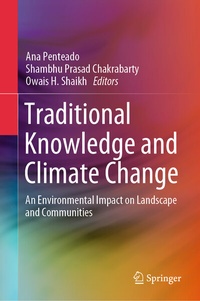
Traditional Knowledge and Climate Change
Description

This edited book uses a methodology that includes multidisciplinary collaboration to approach climate issues from several disciplines involved in climate governance. The main aim is to showcase collaborative research designed from the point of view of experiences associated with Indigenous Knowledge from an assumption of the equitable importance of its practices, methods of search, and cultural background that Indigenous Peoples custodians have maintained through time immemorial. In showing their applied ethics and activism to protect their traditional land, this book's mission is to advocate the concept of climate justice absent from our mainstream academic and legal discourse. Their investigation into some real-life examples and local practices organised by Nature as their main element offers, inter alia, a detailed account of Indigenous Knowledge's duty of care towards local biodiversity that can potentially be adopted in policy formulation on environmental management and governance. These selected essays represent an international human rights approach, a human understanding of genetic resources that existed for centuries alongside the First Nations and their strategies to mitigate the contemporary climate crisis afflicting all of us. The book revolves around Indigenous Knowledge of First Peoples, tribal and local communities in the Global South. In climate justice, Indigenous Peoples' advocacy to protect our local biodiversity must be crucial change mitigation.
More details
Other editions
Additional editions
Persons
Dr. Penteado received her first law degree in 1994 at Mackenzie University, School of Law, becoming a licensed member of the Brazilian Bar Association in the same year. She earned her Legum Magister LLM from the University of California at Berkeley, specialising in intellectual property law and international law. In 2003, she was an IMURs scholarship holder granted by the Australian government to pursue a Doctor in Philosophy of Laws at the Macquarie University Law School in 2009. She was a former member of the Smithsonian's National Museum of the American Indian in Washington, DC. She was, until recently, an active member of the Trans-Tasman IP Attorneys Board in Australia. Currently, she is involved with a patent certification course delivered at the University of Colombo School of Law in Sri Lanka. She is an adjunct associate professor at Notre Dame University, School of Law, Sydney, Australia.
Professor (Dr.) Shambhu Prasad Chakrabarty received his LL.B. and LL.M. from Calcutta University and Ph.D. from the University of North Bengal. He has taught and researched for over seventeen years at Calcutta University, Amity Law School and WBNUJS. He has authored and edited seven books and written over forty articles and book chapters, including in the Liverpool Law Review and Environmental Management. He acted as the chief editor of the NUJS Journal of Regulatory Studies from August 2019 to 2022. He was the topper at LL.B., of the Batch of 2003 from his college under Calcutta University. He is a scientific member of the Law and Society Association, USA, the Commonwealth Lawyers Association, UK, and IPIRA. He is currently a professor and a dean at the Department of Law at the University of Engineering and Management, Kolkata, India.
Dr. Owais H. Shaikh completed his Ph.D. with Magna-cum-Laude from Ludwig Maximilians Universität, Germany. He wrote his Ph.D. dissertation at the Max Planck Institute for Innovation and Competition in Munich in Intellectual Property laws which Springer published. He has a Master of Laws in Intellectual Property (LL.M.) from the University of Augsburg (MIPLC) and an M.B.A. from the Institute of Business Administration, Karachi. He is also a tutor for the Intellectual Property Management course at the WIPO Academy since 2015 and for IP Strategy at the European Patent Office since 2023. Currently, he is the WIPO National Expert for establishment of Intellectual Property Training Institution in Pakistan. Previously, he taught Intellectual Property Law, Competition Law and Legal Research Methods at Shaheed Zulfiqar Ali Bhutto, the University of Law, Karachi, Pakistan, as an associate professor and was also the Chairperson of the Department of Law. He also worked as Assistant Director at Pakistan Intellectual Property Organisation. He is also a scientific member of IPIRA.
Content
Chapter 1. Water.- Chapter 2. Forests.- Chapter 3. Air.- Chapter 4. Soil & Rock.- Chapter 5. Sun.- Chapter 6. Culture.
